Journal: bioRxiv / Year: 2025 Title: ADAPT-M: A workflow for rapid, quantitative measurements of enriched protein libraries. Authors: Carla P Perez / Nicole V DelRosso / Cameron L Noland / Udit Parekh / Christian A Choe / Raphael R Eguchi / Qi Wen / Polly M Fordyce / Po-Ssu Huang / Abstract: Protein-protein interactions underpin most cellular interactions, and engineered binders present powerful tools for probing biology and developing novel therapeutics. One bottleneck in binder ...Protein-protein interactions underpin most cellular interactions, and engineered binders present powerful tools for probing biology and developing novel therapeutics. One bottleneck in binder generation is the scalable, quantitative characterization of these interactions. We present ADAPT-M (ffinity etermination by daptation of roein binders for icrofluidics), a streamlined workflow that connects yeast surface display (YSD) with affinity and kinetic measurements using the high-throughput STAMMPPING microfluidic platform. ADAPT-M quantifies s and dissociation kinetic parameters for hundreds of enriched protein variants in under one week without requiring hands-on protein purification. We applied ADAPT-M to a computationally designed library targeting the SARS-CoV-2 Omicron BA.1 receptor binding domain, successfully recovering and measuring s for most highly enriched YSD variants. Measurements correlate strongly with biolayer interferometry and yeast titration assays. ADAPT-M further enabled selection of lead candidates for structural and mutational analysis, which revealed designed paratopes were preserved despite binding to off-target epitopes. By bridging YSD screening and validation, ADAPT-M accelerates protein binder discovery and supports data-driven protein engineering.
In the structure databanks used in Yorodumi, some data are registered as the other names, "COVID-19 virus" and "2019-nCoV". Here are the details of the virus and the list of structure data.
Jan 31, 2019. EMDB accession codes are about to change! (news from PDBe EMDB page)
EMDB accession codes are about to change! (news from PDBe EMDB page)
The allocation of 4 digits for EMDB accession codes will soon come to an end. Whilst these codes will remain in use, new EMDB accession codes will include an additional digit and will expand incrementally as the available range of codes is exhausted. The current 4-digit format prefixed with “EMD-” (i.e. EMD-XXXX) will advance to a 5-digit format (i.e. EMD-XXXXX), and so on. It is currently estimated that the 4-digit codes will be depleted around Spring 2019, at which point the 5-digit format will come into force.
The EM Navigator/Yorodumi systems omit the EMD- prefix.
Related info.:Q: What is EMD? / ID/Accession-code notation in Yorodumi/EM Navigator
Yorodumi is a browser for structure data from EMDB, PDB, SASBDB, etc.
This page is also the successor to EM Navigator detail page, and also detail information page/front-end page for Omokage search.
The word "yorodu" (or yorozu) is an old Japanese word meaning "ten thousand". "mi" (miru) is to see.
Related info.:EMDB / PDB / SASBDB / Comparison of 3 databanks / Yorodumi Search / Aug 31, 2016. New EM Navigator & Yorodumi / Yorodumi Papers / Jmol/JSmol / Function and homology information / Changes in new EM Navigator and Yorodumi
 Movie
Movie Controller

 Yorodumi
 Open data
 Basic information
 Map data
 Sample
 Keywords
 Function and homology information
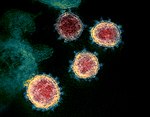 Severe acute respiratory syndrome coronavirus 2 / synthetic construct (others)
 Authors
 Citation
 Structure visualization
 Downloads & links
 emd_72524.png
 https://data.pdbj.org/pub/emdb/structures/EMD-72524
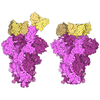
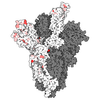
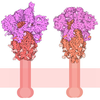
 Z (Sec.)
 Y (Row.)
 X (Col.)


 Sample components
 Homo sapiens (human)
 Processing
 Electron microscopy
 FIELD EMISSION GUN

