regulation of localization / response to inositol / pancreas morphogenesis / BBSome-mediated cargo-targeting to cilium / negative regulation of hair follicle development / central nervous system neuron differentiation / ventral midline determination / mesenchymal to epithelial transition involved in metanephric renal vesicle formation / regulation of heart morphogenesis / negative regulation of epithelial cell differentiation ...regulation of localization / response to inositol / pancreas morphogenesis / BBSome-mediated cargo-targeting to cilium / negative regulation of hair follicle development / central nervous system neuron differentiation / ventral midline determination / mesenchymal to epithelial transition involved in metanephric renal vesicle formation / regulation of heart morphogenesis / negative regulation of epithelial cell differentiation / Activation of SMO / alpha-tubulin acetylation / dorsal/ventral neural tube patterning / contact inhibition / negative regulation of hepatocyte proliferation / myoblast migration / epithelial-mesenchymal cell signaling / atrial septum morphogenesis / spinal cord dorsal/ventral patterning / negative regulation of DNA binding / left/right axis specification / determination of left/right asymmetry in lateral mesoderm / axon extension involved in axon guidance / midgut development / positive regulation of hepatic stellate cell activation / cell development / Hedgehog 'on' state / mammary gland epithelial cell differentiation / CD209 (DC-SIGN) signaling / HDL assembly / Regulation of insulin secretion / Rap1 signalling / type B pancreatic cell development / Ion homeostasis / somite development / positive regulation of multicellular organism growth / PKA activation in glucagon signalling / DARPP-32 events / CREB1 phosphorylation through the activation of Adenylate Cyclase / GPER1 signaling / Factors involved in megakaryocyte development and platelet production / Loss of Nlp from mitotic centrosomes / Recruitment of mitotic centrosome proteins and complexes / Loss of proteins required for interphase microtubule organization from the centrosome / Recruitment of NuMA to mitotic centrosomes / Anchoring of the basal body to the plasma membrane / AURKA Activation by TPX2 / RET signaling / mesenchymal to epithelial transition / Interleukin-3, Interleukin-5 and GM-CSF signaling / positive regulation of organ growth / dentate gyrus development / patched binding / VEGFA-VEGFR2 Pathway / smooth muscle tissue development / Regulation of PLK1 Activity at G2/M Transition / PKA activation / Hedgehog 'off' state / Hedgehog 'off' state / pattern specification process / forebrain morphogenesis / MAPK6/MAPK4 signaling / 9+0 non-motile cilium / GLI3 is processed to GLI3R by the proteasome / anterior/posterior pattern specification / cerebellar cortex morphogenesis / positive regulation of mesenchymal cell proliferation / cellular response to cholesterol / determination of left/right symmetry / positive regulation of branching involved in ureteric bud morphogenesis / thalamus development / cell fate specification / positive regulation of smoothened signaling pathway / dorsal/ventral pattern formation / oxysterol binding / neural crest cell migration / commissural neuron axon guidance / hair follicle morphogenesis / odontogenesis of dentin-containing tooth / smoothened signaling pathway / mesoderm formation / digestive tract development / homeostasis of number of cells within a tissue / positive regulation of neural precursor cell proliferation / cAMP-dependent protein kinase inhibitor activity / positive regulation of vascular associated smooth muscle cell migration / positive regulation of neuroblast proliferation / histone H1-4S35 kinase activity / cAMP-dependent protein kinase / positive regulation of triglyceride catabolic process / cAMP-dependent protein kinase activity / embryonic organ development / regulation of bicellular tight junction assembly / heart looping / cAMP-dependent protein kinase complex / negative regulation of glycolytic process through fructose-6-phosphate / multicellular organism growth / ciliary membrane / Mitochondrial protein degradation / sperm capacitation Similarity search - Function
Smoothened, transmembrane domain / Smoothened, cysteine-rich domain / Frizzled/Smoothened, transmembrane domain / Frizzled/Smoothened family membrane region / Frizzled/Smoothened family membrane region / Frizzled/secreted frizzled-related protein / Frizzled / Frizzled domain / Frizzled cysteine-rich domain superfamily / Fz domain ...Smoothened, transmembrane domain / Smoothened, cysteine-rich domain / Frizzled/Smoothened, transmembrane domain / Frizzled/Smoothened family membrane region / Frizzled/Smoothened family membrane region / Frizzled/secreted frizzled-related protein / Frizzled / Frizzled domain / Frizzled cysteine-rich domain superfamily / Fz domain / Frizzled (fz) domain profile. / cAMP-dependent protein kinase catalytic subunit / GPCR, family 2-like / G-protein coupled receptors family 2 profile 2. / Extension to Ser/Thr-type protein kinases / AGC-kinase, C-terminal / AGC-kinase C-terminal domain profile. / Serine/threonine-protein kinase, active site / Serine/Threonine protein kinases active-site signature. / Protein kinase domain / Serine/Threonine protein kinases, catalytic domain / Protein kinase, ATP binding site / Protein kinases ATP-binding region signature. / Protein kinase domain profile. / Protein kinase domain / Protein kinase-like domain superfamily Similarity search - Domain/homology
National Institutes of Health/National Eye Institute (NIH/NEI)
R01EY035377
United States
National Institutes of Health/National Institute of General Medical Sciences (NIH/NIGMS)
R35GM133672
United States
Citation
Journal: Nat Struct Mol Biol / Year: 2026 Title: Structural mechanism for noncanonical GPCR signaling in the Hedgehog pathway. Authors: William P Steiner / Nathan Iverson / Guibing Liu / Varun Venkatakrishnan / Jian Wu / Tomasz Maciej Stepniewski / Zachary Michaelson / Jan W Bröckel / Ju-Fen Zhu / Jessica G H Bruystens / ...Authors: William P Steiner / Nathan Iverson / Guibing Liu / Varun Venkatakrishnan / Jian Wu / Tomasz Maciej Stepniewski / Zachary Michaelson / Jan W Bröckel / Ju-Fen Zhu / Jessica G H Bruystens / Annabel Lee / Isaac Nelson / Daniela Bertinetti / Corvin D Arveseth / Gerald Tan / Paul Spaltenstein / Jiewei Xu / Ruth Hüttenhain / Michael S Kay / Friedrich W Herberg / Erhu Cao / Jana Selent / Ganesh S Anand / Roland L Dunbrack / Susan S Taylor / Benjamin R Myers / Abstract: The Hedgehog (Hh) pathway is fundamental to embryogenesis, tissue homeostasis and cancer. Hh signals are transduced through an unusual mechanism; upon agonist-induced phosphorylation, the ...The Hedgehog (Hh) pathway is fundamental to embryogenesis, tissue homeostasis and cancer. Hh signals are transduced through an unusual mechanism; upon agonist-induced phosphorylation, the noncanonical G-protein-coupled receptor (GPCR) Smoothened (SMO) binds the protein kinase A (PKA) catalytic subunit (PKA-C) and physically blocks its enzymatic activity. Here, by combining computational structural approaches with biochemical and functional studies, we show that SMO mimics strategies prevalent in canonical GPCR and PKA signaling complexes, despite little sequence or secondary-structure homology. The intrinsically disordered SMO cytoplasmic domain binds the PKA-C active site, resembling the regulatory subunit within PKA holoenzymes, while the SMO transmembrane domain binds a conserved PKA-C interaction hub. Unlike prevailing GPCR signal transduction models, phosphorylation of SMO promotes intramolecular electrostatic interactions that stabilize structural elements within its cytoplasmic domain, thereby remodeling it into a PKA-inhibiting conformation. Our work provides a structural mechanism for a central step in Hh signaling and defines a principle for disordered GPCR domains to transmit signals intracellularly.
Name: mouse Smoothened 64-674 / type: protein_or_peptide / ID: 1 Details: mouse Smoothened 64-674 with an N-terminal FLAG tag followed by a TEV cleavage site Enantiomer: LEVO
In the structure databanks used in Yorodumi, some data are registered as the other names, "COVID-19 virus" and "2019-nCoV". Here are the details of the virus and the list of structure data.
Jan 31, 2019. EMDB accession codes are about to change! (news from PDBe EMDB page)
EMDB accession codes are about to change! (news from PDBe EMDB page)
The allocation of 4 digits for EMDB accession codes will soon come to an end. Whilst these codes will remain in use, new EMDB accession codes will include an additional digit and will expand incrementally as the available range of codes is exhausted. The current 4-digit format prefixed with “EMD-” (i.e. EMD-XXXX) will advance to a 5-digit format (i.e. EMD-XXXXX), and so on. It is currently estimated that the 4-digit codes will be depleted around Spring 2019, at which point the 5-digit format will come into force.
The EM Navigator/Yorodumi systems omit the EMD- prefix.
Related info.:Q: What is EMD? / ID/Accession-code notation in Yorodumi/EM Navigator
Yorodumi is a browser for structure data from EMDB, PDB, SASBDB, etc.
This page is also the successor to EM Navigator detail page, and also detail information page/front-end page for Omokage search.
The word "yorodu" (or yorozu) is an old Japanese word meaning "ten thousand". "mi" (miru) is to see.
Related info.:EMDB / PDB / SASBDB / Comparison of 3 databanks / Yorodumi Search / Aug 31, 2016. New EM Navigator & Yorodumi / Yorodumi Papers / Jmol/JSmol / Function and homology information / Changes in new EM Navigator and Yorodumi
 Movie
Movie Controller


 Open data
 Basic information
 Map data
 Sample
 Keywords
 Function and homology information
 Mus musculus (house mouse) /
  Bos taurus (domestic cattle)
 Authors
 United States, 2 items
  Citation


 Structure visualization
 Downloads & links
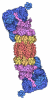
 emd_72508.png
 https://data.pdbj.org/pub/emdb/structures/EMD-72508



 Z (Sec.)
 Y (Row.)
 X (Col.)


 Sample components
 Homo sapiens (human)
 Processing
 Electron microscopy
 FIELD EMISSION GUN
