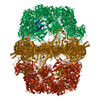
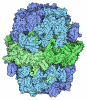
Journal: Nat Microbiol / Year: 2026 Title: Decreased cytoplasmic crowding via inhibition of ribosome biogenesis can trigger Candida albicans filamentous growth. Authors: Antonio Serrano / Charles Puerner / Louis Chevalier / Emily Plumb / Johannes Elferich / Stephen Diggs / Ludwig Roman Sinn / Nikolaus Grigorieff / Markus Ralser / Morgan Delarue / Martine ...Authors: Antonio Serrano / Charles Puerner / Louis Chevalier / Emily Plumb / Johannes Elferich / Stephen Diggs / Ludwig Roman Sinn / Nikolaus Grigorieff / Markus Ralser / Morgan Delarue / Martine Bassilana / Robert Alan Arkowitz / Abstract: The human fungal pathogen Candida albicans undergoes a morphological transition from a budding yeast to a filamentous form, which is associated with pathogenesis. Various cues mediate this transition ...The human fungal pathogen Candida albicans undergoes a morphological transition from a budding yeast to a filamentous form, which is associated with pathogenesis. Various cues mediate this transition including intracellular reorganization. The cytoplasm is densely packed with proteins including large macromolecular complexes, such as ribosomes, and hence, molecular crowding can impact a range of cellular processes. However, the relationship between cytoplasmic molecular crowding and morphological growth states is unclear. Using a fluorescent microrheological probe and single particle tracking, we observed a striking decrease in molecular crowding during filamentous growth in C. albicans. On the basis of simulations, proteomics and structural data from in situ cryogenic electron microscopy, we show that the reduction in crowding is due to a decrease in ribosome concentration that results in part from an inhibition of ribosome biogenesis, combined with an increase in cytoplasmic volume, leading to a dilution of ribosomes. Filamentation was enhanced in a mutant defective in ribosome biogenesis, while translation was not affected, suggesting that inhibition of ribosome biogenesis is a trigger for C. albicans morphogenesis. Overall, we show that filamentous growth is associated with reduced cytoplasmic crowding via changes in ribosome concentration, suggesting that combination therapies in which ribosome biogenesis is also targeted may be advantageous.
In the structure databanks used in Yorodumi, some data are registered as the other names, "COVID-19 virus" and "2019-nCoV". Here are the details of the virus and the list of structure data.
Jan 31, 2019. EMDB accession codes are about to change! (news from PDBe EMDB page)
EMDB accession codes are about to change! (news from PDBe EMDB page)
The allocation of 4 digits for EMDB accession codes will soon come to an end. Whilst these codes will remain in use, new EMDB accession codes will include an additional digit and will expand incrementally as the available range of codes is exhausted. The current 4-digit format prefixed with “EMD-” (i.e. EMD-XXXX) will advance to a 5-digit format (i.e. EMD-XXXXX), and so on. It is currently estimated that the 4-digit codes will be depleted around Spring 2019, at which point the 5-digit format will come into force.
The EM Navigator/Yorodumi systems omit the EMD- prefix.
Related info.:Q: What is EMD? / ID/Accession-code notation in Yorodumi/EM Navigator
Yorodumi is a browser for structure data from EMDB, PDB, SASBDB, etc.
This page is also the successor to EM Navigator detail page, and also detail information page/front-end page for Omokage search.
The word "yorodu" (or yorozu) is an old Japanese word meaning "ten thousand". "mi" (miru) is to see.
Related info.:EMDB / PDB / SASBDB / Comparison of 3 databanks / Yorodumi Search / Aug 31, 2016. New EM Navigator & Yorodumi / Yorodumi Papers / Jmol/JSmol / Function and homology information / Changes in new EM Navigator and Yorodumi
 Movie
Movie Controller

 Yorodumi
 Open data
 Basic information
 Map data
 Sample
 Keywords
 Candida albicans (yeast)
 Authors
 United States, 1 items
  Citation


 Structure visualization
 Downloads & links
 EMDB map data format
 emd_72464.png
 https://data.pdbj.org/pub/emdb/structures/EMD-72464


 Z (Sec.)
 Y (Row.)
 X (Col.)


 Sample components
 Processing
 Electron microscopy
 FIELD EMISSION GUN