 Movie
Movie Controller

[English] 日本語
 Yorodumi
- EMDB-72371: Human Oct4 bound to nucleosome reconstituted with human histones ... -
+ Open data

- Basic information
| Entry |  | |||||||||
|---|---|---|---|---|---|---|---|---|---|---|
| Title | Human Oct4 bound to nucleosome reconstituted with human histones and 182 bp human LIN28B sequence | |||||||||
 Map data Map data | Electron density map of Oct4 bound to LIN28B nucleosome | |||||||||
 Sample Sample |
| |||||||||
 Keywords Keywords | Transcription factor / Oct4 / Nucleosome / Protein-DNA complex / Chromatin binding / Gene Regulation / Pioneer Factor / DNA BINDING PROTEIN | |||||||||
| Biological species |  Homo sapiens (human) Homo sapiens (human) | |||||||||
| Method | single particle reconstruction / cryo EM / Resolution: 6.0 Å | |||||||||
 Authors Authors | Sinha KK / Halic M | |||||||||
| Funding support |  United States, 1 items United States, 1 items
| |||||||||
 Citation Citation | Journal: Nature / Year: 2023 Title: Histone modifications regulate pioneer transcription factor cooperativity. Authors: Kalyan K Sinha / Silvija Bilokapic / Yongming Du / Deepshikha Malik / Mario Halic / Abstract: Pioneer transcription factors have the ability to access DNA in compacted chromatin. Multiple transcription factors can bind together to a regulatory element in a cooperative way, and cooperation ...Pioneer transcription factors have the ability to access DNA in compacted chromatin. Multiple transcription factors can bind together to a regulatory element in a cooperative way, and cooperation between the pioneer transcription factors OCT4 (also known as POU5F1) and SOX2 is important for pluripotency and reprogramming. However, the molecular mechanisms by which pioneer transcription factors function and cooperate on chromatin remain unclear. Here we present cryo-electron microscopy structures of human OCT4 bound to a nucleosome containing human LIN28B or nMATN1 DNA sequences, both of which bear multiple binding sites for OCT4. Our structural and biochemistry data reveal that binding of OCT4 induces changes to the nucleosome structure, repositions the nucleosomal DNA and facilitates cooperative binding of additional OCT4 and of SOX2 to their internal binding sites. The flexible activation domain of OCT4 contacts the N-terminal tail of histone H4, altering its conformation and thus promoting chromatin decompaction. Moreover, the DNA-binding domain of OCT4 engages with the N-terminal tail of histone H3, and post-translational modifications at H3K27 modulate DNA positioning and affect transcription factor cooperativity. Thus, our findings suggest that the epigenetic landscape could regulate OCT4 activity to ensure proper cell programming. | |||||||||
| History |
|
- Structure visualization
| Supplemental images |
|---|

- Downloads & links
-EMDB archive
| Map data | emd_72371.map.gz | 31.9 MB |  EMDB map data format EMDB map data format | |
|---|---|---|---|---|
| Header (meta data) | emd-72371-v30.xmlemd-72371.xml | 21.3 KB 21.3 KB | Display Display | EMDB header |
| Images |  emd_72371.png emd_72371.png | 54 KB | ||
| Filedesc metadata | emd-72371.cif.gz | 5.9 KB | ||
| Others | emd_72371_half_map_1.map.gzemd_72371_half_map_2.map.gz | 59.3 MB 59.3 MB | ||
| Archive directory |  https://data.pdbj.org/pub/emdb/structures/EMD-72371ftp://data.pdbj.org/pub/emdb/structures/EMD-72371 https://data.pdbj.org/pub/emdb/structures/EMD-72371ftp://data.pdbj.org/pub/emdb/structures/EMD-72371 | HTTPS FTP |
-Links
| EMDB pages | EMDB (EBI/PDBe) / EMDataResource |
|---|
-Map
| File | Download / File: emd_72371.map.gz / Format: CCP4 / Size: 64 MB / Type: IMAGE STORED AS FLOATING POINT NUMBER (4 BYTES) | ||||||||||||||||||||||||||||||||||||
|---|---|---|---|---|---|---|---|---|---|---|---|---|---|---|---|---|---|---|---|---|---|---|---|---|---|---|---|---|---|---|---|---|---|---|---|---|---|
| Annotation | Electron density map of Oct4 bound to LIN28B nucleosome | ||||||||||||||||||||||||||||||||||||
| Projections & slices | Image control
Images are generated by Spider. | ||||||||||||||||||||||||||||||||||||
| Voxel size | X=Y=Z: 1.044 Å | ||||||||||||||||||||||||||||||||||||
| Density |
| ||||||||||||||||||||||||||||||||||||
| Symmetry | Space group: 1 | ||||||||||||||||||||||||||||||||||||
| Details | EMDB XML:
|
 Z (Sec.)
 Y (Row.)
 X (Col.)


-Supplemental data
-Half map: Oct4 bound to LIN28B nucleosome - half map A
| File | emd_72371_half_map_1.map | ||||||||||||
|---|---|---|---|---|---|---|---|---|---|---|---|---|---|
| Annotation | Oct4 bound to LIN28B nucleosome - half map A | ||||||||||||
| Projections & Slices |
| ||||||||||||
| Density Histograms |


-Half map: Oct4 bound to LIN28B nucleosome - half map B
| File | emd_72371_half_map_2.map | ||||||||||||
|---|---|---|---|---|---|---|---|---|---|---|---|---|---|
| Annotation | Oct4 bound to LIN28B nucleosome - half map B | ||||||||||||
| Projections & Slices |
| ||||||||||||
| Density Histograms |


- Sample components
-Entire : Human Oct4 bound to a Nucleosome with human histones and human LI...
| Entire | Name: Human Oct4 bound to a Nucleosome with human histones and human LIN28 DNA sequence |
|---|---|
| Components |
|
-Supramolecule #1: Human Oct4 bound to a Nucleosome with human histones and human LI...
| Supramolecule | Name: Human Oct4 bound to a Nucleosome with human histones and human LIN28 DNA sequence type: complex / ID: 1 / Parent: 0 / Macromolecule list: all |
|---|---|
| Source (natural) | Organism: Homo sapiens (human) |
-Macromolecule #1: OCT4
| Macromolecule | Name: OCT4 / type: protein_or_peptide / ID: 1 / Enantiomer: LEVO |
|---|---|
| Source (natural) | Organism: Homo sapiens (human) |
| Recombinant expression | Organism:   Escherichia coli (E. coli) Escherichia coli (E. coli) |
| Sequence | String: GSSHHHHHHS SGLVPRGSHM ASMTGGQQMG RDPNSMAGHL ASDFAFSPPP GGGGDGPGGP EPGWVDPRTW LSFQGPPGGP GIGPGVGPG SEVWGIPPCP PPYEFCGGMA YCGPQVGVGL VPQGGLETSQ PEGEAGVGVE SNSDGASPEP CTVTPGAVKL E KEKLEQNP ...String: GSSHHHHHHS SGLVPRGSHM ASMTGGQQMG RDPNSMAGHL ASDFAFSPPP GGGGDGPGGP EPGWVDPRTW LSFQGPPGGP GIGPGVGPG SEVWGIPPCP PPYEFCGGMA YCGPQVGVGL VPQGGLETSQ PEGEAGVGVE SNSDGASPEP CTVTPGAVKL E KEKLEQNP EESQDIKALQ KELEQFAKLL KQKRITLGYT QADVGLTLGV LFGKVFSQTT ICRFEALQLS FKNMCKLRPL LQ KWVEEAD NNENLQEICK AETLVQARKR KRTSIENRVR GNLENLFLQC PKPTLQQISH IAQQLGLEKD VVRVWFCNRR QKG KRSSSD YAQREDFEAA GSPFSGGPVS FPLAPGPHFG TPGYGSPHFT ALYSSVPFPE GEAFPPVSVT TLGSPMHSN |
-Macromolecule #2: Histone H2A
| Macromolecule | Name: Histone H2A / type: protein_or_peptide / ID: 2 / Enantiomer: LEVO |
|---|---|
| Source (natural) | Organism: Homo sapiens (human) |
| Recombinant expression | Organism: Escherichia coli (E. coli) |
| Sequence | String: S G R G K Q G G K A R A K A K T R S S R A G L Q F P V G R V H R L L R K G N Y A E R V G A G A P V Y L A A V L E Y L T A E I L E L A G N A A R D N K K T R I I P R H L Q L A I ...String: S G R G K Q G G K A R A K A K T R S S R A G L Q F P V G R V H R L L R K G N Y A E R V G A G A P V Y L A A V L E Y L T A E I L E L A G N A A R D N K K T R I I P R H L Q L A I R N D E E L N K L L G K V T I A Q G G V L P N I Q A VL L P K K T E S H H K A K G K |
-Macromolecule #3: Histone H2B
| Macromolecule | Name: Histone H2B / type: protein_or_peptide / ID: 3 / Enantiomer: LEVO |
|---|---|
| Source (natural) | Organism: Homo sapiens (human) |
| Recombinant expression | Organism: Escherichia coli (E. coli) |
| Sequence | String: P E P S K S A P A P K K G S K K A I T K A Q K K D G K K R K R S R K E S Y S I Y V Y K V L K Q V H P D T G I S S K A M G I M N S F V N D I F E R I A G E A S R L A H Y N K R S ...String: P E P S K S A P A P K K G S K K A I T K A Q K K D G K K R K R S R K E S Y S I Y V Y K V L K Q V H P D T G I S S K A M G I M N S F V N D I F E R I A G E A S R L A H Y N K R S T I T S R E I Q T A V R L L L P G E L A K H A V S E GT K A V T K Y T S S K |
-Macromolecule #4: Histone H3
| Macromolecule | Name: Histone H3 / type: protein_or_peptide / ID: 4 / Enantiomer: LEVO |
|---|---|
| Source (natural) | Organism: Homo sapiens (human) |
| Recombinant expression | Organism: Escherichia coli (E. coli) |
| Sequence | String: A R T K Q T A R K S T G G K A P R K Q L A T K A A R K S A P A T G G V K K P H R Y R P G T V A L R E I R R Y Q K S T E L L I R K L P F Q R L V R E I A Q D F K T D L R F Q SS A ...String: A R T K Q T A R K S T G G K A P R K Q L A T K A A R K S A P A T G G V K K P H R Y R P G T V A L R E I R R Y Q K S T E L L I R K L P F Q R L V R E I A Q D F K T D L R F Q SS A V M A L Q E A C E A Y L V G L F E D T N L C A I H A KR V T I M P K D I Q L A R R I R G E R A |
-Macromolecule #5: Histone H4
| Macromolecule | Name: Histone H4 / type: protein_or_peptide / ID: 5 / Enantiomer: LEVO |
|---|---|
| Source (natural) | Organism: Homo sapiens (human) |
| Recombinant expression | Organism: Escherichia coli (E. coli) |
| Sequence | String: MSGRGKGGKG LGKGGAKRHR KVLRDNIQGI TKPAIRRLAR RGGVKRISGL IYEETRGVLK VFLENVIRDA VTYTEHAKRK TVTAMDVVYA LKRQGRTLYG FGG |
-Macromolecule #6: LIN28B DNA
| Macromolecule | Name: LIN28B DNA / type: dna / ID: 6 / Classification: DNA |
|---|---|
| Source (natural) | Organism: Homo sapiens (human) |
| Sequence | String: GCAT AAG T TA AGT GGT ATT AAC A TA TCC TCA GTG GTG A GT ATT AAC ATG GAA C TT ACT CCA ACA ATA C AG ATG CTG AAT AAA T GT AGT CTA AGT GAA G AA AGA AGG AAA GGT G GG AGC TGC CAT CAC T CA ...String: GCAT AAG T TA AGT GGT ATT AAC A TA TCC TCA GTG GTG A GT ATT AAC ATG GAA C TT ACT CCA ACA ATA C AG ATG CTG AAT AAA T GT AGT CTA AGT GAA G AA AGA AGG AAA GGT G GG AGC TGC CAT CAC T CA GAA TTG TCC AGC A GG GAT TGT GCA AGC T TG TGA ATA AAG ACA C AT ACT TCA T |
-Experimental details
-Structure determination
| Method | cryo EM |
|---|---|
 Processing Processing | single particle reconstruction |
| Aggregation state | particle |
-Sample preparation
| Buffer | pH: 7.5 / Component:
| ||||||
|---|---|---|---|---|---|---|---|
| Grid | Model: Quantifoil R2/1 / Material: COPPER / Mesh: 300 / Support film - Material: CARBON / Support film - topology: HOLEY | ||||||
| Vitrification | Cryogen name: NITROGEN / Chamber humidity: 95 % / Chamber temperature: 10 K / Instrument: FEI VITROBOT MARK IV |
- Electron microscopy
| Microscope | FEI TALOS ARCTICA |
|---|---|
| Image recording | Film or detector model: GATAN K3 (6k x 4k) / Average electron dose: 60.0 e/Å2 |
| Electron beam | Acceleration voltage: 200 kV / Electron source:  FIELD EMISSION GUN FIELD EMISSION GUN |
| Electron optics | Illumination mode: FLOOD BEAM / Imaging mode: BRIGHT FIELD / Nominal defocus max: 3.0 µm / Nominal defocus min: 0.7000000000000001 µm |
| Experimental equipment | 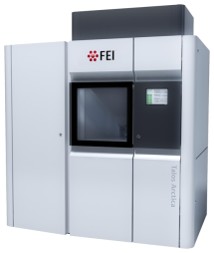 Model: Talos Arctica / Image courtesy: FEI Company |
