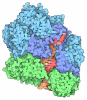
- EMDB-71891: Human Cullin-4 in complex with CAND2 -
+
Open data
ID or keywords:
Loading...
-
Basic information
Entry
Database: EMDB / ID: EMD-71891
Title
Human Cullin-4 in complex with CAND2
Map data
Sample
Complex: CAND2-CUL4
Protein or peptide: Cullin-4A
Protein or peptide: Cullin-associated NEDD8-dissociated protein 2
Keywords
Complex / LIGASE
Function / homology
Function and homology information
SCF complex assembly / regulation of mitotic cytokinesis / regulation of miRNA-mediated gene silencing / regulation of cell cycle phase transition / regulation of stem cell population maintenance / regulation of natural killer cell activation / negative regulation of adipose tissue development / regulation of cellular response to stress / regulation of DNA-templated DNA replication initiation / ubiquitin-dependent protein catabolic process via the C-end degron rule pathway ...SCF complex assembly / regulation of mitotic cytokinesis / regulation of miRNA-mediated gene silencing / regulation of cell cycle phase transition / regulation of stem cell population maintenance / regulation of natural killer cell activation / negative regulation of adipose tissue development / regulation of cellular response to stress / regulation of DNA-templated DNA replication initiation / ubiquitin-dependent protein catabolic process via the C-end degron rule pathway / Cul4A-RING E3 ubiquitin ligase complex / Cul4-RING E3 ubiquitin ligase complex / ubiquitin ligase complex scaffold activity / replication fork processing / regulation of embryonic development / intrinsic apoptotic signaling pathway / epigenetic regulation of gene expression / TBP-class protein binding / regulation of autophagy / T cell activation / G1/S transition of mitotic cell cycle / nucleotide-excision repair / cell population proliferation / Recognition of DNA damage by PCNA-containing replication complex / DNA Damage Recognition in GG-NER / Dual Incision in GG-NER / Transcription-Coupled Nucleotide Excision Repair (TC-NER) / in utero embryonic development / Formation of TC-NER Pre-Incision Complex / Formation of Incision Complex in GG-NER / positive regulation of protein catabolic process / cellular response to UV / Dual incision in TC-NER / Gap-filling DNA repair synthesis and ligation in TC-NER / ubiquitin protein ligase activity / regulation of cell population proliferation / rhythmic process / Neddylation / ribosome biogenesis / spermatogenesis / regulation of apoptotic process / proteasome-mediated ubiquitin-dependent protein catabolic process / protein ubiquitination / ubiquitin protein ligase binding / DNA damage response / positive regulation of DNA-templated transcription / DNA-templated transcription / nucleoplasm / nucleus / cytosol / cytoplasm Similarity search - Function
National Institutes of Health/National Institute of General Medical Sciences (NIH/NIGMS)
R35GM138016
United States
Citation
Journal: Structure / Year: 2026 Title: CAND1 and CAND2 drive CUL4 substrate receptor exchange with largely comparable biochemical efficiency, unlike their relative effects on CUL1. Authors: Kankan Wang / Sebastian Kenny / Zhana Chagan / Lihong Li / Chittaranjan Das / Xing Liu / Abstract: Cullin-RING ubiquitin ligases (CRLs) regulate diverse cellular processes by dynamically recruiting substrate receptors onto conserved cullin-RING scaffolds. CAND1 and CAND2 function as substrate ...Cullin-RING ubiquitin ligases (CRLs) regulate diverse cellular processes by dynamically recruiting substrate receptors onto conserved cullin-RING scaffolds. CAND1 and CAND2 function as substrate receptor exchange factors for CRL1, but CAND2 displays reduced efficiency in CRL1 disassembly, exhibits tissue-specific expression, and shows distinct disease associations, raising questions about its function in other CRL subfamilies. Here, we define the regulatory roles of CAND1 and CAND2 in CRL4 remodeling. Using genetic perturbation, real-time kinetic analyses, and quantitative interaction proteomics, we show that both CAND proteins promote CRL4-mediated protein degradation and enhance the dynamic exchange of DDB1·DCAF substrate receptor modules, likely through conserved yet distinct structural features. In contrast to their differential efficiencies in CRL1 disassembly, CAND1 and CAND2 exhibit similar kinetic parameters and comparable exchange efficiencies across most of the CRL4 complexes. These findings establish CAND1 and CAND2 as bona fide CRL4 exchange factors and reveal biochemical distinctions between CRL4 and CRL1 regulation.
UniProtKB: Cullin-associated NEDD8-dissociated protein 2
-
Experimental details
-
Structure determination
Method
cryo EM
Processing
single particle reconstruction
Aggregation state
particle
-
Sample preparation
Buffer
pH: 7.4
Grid
Model: Quantifoil R1.2/1.3 / Support film - Material: CARBON / Support film - topology: HOLEY
Vitrification
Cryogen name: ETHANE / Chamber humidity: 100 % / Chamber temperature: 277 K / Instrument: FEI VITROBOT MARK II
-
Electron microscopy
Microscope
TFS KRIOS
Specialist optics
Energy filter - Name: GIF Bioquantum / Energy filter - Slit width: 20 eV
Image recording
Film or detector model: GATAN K3 (6k x 4k) / Number grids imaged: 1 / Number real images: 5666 / Average exposure time: 3.19 sec. / Average electron dose: 1.52 e/Å2
Electron beam
Acceleration voltage: 300 kV / Electron source: FIELD EMISSION GUN
In the structure databanks used in Yorodumi, some data are registered as the other names, "COVID-19 virus" and "2019-nCoV". Here are the details of the virus and the list of structure data.
Jan 31, 2019. EMDB accession codes are about to change! (news from PDBe EMDB page)
EMDB accession codes are about to change! (news from PDBe EMDB page)
The allocation of 4 digits for EMDB accession codes will soon come to an end. Whilst these codes will remain in use, new EMDB accession codes will include an additional digit and will expand incrementally as the available range of codes is exhausted. The current 4-digit format prefixed with “EMD-” (i.e. EMD-XXXX) will advance to a 5-digit format (i.e. EMD-XXXXX), and so on. It is currently estimated that the 4-digit codes will be depleted around Spring 2019, at which point the 5-digit format will come into force.
The EM Navigator/Yorodumi systems omit the EMD- prefix.
Related info.:Q: What is EMD? / ID/Accession-code notation in Yorodumi/EM Navigator
Yorodumi is a browser for structure data from EMDB, PDB, SASBDB, etc.
This page is also the successor to EM Navigator detail page, and also detail information page/front-end page for Omokage search.
The word "yorodu" (or yorozu) is an old Japanese word meaning "ten thousand". "mi" (miru) is to see.
Related info.:EMDB / PDB / SASBDB / Comparison of 3 databanks / Yorodumi Search / Aug 31, 2016. New EM Navigator & Yorodumi / Yorodumi Papers / Jmol/JSmol / Function and homology information / Changes in new EM Navigator and Yorodumi
 Movie
Movie Controller


 Open data
 Basic information
 Map data
 Sample
 Keywords
 Function and homology information
 Homo sapiens (human)
 Authors
 United States, 1 items
  Citation
 Structure visualization
 Downloads & links
 emd_71891.png
 http://ftp.pdbj.org/pub/emdb/structures/EMD-71891

 Z (Sec.)
 Y (Row.)
 X (Col.)


 Sample components
 Escherichia coli (E. coli)
 Processing
 Electron microscopy
 FIELD EMISSION GUN
