positive regulation by virus of viral protein levels in host cell / spindle assembly involved in female meiosis / epigenetic programming in the zygotic pronuclei / UV-damage excision repair / biological process involved in interaction with symbiont / regulation of mitotic cytokinesis / regulation of mitotic cell cycle phase transition / regulation of miRNA-mediated gene silencing / regulation of natural killer cell activation / WD40-repeat domain binding ...positive regulation by virus of viral protein levels in host cell / spindle assembly involved in female meiosis / epigenetic programming in the zygotic pronuclei / UV-damage excision repair / biological process involved in interaction with symbiont / regulation of mitotic cytokinesis / regulation of mitotic cell cycle phase transition / regulation of miRNA-mediated gene silencing / regulation of natural killer cell activation / WD40-repeat domain binding / regulation of cell cycle phase transition / Cul4-RING E3 ubiquitin ligase complex / regulation of stem cell population maintenance / Cul4A-RING E3 ubiquitin ligase complex / Cul4B-RING E3 ubiquitin ligase complex / ubiquitin ligase complex scaffold activity / negative regulation of adipose tissue development / regulation of cellular response to stress / viral release from host cell / cullin family protein binding / regulation of DNA-templated DNA replication initiation / positive regulation of viral genome replication / positive regulation of gluconeogenesis / rhythmic process / regulation of embryonic development / replication fork processing / cellular response to estradiol stimulus / maturation of LSU-rRNA from tricistronic rRNA transcript (SSU-rRNA, 5.8S rRNA, LSU-rRNA) / proteasomal protein catabolic process / epigenetic regulation of gene expression / nucleotide-excision repair / regulation of autophagy / Recognition of DNA damage by PCNA-containing replication complex / regulation of circadian rhythm / DNA Damage Recognition in GG-NER / cell population proliferation / Dual Incision in GG-NER / Transcription-Coupled Nucleotide Excision Repair (TC-NER) / Formation of TC-NER Pre-Incision Complex / Formation of Incision Complex in GG-NER / cellular response to UV / positive regulation of protein catabolic process / Dual incision in TC-NER / Gap-filling DNA repair synthesis and ligation in TC-NER / regulation of cell population proliferation / site of double-strand break / Neddylation / spermatogenesis / ubiquitin-dependent protein catabolic process / damaged DNA binding / proteasome-mediated ubiquitin-dependent protein catabolic process / regulation of apoptotic process / chromosome, telomeric region / RNA helicase activity / protein-macromolecule adaptor activity / protein ubiquitination / RNA helicase / chromosome / DNA repair / DNA damage response / nucleolus / protein-containing complex binding / : / ATP hydrolysis activity / protein-containing complex / DNA binding / RNA binding / extracellular exosome / nucleoplasm / ATP binding / membrane / nucleus / cytoplasm Similarity search - Function
National Institutes of Health/National Institute of General Medical Sciences (NIH/NIGMS)
1 K99GM154065-01A1
United States
National Institutes of Health/National Cancer Institute (NIH/NCI)
5R01CA214608-09
United States
Citation
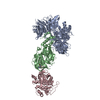
Journal: Nature / Year: 2026 Title: DCAF11-dependent molecular glue degrader activated by glutathionylation. Authors: Hojong Yoon / Franziska Wachter / Katharine A Barrett / Cyrus Jin / Anna Rodríguez-Pöhnlein / Justine C Rutter / Ryan J Lumpkin / Rebecca J Metivier / Katherine A Donovan / Kheewoong Baek ...Authors: Hojong Yoon / Franziska Wachter / Katharine A Barrett / Cyrus Jin / Anna Rodríguez-Pöhnlein / Justine C Rutter / Ryan J Lumpkin / Rebecca J Metivier / Katherine A Donovan / Kheewoong Baek / Yongying Jiang / Minwoo Lee / Robert W Kalis / Jianwei Che / Yuan Xiong / Eric S Fischer / Benjamin L Ebert / Abstract: Targeted protein degradation is a powerful pharmacological strategy that harnesses the ubiquitin proteasome system to eliminate disease-relevant proteins, including otherwise undruggable proteins. ...Targeted protein degradation is a powerful pharmacological strategy that harnesses the ubiquitin proteasome system to eliminate disease-relevant proteins, including otherwise undruggable proteins. Here we report an unbiased and broadly applicable platform for the systematic discovery of molecular glues across diverse E3 ligases. Using multiplexed mass spectrometry-based chemical screening, we identified M12, a molecular glue that reprogrammes the E3 ligase DCAF11 to degrade DDX18. Mechanistically, M12 functions as a prodrug that is activated through glutathione S-transferase-mediated glutathionylation. The glutathione moiety binds to an evolutionary conserved glutathione-binding site on DCAF11, and the exposed M12 moiety facilitates neo-substrate recruitment. We demonstrate that this glutathione-dependent mechanism readily enables targeted degradation of a range of proteins. Collectively, these findings establish that metabolically activated compounds can redirect E3 ligase function, thereby expanding the scope of targeted protein degradation and chemically induced proximity.
Model: Quantifoil R0.6/1 / Material: GOLD / Mesh: 300 / Support film - Material: CARBON / Support film - topology: HOLEY ARRAY
Vitrification
Cryogen name: ETHANE / Chamber humidity: 90 % / Chamber temperature: 283.15 K / Instrument: LEICA EM GP
-
Electron microscopy
Microscope
TFS KRIOS
Software
Name: EPU
Image recording
Film or detector model: TFS FALCON 4i (4k x 4k) / Number grids imaged: 1 / Number real images: 10632 / Average exposure time: 3.16 sec. / Average electron dose: 52.004 e/Å2
Electron beam
Acceleration voltage: 300 kV / Electron source: FIELD EMISSION GUN
In the structure databanks used in Yorodumi, some data are registered as the other names, "COVID-19 virus" and "2019-nCoV". Here are the details of the virus and the list of structure data.
Jan 31, 2019. EMDB accession codes are about to change! (news from PDBe EMDB page)
EMDB accession codes are about to change! (news from PDBe EMDB page)
The allocation of 4 digits for EMDB accession codes will soon come to an end. Whilst these codes will remain in use, new EMDB accession codes will include an additional digit and will expand incrementally as the available range of codes is exhausted. The current 4-digit format prefixed with “EMD-” (i.e. EMD-XXXX) will advance to a 5-digit format (i.e. EMD-XXXXX), and so on. It is currently estimated that the 4-digit codes will be depleted around Spring 2019, at which point the 5-digit format will come into force.
The EM Navigator/Yorodumi systems omit the EMD- prefix.
Related info.:Q: What is EMD? / ID/Accession-code notation in Yorodumi/EM Navigator
Yorodumi is a browser for structure data from EMDB, PDB, SASBDB, etc.
This page is also the successor to EM Navigator detail page, and also detail information page/front-end page for Omokage search.
The word "yorodu" (or yorozu) is an old Japanese word meaning "ten thousand". "mi" (miru) is to see.
Related info.:EMDB / PDB / SASBDB / Comparison of 3 databanks / Yorodumi Search / Aug 31, 2016. New EM Navigator & Yorodumi / Yorodumi Papers / Jmol/JSmol / Function and homology information / Changes in new EM Navigator and Yorodumi
 Movie
Movie Controller

 Yorodumi
 Open data
 Basic information
 Map data
 Sample
 Keywords
 Function and homology information
 Homo sapiens (human)
 Authors
 United States, 2 items
  Citation
 Structure visualization
 Downloads & links
 emd_71833.png
 https://data.pdbj.org/pub/emdb/structures/EMD-71833

 Z (Sec.)
 Y (Row.)
 X (Col.)


 Sample components
 Trichoplusia ni (cabbage looper)
 Processing
 Electron microscopy
 FIELD EMISSION GUN