National Institutes of Health/National Institute of Diabetes and Digestive and Kidney Disease (NIH/NIDDK)
U24 DK116195
United States
Citation
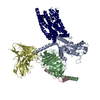
Journal: Nat Struct Mol Biol / Year: 2026 Title: Structural insights into coffee bitter taste perception by TAS2R43 receptor. Authors: Yoojoong Kim / Ryan H Gumpper / Yuxuan Zhuang / Ron O Dror / Bryan L Roth / Abstract: Bitter taste functions as a means of both protection against potentially toxic compounds and savoring bitter tasting foods and beverages. Among the 26 bitter taste receptors, taste receptor type 2 ...Bitter taste functions as a means of both protection against potentially toxic compounds and savoring bitter tasting foods and beverages. Among the 26 bitter taste receptors, taste receptor type 2 member 43 (TAS2R43) has been identified as key for recognizing the bitter taste of coffee. TAS2R43 has also been implicated in many other physiological processes, including the regulation of glucagon-like peptide 1 release from the intestine, bronchodilation, innate immunity and metabolism. Here we report cryo-electron microscopy structures of human TAS2R43 coupled with inhibitory G protein or gustducin (G) stabilized by the potent nephrotoxin and carcinogen aristolochic acid I. Both structures revealed that aristolochic acid I binds in a presumed orthosteric pocket shared with other bitter taste receptor. Further structural, functional and computational studies revealed potential modes for coffee's constituents including caffeine and cafestol, which are bitter tastants from coffee. Lastly, long-timescale molecular dynamics simulations identified potential cryptic allosteric pockets in TAS2R43. These structures could accelerate the search for specific bitter taste ligands that ultimately may be therapeutically useful.
In the structure databanks used in Yorodumi, some data are registered as the other names, "COVID-19 virus" and "2019-nCoV". Here are the details of the virus and the list of structure data.
Jan 31, 2019. EMDB accession codes are about to change! (news from PDBe EMDB page)
EMDB accession codes are about to change! (news from PDBe EMDB page)
The allocation of 4 digits for EMDB accession codes will soon come to an end. Whilst these codes will remain in use, new EMDB accession codes will include an additional digit and will expand incrementally as the available range of codes is exhausted. The current 4-digit format prefixed with “EMD-” (i.e. EMD-XXXX) will advance to a 5-digit format (i.e. EMD-XXXXX), and so on. It is currently estimated that the 4-digit codes will be depleted around Spring 2019, at which point the 5-digit format will come into force.
The EM Navigator/Yorodumi systems omit the EMD- prefix.
Related info.:Q: What is EMD? / ID/Accession-code notation in Yorodumi/EM Navigator
Yorodumi is a browser for structure data from EMDB, PDB, SASBDB, etc.
This page is also the successor to EM Navigator detail page, and also detail information page/front-end page for Omokage search.
The word "yorodu" (or yorozu) is an old Japanese word meaning "ten thousand". "mi" (miru) is to see.
Related info.:EMDB / PDB / SASBDB / Comparison of 3 databanks / Yorodumi Search / Aug 31, 2016. New EM Navigator & Yorodumi / Yorodumi Papers / Jmol/JSmol / Function and homology information / Changes in new EM Navigator and Yorodumi
 Movie
Movie Controller

 Yorodumi
 Open data
 Basic information
 Map data
 Sample
 Keywords
 Homo sapiens (human)
 Authors
 United States, 1 items
  Citation
 Structure visualization
 Downloads & links
 EMDB map data format
 emd_71044.png
 https://data.pdbj.org/pub/emdb/structures/EMD-71044


 Z (Sec.)
 Y (Row.)
 X (Col.)


 Sample components
 Processing
 Electron microscopy
 FIELD EMISSION GUN