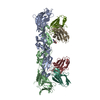
Journal: Commun Biol / Year: 2026 Title: Structural basis for antibody cross-neutralization of Dengue and Zika viruses. Authors: Nicholas K Hurlburt / Jay Lubow / Leslie Goo / Marie Pancera / Abstract: Safe and effective vaccines against co-circulating mosquito-borne orthoflaviviruses such as Zika virus (ZikV) and the four serotypes of Dengue virus (DenV1-4) must elicit broadly neutralizing ...Safe and effective vaccines against co-circulating mosquito-borne orthoflaviviruses such as Zika virus (ZikV) and the four serotypes of Dengue virus (DenV1-4) must elicit broadly neutralizing antibodies (bnAbs) to prevent the risk of enhancement of infection by non-neutralizing antibodies. We recently discovered new orthoflavivirus-directed bnAbs, including F25.S02, which neutralizes DenV1-4 and ZikV with comparable or superior potency to the previously characterized E dimer epitope (EDE) bnAbs. Here, we used cryoEM and X-ray crystallography to understand the basis of cross-neutralization of F25.S02 at the molecular level. We obtained a ~ 4.2 Å cryoEM structure of F25.S02 Fab bound to a stabilized DenV3 soluble E protein dimer and a 2.3 Å crystal structure of F25.S02 Fab bound to ZikV soluble E protein dimer. Like previously described EDE1 bnAbs, the structural epitope of F25.S02 is at the E dimer interface, encompassing predominantly conserved regions in domain II, including the fusion loop. However, unlike EDE1 bnAbs, F25.S02 binding is almost entirely dependent on the heavy chain and is shifted slightly away from the dimer symmetry axis. Our findings emphasize the importance of this cross-neutralizing site of vulnerability for DenV and ZikV that can facilitate rational design of vaccines and therapeutics.
In the structure databanks used in Yorodumi, some data are registered as the other names, "COVID-19 virus" and "2019-nCoV". Here are the details of the virus and the list of structure data.
Jan 31, 2019. EMDB accession codes are about to change! (news from PDBe EMDB page)
EMDB accession codes are about to change! (news from PDBe EMDB page)
The allocation of 4 digits for EMDB accession codes will soon come to an end. Whilst these codes will remain in use, new EMDB accession codes will include an additional digit and will expand incrementally as the available range of codes is exhausted. The current 4-digit format prefixed with “EMD-” (i.e. EMD-XXXX) will advance to a 5-digit format (i.e. EMD-XXXXX), and so on. It is currently estimated that the 4-digit codes will be depleted around Spring 2019, at which point the 5-digit format will come into force.
The EM Navigator/Yorodumi systems omit the EMD- prefix.
Related info.:Q: What is EMD? / ID/Accession-code notation in Yorodumi/EM Navigator
Yorodumi is a browser for structure data from EMDB, PDB, SASBDB, etc.
This page is also the successor to EM Navigator detail page, and also detail information page/front-end page for Omokage search.
The word "yorodu" (or yorozu) is an old Japanese word meaning "ten thousand". "mi" (miru) is to see.
Related info.:EMDB / PDB / SASBDB / Comparison of 3 databanks / Yorodumi Search / Aug 31, 2016. New EM Navigator & Yorodumi / Yorodumi Papers / Jmol/JSmol / Function and homology information / Changes in new EM Navigator and Yorodumi
 Movie
Movie Controller

 Yorodumi
 Open data
 Basic information
 Map data
 Sample
 Keywords
 Function and homology information
 Homo sapiens (human) /
  dengue virus type 3
 Authors
 Citation
 Structure visualization
 Downloads & links
 emd_70931.png
 http://ftp.pdbj.org/pub/emdb/structures/EMD-70931

 Z (Sec.)
 Y (Row.)
 X (Col.)


 Sample components
 Processing
 Electron microscopy
 FIELD EMISSION GUN