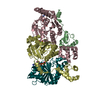
Octamer / RAD51 / XRCC3 / RAD51C / DNA BINDING PROTEIN
Function / homology
Function and homology information
telomeric loop disassembly / telomere maintenance via telomere trimming / resolution of mitotic recombination intermediates / Rad51C-XRCC3 complex / Rad51B-Rad51C-Rad51D-XRCC2 complex / meiotic DNA recombinase assembly / presynaptic intermediate filament cytoskeleton / response to glucoside / crossover junction DNA endonuclease activity / mitotic recombination-dependent replication fork processing ...telomeric loop disassembly / telomere maintenance via telomere trimming / resolution of mitotic recombination intermediates / Rad51C-XRCC3 complex / Rad51B-Rad51C-Rad51D-XRCC2 complex / meiotic DNA recombinase assembly / presynaptic intermediate filament cytoskeleton / response to glucoside / crossover junction DNA endonuclease activity / mitotic recombination-dependent replication fork processing / chromosome organization involved in meiotic cell cycle / telomere maintenance via telomere lengthening / cellular response to cisplatin / double-strand break repair involved in meiotic recombination / DNA recombinase assembly / nuclear ubiquitin ligase complex / cellular response to camptothecin / t-circle formation / DNA strand invasion / mitotic recombination / lateral element / Impaired BRCA2 binding to PALB2 / positive regulation of mitotic cell cycle spindle assembly checkpoint / DNA strand exchange activity / telomere maintenance via recombination / reciprocal meiotic recombination / sister chromatid cohesion / regulation of centrosome duplication / response to X-ray / regulation of double-strand break repair via homologous recombination / ATP-dependent DNA damage sensor activity / regulation of DNA damage checkpoint / Homologous DNA Pairing and Strand Exchange / Defective homologous recombination repair (HRR) due to BRCA1 loss of function / Defective HDR through Homologous Recombination Repair (HRR) due to PALB2 loss of BRCA1 binding function / Defective HDR through Homologous Recombination Repair (HRR) due to PALB2 loss of BRCA2/RAD51/RAD51C binding function / Resolution of D-loop Structures through Synthesis-Dependent Strand Annealing (SDSA) / HDR through Single Strand Annealing (SSA) / nuclear chromosome / Resolution of D-loop Structures through Holliday Junction Intermediates / Transcriptional Regulation by E2F6 / nuclear replication fork / Impaired BRCA2 binding to RAD51 / Presynaptic phase of homologous DNA pairing and strand exchange / ATP-dependent activity, acting on DNA / interstrand cross-link repair / positive regulation of G2/M transition of mitotic cell cycle / condensed chromosome / DNA polymerase binding / nucleosome binding / supramolecular fiber organization / replication fork processing / meiotic cell cycle / cellular response to ionizing radiation / condensed nuclear chromosome / replication fork / double-strand break repair via homologous recombination / cellular response to gamma radiation / response to toxic substance / protein-DNA complex / PML body / Meiotic recombination / HDR through Homologous Recombination (HRR) / Hydrolases; Acting on acid anhydrides; Acting on acid anhydrides to facilitate cellular and subcellular movement / single-stranded DNA binding / site of double-strand break / Factors involved in megakaryocyte development and platelet production / DNA recombination / double-stranded DNA binding / chromosome, telomeric region / response to xenobiotic stimulus / chromosome / mitochondrial matrix / DNA repair / centrosome / chromatin binding / DNA damage response / nucleolus / chromatin / perinuclear region of cytoplasm / enzyme binding / ATP hydrolysis activity / protein-containing complex / mitochondrion / DNA binding / nucleoplasm / ATP binding / identical protein binding / nucleus / cytosol / cytoplasm Similarity search - Function
: / XRCC3/RpoA-like, helix-hairpin-helix domain / : / : / DNA recombination/repair protein Rad51 / DNA recombination and repair protein, RecA-like / DNA recombination and repair protein Rad51-like, C-terminal / Rad51 / DNA recombination and repair protein RecA, monomer-monomer interface / RecA family profile 2. ...: / XRCC3/RpoA-like, helix-hairpin-helix domain / : / : / DNA recombination/repair protein Rad51 / DNA recombination and repair protein, RecA-like / DNA recombination and repair protein Rad51-like, C-terminal / Rad51 / DNA recombination and repair protein RecA, monomer-monomer interface / RecA family profile 2. / DNA recombination and repair protein RecA-like, ATP-binding domain / RecA family profile 1. / DNA repair Rad51/transcription factor NusA, alpha-helical / : / SAM-like Helix-hairpin-helix tandem / ATPases associated with a variety of cellular activities / AAA+ ATPase domain / P-loop containing nucleoside triphosphate hydrolase Similarity search - Domain/homology
DNA repair protein RAD51 homolog 3 / DNA repair protein XRCC3 / DNA repair protein RAD51 homolog 1 Similarity search - Component
Biological species
Homo sapiens (human)
Method
single particle reconstruction / cryo EM / Resolution: 3.25 Å
National Institutes of Health/National Institute of General Medical Sciences (NIH/NIGMS)
United States
Citation
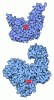
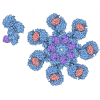
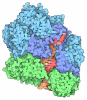
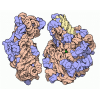
Journal: Nat Struct Mol Biol / Year: 2026 Title: Structural insight into how RAD51 paralog exchange regulates RAD51 filament formation. Authors: Yashpal Rawal / Youngho Kwon / Lijia Jia / Eliza A Ruben / Jae-Hoon Ji / Lijuan Guo / Caleb M Stratton / Digant Nayak / Miriam Tovar / Qingming Fang / Mohd Azrin Jamalruddin / Shuo Zhou / ...Authors: Yashpal Rawal / Youngho Kwon / Lijia Jia / Eliza A Ruben / Jae-Hoon Ji / Lijuan Guo / Caleb M Stratton / Digant Nayak / Miriam Tovar / Qingming Fang / Mohd Azrin Jamalruddin / Shuo Zhou / Sahiti Kuppa / Shahrez Syed / Angela M Jasper / Jeffrey N Katz / Cody M Rogers / Hardeep Kaur / Lorena Samentar / Weixing Zhao / Eloise Dray / Fang Zhang / Svetla Stoilova-McPhie / Alexander B Taylor / Sandeep Burma / Manjeet K Rao / David S Libich / Robert Hromas / Alexander V Mazin / Maria Jasin / Daohong Zhou / Kara A Bernstein / Eric C Greene / Elizabeth V Wasmuth / Patrick Sung / Shaun K Olsen / Abstract: Homologous recombination (HR) repairs DNA double-strand breaks and stabilizes stressed replication forks, and HR deficiency promotes genome instability and cancer. HR requires assembly of RAD51 ...Homologous recombination (HR) repairs DNA double-strand breaks and stabilizes stressed replication forks, and HR deficiency promotes genome instability and cancer. HR requires assembly of RAD51 nucleoprotein filaments on single-stranded DNA (ssDNA), a process regulated by the human RAD51 paralogs RAD51C, XRCC3, RAD51D and XRCC2. Here, using cryo-electron microscopy, we find that the RAD51-XRCC3-RAD51C complex (RAD51-X3C) assembles into an octamer in which XRCC3 engages the RAD51 DNA-binding surface and RAD51 subunits adopt a misaligned configuration incompatible with filament formation. These features define an autoinhibited RAD51-X3C state that limits nonproductive RAD51 binding to double-stranded DNA or RNA-DNA hybrids while preserving RAD51 availability for ssDNA-dependent strand exchange. We further show that the RAD51D-XRCC2 paralog complex remodels RAD51-X3C into a pentameric RAD51-X3CDX2 assembly by engaging the exposed RAD51C surface and disrupting contacts that stabilize the octamer. This remodeling exposes the RAD51 DNA-binding interface, enhances RAD51-ssDNA filament assembly, and promotes strand exchange on RPA-coated ssDNA, and yields a filament-compatible paralog assembly that integrates into ssDNA-bound RAD51 filaments. Together, these findings establish paralog exchange as a mechanism that converts an autoinhibited RAD51-X3C octamer into an activated RAD51-X3CDX2 pentamer to regulate RAD51 filament formation during HR and replication fork preservation.
In the structure databanks used in Yorodumi, some data are registered as the other names, "COVID-19 virus" and "2019-nCoV". Here are the details of the virus and the list of structure data.
Jan 31, 2019. EMDB accession codes are about to change! (news from PDBe EMDB page)
EMDB accession codes are about to change! (news from PDBe EMDB page)
The allocation of 4 digits for EMDB accession codes will soon come to an end. Whilst these codes will remain in use, new EMDB accession codes will include an additional digit and will expand incrementally as the available range of codes is exhausted. The current 4-digit format prefixed with “EMD-” (i.e. EMD-XXXX) will advance to a 5-digit format (i.e. EMD-XXXXX), and so on. It is currently estimated that the 4-digit codes will be depleted around Spring 2019, at which point the 5-digit format will come into force.
The EM Navigator/Yorodumi systems omit the EMD- prefix.
Related info.:Q: What is EMD? / ID/Accession-code notation in Yorodumi/EM Navigator
Yorodumi is a browser for structure data from EMDB, PDB, SASBDB, etc.
This page is also the successor to EM Navigator detail page, and also detail information page/front-end page for Omokage search.
The word "yorodu" (or yorozu) is an old Japanese word meaning "ten thousand". "mi" (miru) is to see.
Related info.:EMDB / PDB / SASBDB / Comparison of 3 databanks / Yorodumi Search / Aug 31, 2016. New EM Navigator & Yorodumi / Yorodumi Papers / Jmol/JSmol / Function and homology information / Changes in new EM Navigator and Yorodumi
 Movie
Movie Controller

 Yorodumi
 Open data
 Basic information
 Map data
 Sample
 Keywords
 Function and homology information
 Homo sapiens (human)
 Authors
 United States, 1 items
  Citation
 Structure visualization
 Downloads & links
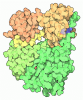
 emd_70624.png
 https://data.pdbj.org/pub/emdb/structures/EMD-70624


 Z (Sec.)
 Y (Row.)
 X (Col.)


 Sample components
 Escherichia coli (E. coli)
 Trichoplusia ni (cabbage looper)
 Processing
 Electron microscopy
 FIELD EMISSION GUN