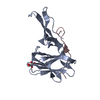
Journal: J Am Chem Soc / Year: 2026 Title: Co-Translational Incorporation of - and -β-Hydroxy Acids : A Structural and Biochemical Study on the Ribosome. Authors: Chandrima Majumdar / Alexandra D Kent / Noah X Hamlish / Cathy Zhu / Katelyn A Fitzgerald / Jamie H D Cate / Alanna Schepartz / Abstract: Engineering the translation apparatus to accept backbone-modified amino acid analogues would enable the programmed synthesis of sequence-defined biopolymers with tunable properties. β-Hydroxy acids ...Engineering the translation apparatus to accept backbone-modified amino acid analogues would enable the programmed synthesis of sequence-defined biopolymers with tunable properties. β-Hydroxy acids are of particular interest because they could support the programmed biosynthesis of both biocompatible polyester materials as well as natural product-like depsipeptides. Previous work has reported that both enantiomers of β-hydroxy-N-Boc-lysine (β-OH-BocK) are substrates for the orthogonal pyrrolysyl-tRNA synthetase (PylRS)/tRNA pair, but only one enantiomer is introduced into protein . Here we make use of high-resolution cryogenic electron microscopy (cryo-EM) to determine the structural basis for this observation. These structures reveal both β-OH-BocK isomers equally well-positioned within the ribosomal A site regardless of stereochemistry. Consistent with this observation, translation reactions charged with tRNAs acylated with - or -β-OH-BocK produced roughly equal amounts of translated product when quantified on the basis of either mass spectrometry or luminescence. Together, these experiments imply that the substantial preferential incorporation of one enantiomer over the other observed previously results primarily from deficiencies in the steps that precede bond formation by the ribosome. Indeed, as predicted by this work and demonstrated in an accompanying paper (Soni, C. Co-Translational Incorporation of ()- and ()-β-Hydroxyacids : Directed Evolution of Efficient Aminoacyl-tRNA Synthetases. 2026, 148, 10.1021/jacs.5c18595), when cells are provided with an active and orthogonal aminoacyl-tRNA synthetase/tRNA pair that accepts both - and -β-OH-BocK as substrates, both monomers are introduced into protein in good yield and with high fidelity.
Organism: Escherichia coli (E. coli) / Strain: MRE600
-
Experimental details
-
Structure determination
Method
cryo EM
Processing
single particle reconstruction
Aggregation state
particle
-
Sample preparation
Buffer
pH: 7.5
Grid
Model: Quantifoil R1.2/1.3 / Material: GOLD / Mesh: 300 / Support film - Material: CARBON / Support film - topology: CONTINUOUS / Support film - Film thickness: 2
Vitrification
Cryogen name: ETHANE / Chamber humidity: 100 % / Chamber temperature: 277 K / Instrument: FEI VITROBOT MARK IV
-
Electron microscopy
Microscope
TFS KRIOS
Image recording
Film or detector model: GATAN K3 BIOQUANTUM (6k x 4k) / Average electron dose: 40.0 e/Å2
Electron beam
Acceleration voltage: 300 kV / Electron source: FIELD EMISSION GUN
Electron optics
Illumination mode: OTHER / Imaging mode: BRIGHT FIELD / Nominal defocus max: 1.5 µm / Nominal defocus min: 0.5 µm
In the structure databanks used in Yorodumi, some data are registered as the other names, "COVID-19 virus" and "2019-nCoV". Here are the details of the virus and the list of structure data.
Jan 31, 2019. EMDB accession codes are about to change! (news from PDBe EMDB page)
EMDB accession codes are about to change! (news from PDBe EMDB page)
The allocation of 4 digits for EMDB accession codes will soon come to an end. Whilst these codes will remain in use, new EMDB accession codes will include an additional digit and will expand incrementally as the available range of codes is exhausted. The current 4-digit format prefixed with “EMD-” (i.e. EMD-XXXX) will advance to a 5-digit format (i.e. EMD-XXXXX), and so on. It is currently estimated that the 4-digit codes will be depleted around Spring 2019, at which point the 5-digit format will come into force.
The EM Navigator/Yorodumi systems omit the EMD- prefix.
Related info.:Q: What is EMD? / ID/Accession-code notation in Yorodumi/EM Navigator
Yorodumi is a browser for structure data from EMDB, PDB, SASBDB, etc.
This page is also the successor to EM Navigator detail page, and also detail information page/front-end page for Omokage search.
The word "yorodu" (or yorozu) is an old Japanese word meaning "ten thousand". "mi" (miru) is to see.
Related info.:EMDB / PDB / SASBDB / Comparison of 3 databanks / Yorodumi Search / Aug 31, 2016. New EM Navigator & Yorodumi / Yorodumi Papers / Jmol/JSmol / Function and homology information / Changes in new EM Navigator and Yorodumi
 Movie
Movie Controller

 Yorodumi
 Open data
 Basic information
 Map data
 Sample
 Keywords
 Escherichia coli (E. coli)
 Authors
 United States, 1 items
  Citation
 Structure visualization
 Downloads & links
 EMDB map data format
 emd_70056.png
 https://data.pdbj.org/pub/emdb/structures/EMD-70056


 Z (Sec.)
 Y (Row.)
 X (Col.)


 Sample components
 Processing
 Electron microscopy
 FIELD EMISSION GUN