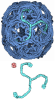
- EMDB-68805: Structure of Arabidopsis SNX1 (Class l, 7-fold) -
+
Open data
ID or keywords:
Loading...
-
Basic information
Entry
Database: EMDB / ID: EMD-68805
Title
Structure of Arabidopsis SNX1 (Class l, 7-fold)
Map data
Sample
Complex: Arabidopsis thaliana SNX1 complex with liposome
Protein or peptide: Sorting nexin 1
Keywords
SNX protein / Arabidopsis thaliana / tube / MEMBRANE PROTEIN
Function / homology
Function and homology information
positive gravitropism / root development / retromer complex / Golgi to vacuole transport / protein targeting to vacuole / endosome to lysosome transport / multivesicular body / phosphatidylinositol binding / protein localization to plasma membrane / chloroplast ...positive gravitropism / root development / retromer complex / Golgi to vacuole transport / protein targeting to vacuole / endosome to lysosome transport / multivesicular body / phosphatidylinositol binding / protein localization to plasma membrane / chloroplast / endosome / endosome membrane / Golgi apparatus / membrane / plasma membrane Similarity search - Function
Sorting nexin Vps5-like, C-terminal / Vps5 C terminal like / PhoX homologous domain, present in p47phox and p40phox. / PX domain profile. / PX domain / Phox homology / PX domain superfamily / AH/BAR domain superfamily Similarity search - Domain/homology
National Natural Science Foundation of China (NSFC)
32270727, 32000141
China
Other government
2021J01029
Other government
20720210094
The University Grants Committee, Research Grants Council (RGC)
CUHK14106823, C4033-19E, C4002-20W, C4002-21EF, C4014-23G, R4005-18, Senior Research Fellow Scheme SRFS2122-4S01 and CRS_CUHK405/23
Hong Kong
Citation
Journal: Nat Commun / Year: 2026 Title: SNX-mediated biogenesis of a plant-unique vesicle derived from the multivesicular body. Authors: Yanbin Li / Ran Tao / Hai Zhang / Xiaokang Wen / Stephen King Pong Leung / Qing Qi / Xiaohui Zheng / Haoxuan Guo / Congxian Wu / Zhifei Fu / Xiaorong Huang / Wilson Chun Yu Lau / Liwen Jiang / Yong Cui / Abstract: Retrograde transport is central to endomembrane homeostasis, yet the identity and origin of plant retrograde carriers remain unresolved. Prevailing models propose that plant vacuolar sorting ...Retrograde transport is central to endomembrane homeostasis, yet the identity and origin of plant retrograde carriers remain unresolved. Prevailing models propose that plant vacuolar sorting receptors (VSRs) recycle either from multivesicular bodies (MVBs) to the trans-Golgi network (TGN) or from the TGN to the Golgi apparatus and/or endoplasmic reticulum (ER). However, the ultrastructural features of plant retrograde transport carriers remain largely unresolved. Here, we show that plant retrograde transport is likely mediated by a previously unrecognized class of MVB-derived spherical vesicles. Using correlative light and electron microscopy and three-dimensional electron tomography, we identify a distinct population of ~30-50 nm spherical vesicles adjacent to MVBs, including nascent vesicles budding from the MVB limiting membrane in Arabidopsis root cells. Immunogold labeling shows that these vesicles are enriched in retromer components and VSRs, suggesting that they possibly function as retrograde transport carriers. To investigate their biogenesis, we perform cryo-electron microscopy and liposome tubulation assays, showing that Arabidopsis SNX1 generates shorter membrane tubules than its mammalian counterpart, consistent with reduced membrane affinity linked to differences in the amphipathic helix. Notably, the SNX1-SNX2 heterodimer produces heterogeneous structures, including spherical vesicles, recapitulating in vivo observations. Lastly, knockdown of SNX1 or SNX2 results in vacuolar mislocalization and increased degradation of GFP-VSR2, and defects in SNX1 and VPS29 inhibit formation of spherical vesicles adjacent to MVBs, resulting in embryonic lethality before the globular stage. Together, these findings establish MVB-derived spherical vesicles as plant retrograde carriers and reveal a distinct SNX-mediated mechanism underlying their formation.
In the structure databanks used in Yorodumi, some data are registered as the other names, "COVID-19 virus" and "2019-nCoV". Here are the details of the virus and the list of structure data.
Jan 31, 2019. EMDB accession codes are about to change! (news from PDBe EMDB page)
EMDB accession codes are about to change! (news from PDBe EMDB page)
The allocation of 4 digits for EMDB accession codes will soon come to an end. Whilst these codes will remain in use, new EMDB accession codes will include an additional digit and will expand incrementally as the available range of codes is exhausted. The current 4-digit format prefixed with “EMD-” (i.e. EMD-XXXX) will advance to a 5-digit format (i.e. EMD-XXXXX), and so on. It is currently estimated that the 4-digit codes will be depleted around Spring 2019, at which point the 5-digit format will come into force.
The EM Navigator/Yorodumi systems omit the EMD- prefix.
Related info.:Q: What is EMD? / ID/Accession-code notation in Yorodumi/EM Navigator
Yorodumi is a browser for structure data from EMDB, PDB, SASBDB, etc.
This page is also the successor to EM Navigator detail page, and also detail information page/front-end page for Omokage search.
The word "yorodu" (or yorozu) is an old Japanese word meaning "ten thousand". "mi" (miru) is to see.
Related info.:EMDB / PDB / SASBDB / Comparison of 3 databanks / Yorodumi Search / Aug 31, 2016. New EM Navigator & Yorodumi / Yorodumi Papers / Jmol/JSmol / Function and homology information / Changes in new EM Navigator and Yorodumi
 Movie
Movie Controller


 Open data
 Basic information
 Map data
 Sample
 Keywords
 Function and homology information
 Arabidopsis thaliana (thale cress)
 Authors
 China,
  Citation
 Structure visualization
 Downloads & links
 emd_68805.png
 http://ftp.pdbj.org/pub/emdb/structures/EMD-68805


 Z (Sec.)
 Y (Row.)
 X (Col.)


 Sample components
 Escherichia coli (E. coli)
 Processing
 Electron microscopy
 FIELD EMISSION GUN

