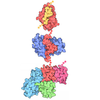
- EMDB-68255: The structure of HER2-m66-trastuzumab -
+
Open data
ID or keywords:
Loading...
-
Basic information
Entry
Database: EMDB / ID: EMD-68255
Title
The structure of HER2-m66-trastuzumab
Map data
None
Sample
Complex: HER2-m66-trastuzumab
Protein or peptide: Trastuzumab FAB LIGHT CHAIN
Protein or peptide: m66 (murine-derived) HEAVY CHAIN,
Protein or peptide: Receptor tyrosine-protein kinase erbB-2
Protein or peptide: m66 (murine-derived) HEAVY CHAIN,
Protein or peptide: Trastuzumab FAB HEAVY CHAIN
Protein or peptide: Receptor tyrosine-protein kinase erbB-2
Keywords
Human epidermal growth factor receptor 2 (HER2) / m66 (murine-derived) / r40 (rabbit-derived) / PROTEIN BINDING/IMMUNE SYSTEM / PROTEIN BINDING-IMMUNE SYSTEM complex
Function / homology
Function and homology information
ERBB3:ERBB2 complex / ERBB2-ERBB4 signaling pathway / GRB7 events in ERBB2 signaling / RNA polymerase I core binding / semaphorin receptor complex / Developmental Lineage of Mammary Stem Cells / ErbB-3 class receptor binding / Sema4D induced cell migration and growth-cone collapse / regulation of microtubule-based process / PLCG1 events in ERBB2 signaling ...ERBB3:ERBB2 complex / ERBB2-ERBB4 signaling pathway / GRB7 events in ERBB2 signaling / RNA polymerase I core binding / semaphorin receptor complex / Developmental Lineage of Mammary Stem Cells / ErbB-3 class receptor binding / Sema4D induced cell migration and growth-cone collapse / regulation of microtubule-based process / PLCG1 events in ERBB2 signaling / ERBB2-EGFR signaling pathway / enzyme-linked receptor protein signaling pathway / ERBB2 Activates PTK6 Signaling / Drug-mediated inhibition of ERBB2 signaling / Resistance of ERBB2 KD mutants to trastuzumab / Resistance of ERBB2 KD mutants to sapitinib / Resistance of ERBB2 KD mutants to tesevatinib / Resistance of ERBB2 KD mutants to neratinib / Resistance of ERBB2 KD mutants to osimertinib / Resistance of ERBB2 KD mutants to afatinib / Resistance of ERBB2 KD mutants to AEE788 / Resistance of ERBB2 KD mutants to lapatinib / Drug resistance in ERBB2 TMD/JMD mutants / neurotransmitter receptor localization to postsynaptic specialization membrane / ERBB2-ERBB3 signaling pathway / positive regulation of MAP kinase activity / positive regulation of Rho protein signal transduction / ERBB2 Regulates Cell Motility / positive regulation of transcription by RNA polymerase I / Developmental Lineage of Mammary Gland Myoepithelial Cells / semaphorin-plexin signaling pathway / PI3K events in ERBB2 signaling / regulation of angiogenesis / Developmental Lineage of Mammary Gland Luminal Epithelial Cells / positive regulation of protein targeting to membrane / regulation of ERK1 and ERK2 cascade / Schwann cell development / coreceptor activity / Signaling by ERBB2 / TFAP2 (AP-2) family regulates transcription of growth factors and their receptors / transmembrane receptor protein tyrosine kinase activity / positive regulation of epithelial cell proliferation / peptidyl-tyrosine phosphorylation / positive regulation of cell adhesion / GRB2 events in ERBB2 signaling / cell surface receptor protein tyrosine kinase signaling pathway / basal plasma membrane / SHC1 events in ERBB2 signaling / cellular response to epidermal growth factor stimulus / Constitutive Signaling by Overexpressed ERBB2 / wound healing / Downregulation of ERBB2:ERBB3 signaling / phosphatidylinositol 3-kinase/protein kinase B signal transduction / neuromuscular junction / positive regulation of translation / Signaling by ERBB2 TMD/JMD mutants / receptor protein-tyrosine kinase / Signaling by ERBB2 ECD mutants / Signaling by ERBB2 KD Mutants / receptor tyrosine kinase binding / positive regulation of JNK cascade / cellular response to growth factor stimulus / epidermal growth factor receptor signaling pathway / ruffle membrane / cell population proliferation / Downregulation of ERBB2 signaling / Constitutive Signaling by Aberrant PI3K in Cancer / transmembrane signaling receptor activity / neuron differentiation / PIP3 activates AKT signaling / myelin sheath / positive regulation of cell growth / PI5P, PP2A and IER3 Regulate PI3K/AKT Signaling / RAF/MAP kinase cascade / protein tyrosine kinase activity / presynaptic membrane / basolateral plasma membrane / early endosome / protein phosphorylation / positive regulation of MAPK cascade / cell surface receptor signaling pathway / signaling receptor complex / postsynaptic membrane / intracellular signal transduction / apical plasma membrane / endosome membrane / protein heterodimerization activity / signaling receptor binding / negative regulation of apoptotic process / perinuclear region of cytoplasm / signal transduction / nucleoplasm / ATP binding / membrane / identical protein binding / nucleus / plasma membrane / cytosol Similarity search - Function
: / Epidermal growth factor receptor transmembrane-juxtamembrane segment / Tyrosine protein kinase, EGF/ERB/XmrK receptor / Growth factor receptor domain 4 / Growth factor receptor domain IV / Receptor L-domain / Furin-like cysteine-rich domain / Receptor L-domain superfamily / Furin-like cysteine rich region / Receptor L domain ...: / Epidermal growth factor receptor transmembrane-juxtamembrane segment / Tyrosine protein kinase, EGF/ERB/XmrK receptor / Growth factor receptor domain 4 / Growth factor receptor domain IV / Receptor L-domain / Furin-like cysteine-rich domain / Receptor L-domain superfamily / Furin-like cysteine rich region / Receptor L domain / Furin-like repeat / Furin-like repeats / Growth factor receptor cysteine-rich domain superfamily / : / Tyrosine-protein kinase, catalytic domain / Tyrosine kinase, catalytic domain / Tyrosine protein kinases specific active-site signature. / Tyrosine-protein kinase, active site / Protein tyrosine and serine/threonine kinase / Serine-threonine/tyrosine-protein kinase, catalytic domain / Protein kinase, ATP binding site / Protein kinases ATP-binding region signature. / Protein kinase domain profile. / Protein kinase domain / Protein kinase-like domain superfamily Similarity search - Domain/homology
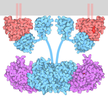
Journal: PLoS One / Year: 2026 Title: Inhibition of HER2 signaling and breast cancer cell growth with a novel antibody targeting HER2 ECD III/IV. Authors: Chunchun Liu / Yulei Ren / Xuan Luo / Peiyun Zhou / Xiangjuan Du / Qianmin Wang / Xue Han / Yanhui Xu / Ping Wang / Dan Zhao / Huirong Yang / Abstract: Human epidermal growth factor receptor 2 (HER2), a ligand-independent tyrosine kinase receptor belonging to the EGFR family, serves as a key oncogenic driver in breast, gastric, and several other ...Human epidermal growth factor receptor 2 (HER2), a ligand-independent tyrosine kinase receptor belonging to the EGFR family, serves as a key oncogenic driver in breast, gastric, and several other solid tumors. Although anti-HER2 therapies have substantially improved survival outcomes-particularly in breast and gastric cancers-treatment resistance and cancer recurrence remain major clinical challenges. Thus, developing novel antibodies exhibiting complementary effects to the current anti-HER2 therapies could provide additional therapeutic benefits. Here, we describe two novel HER2-targeting monoclonal antibodies, m66 (murine-derived) and r40 (rabbit-derived), which inhibit breast cancer cell proliferation in vitro. Of the two, antibody r40 exhibits stronger suppression of the PI3K/AKT and MAPK signaling pathways compared to m66. Moreover, the addition of r40 to the combination of trastuzumab and pertuzumab leads to a significantly enhanced inhibitory effect. We also determined the cryo-EM structures of the HER2-m66-trastuzumab ternary complex and the HER2-r40-trastuzumab-pertuzumab tetrameric complex, at overall resolutions of 3.2 Å and 3.1 Å, respectively. Structural analyses reveal that m66 recognizes an epitope overlapping with that of pertuzumab, whereas r40 binds within the HER2 ECD III/IV-a region distinct from the binding sites of both trastuzumab and pertuzumab. These findings identify r40 as a promising therapeutic candidate for use in combination with trastuzumab and pertuzumab in the treatment of HER2-positive breast cancer.
In the structure databanks used in Yorodumi, some data are registered as the other names, "COVID-19 virus" and "2019-nCoV". Here are the details of the virus and the list of structure data.
Jan 31, 2019. EMDB accession codes are about to change! (news from PDBe EMDB page)
EMDB accession codes are about to change! (news from PDBe EMDB page)
The allocation of 4 digits for EMDB accession codes will soon come to an end. Whilst these codes will remain in use, new EMDB accession codes will include an additional digit and will expand incrementally as the available range of codes is exhausted. The current 4-digit format prefixed with “EMD-” (i.e. EMD-XXXX) will advance to a 5-digit format (i.e. EMD-XXXXX), and so on. It is currently estimated that the 4-digit codes will be depleted around Spring 2019, at which point the 5-digit format will come into force.
The EM Navigator/Yorodumi systems omit the EMD- prefix.
Related info.:Q: What is EMD? / ID/Accession-code notation in Yorodumi/EM Navigator
Yorodumi is a browser for structure data from EMDB, PDB, SASBDB, etc.
This page is also the successor to EM Navigator detail page, and also detail information page/front-end page for Omokage search.
The word "yorodu" (or yorozu) is an old Japanese word meaning "ten thousand". "mi" (miru) is to see.
Related info.:EMDB / PDB / SASBDB / Comparison of 3 databanks / Yorodumi Search / Aug 31, 2016. New EM Navigator & Yorodumi / Yorodumi Papers / Jmol/JSmol / Function and homology information / Changes in new EM Navigator and Yorodumi
 Movie
 Controller


 Open data

 Basic information

 Map data
 Sample
 Keywords
 Function and homology information
 Chimeric Dengue virus vector p4(Delta30)-D2-ME /
 Homo sapiens (human) /

 Mus musculus (house mouse)
 Authors
 Citation

 Structure visualization

 Downloads & links
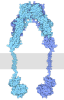
 emd_68255.png
 https://data.pdbj.org/pub/emdb/structures/EMD-68255


 Z (Sec.)
 Y (Row.)
 X (Col.)


 Sample components
 Processing
 Electron microscopy
 FIELD EMISSION GUN