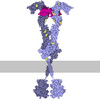
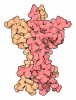
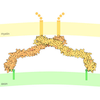
Journal: Adv Sci (Weinh) / Year: 2026 Title: Structural Basis of Lymphangiogenic Receptor VEGFR-3 Activation Mediated by Distinctive Clustering of the Ligand-Receptor Complex. Authors: Ryeongeun Cho / Jinsook Ahn / Jimin Yang / Dong Sun Lee / Gahi Hong / Sangkyu Lee / Ho Min Kim / Abstract: Vascular endothelial growth factor-C (VEGF-C) and its receptor VEGFR-3 are critical for lymphangiogenesis, yet the structural mechanisms beyond simple dimerization that drive activation remain ...Vascular endothelial growth factor-C (VEGF-C) and its receptor VEGFR-3 are critical for lymphangiogenesis, yet the structural mechanisms beyond simple dimerization that drive activation remain unknown. Here, we report the first cryo-EM structure of the human VEGFR-3 full ectodomain in complex with VEGF-C. Such a canonical ligand-induced 2:2 hetero-tetrameric complex further self-assembles into distinct higher-order assemblies-a lateral cis-cluster and an inverted trans-like-cluster. Further analysis of these canonical 2:2 hetero-tetramer in higher-order assemblies identifies that the specificity of VEGF-C for VEGFR-3 and VEGFR-2 over VEGFR-1 is mainly governed by its N-terminal α1 helix, which is structurally accommodated by the D2 domains of VEGFR-3 and VEGFR-2 but sterically excluded by the protruding D1-D2 connecting loop of VEGFR-1. Furthermore, we identify a unique interface within the membrane-proximal D5 domain occurring between neighboring canonical 2:2 complexes, mediated by a specific "WTP motif," as a key driver of cis-clustering. Structure-guided mutagenesis and real-time optogenetic assays support a critical role for cis-clustering in signal amplification and show that enforced receptor clustering can drive robust activation, whereas trans-like-clustering appears dispensable. Collectively, these findings transform the traditional "monomer-to-dimer" activation model of VEGFR-3/VEGF-C into a "dimer-to-cluster" paradigm, providing a blueprint for engineering next-generation therapeutics targeting lymphatic vascular diseases.
In the structure databanks used in Yorodumi, some data are registered as the other names, "COVID-19 virus" and "2019-nCoV". Here are the details of the virus and the list of structure data.
Jan 31, 2019. EMDB accession codes are about to change! (news from PDBe EMDB page)
EMDB accession codes are about to change! (news from PDBe EMDB page)
The allocation of 4 digits for EMDB accession codes will soon come to an end. Whilst these codes will remain in use, new EMDB accession codes will include an additional digit and will expand incrementally as the available range of codes is exhausted. The current 4-digit format prefixed with “EMD-” (i.e. EMD-XXXX) will advance to a 5-digit format (i.e. EMD-XXXXX), and so on. It is currently estimated that the 4-digit codes will be depleted around Spring 2019, at which point the 5-digit format will come into force.
The EM Navigator/Yorodumi systems omit the EMD- prefix.
Related info.:Q: What is EMD? / ID/Accession-code notation in Yorodumi/EM Navigator
Yorodumi is a browser for structure data from EMDB, PDB, SASBDB, etc.
This page is also the successor to EM Navigator detail page, and also detail information page/front-end page for Omokage search.
The word "yorodu" (or yorozu) is an old Japanese word meaning "ten thousand". "mi" (miru) is to see.
Related info.:EMDB / PDB / SASBDB / Comparison of 3 databanks / Yorodumi Search / Aug 31, 2016. New EM Navigator & Yorodumi / Yorodumi Papers / Jmol/JSmol / Function and homology information / Changes in new EM Navigator and Yorodumi
 Movie
Movie Controller

 Yorodumi
 Open data
 Basic information
 Map data
 Sample
 Keywords
 Function and homology information
 Homo sapiens (human)
 Authors
 Korea, Republic Of, 2 items
  Citation
 Structure visualization
 Downloads & links
 emd_67618.png
 https://data.pdbj.org/pub/emdb/structures/EMD-67618



 Z (Sec.)
 Y (Row.)
 X (Col.)


 Sample components
 Processing
 Electron microscopy
 FIELD EMISSION GUN


