[English] 日本語
Yorodumi
- EMDB-66856: Omicron-specific ultra-potent SARS-CoV-2 neutralizing antibodies ... -

+
Open data


ID or keywords:

Loading...

-
Basic information

Entry
Database: EMDB / ID: EMD-66856
TitleOmicron-specific ultra-potent SARS-CoV-2 neutralizing antibodies targeting the N1/N2 loop of Spike N-terminal domain
Map data
Sample
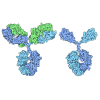
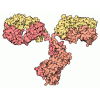
  • Complex: BD58-0730-S 6P trimer complex
    • Protein or peptide: BD58-0730 heavy chain
    • Protein or peptide: BD58-0730 light chain
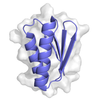
    • Protein or peptide: Spike protein S1
    • Protein or peptide: Spike glycoprotein
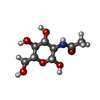
  • Ligand: 2-acetamido-2-deoxy-beta-D-glucopyranose
KeywordsSARS-CoV-2 / N-terminal domain / antibodies / N1/N2 loop / ACE2 competition / VIRAL PROTEIN/IMMUNE SYSTEM / VIRAL PROTEIN-IMMUNE SYSTEM complex
Function / homology
Function and homology information


symbiont-mediated disruption of host tissue / Maturation of spike protein / Translation of Structural Proteins / Virion Assembly and Release / host cell surface / host extracellular space / viral translation / symbiont-mediated-mediated suppression of host tetherin activity / Induction of Cell-Cell Fusion / structural constituent of virion ...symbiont-mediated disruption of host tissue / Maturation of spike protein / Translation of Structural Proteins / Virion Assembly and Release / host cell surface / host extracellular space / viral translation / symbiont-mediated-mediated suppression of host tetherin activity / Induction of Cell-Cell Fusion / structural constituent of virion / membrane fusion / entry receptor-mediated virion attachment to host cell / Attachment and Entry / host cell endoplasmic reticulum-Golgi intermediate compartment membrane / positive regulation of viral entry into host cell / receptor-mediated virion attachment to host cell / host cell surface receptor binding / symbiont-mediated suppression of host innate immune response / receptor ligand activity / endocytosis involved in viral entry into host cell / fusion of virus membrane with host plasma membrane / fusion of virus membrane with host endosome membrane / viral envelope / symbiont entry into host cell / virion attachment to host cell / SARS-CoV-2 activates/modulates innate and adaptive immune responses / host cell plasma membrane / virion membrane / identical protein binding / membrane / plasma membrane
Similarity search - Function
Spike (S) protein S1 subunit, receptor-binding domain, SARS-CoV-2 / Spike (S) protein S1 subunit, N-terminal domain, SARS-CoV-like / Coronavirus spike glycoprotein S1, C-terminal / Coronavirus spike glycoprotein S1, C-terminal / Spike glycoprotein, N-terminal domain superfamily / Spike S1 subunit, receptor binding domain superfamily, betacoronavirus / Spike glycoprotein, betacoronavirus / Betacoronavirus spike (S) glycoprotein S1 subunit N-terminal (NTD) domain profile. / Betacoronavirus spike (S) glycoprotein S1 subunit C-terminal (CTD) domain profile. / Spike (S) protein S1 subunit, receptor-binding domain, betacoronavirus ...Spike (S) protein S1 subunit, receptor-binding domain, SARS-CoV-2 / Spike (S) protein S1 subunit, N-terminal domain, SARS-CoV-like / Coronavirus spike glycoprotein S1, C-terminal / Coronavirus spike glycoprotein S1, C-terminal / Spike glycoprotein, N-terminal domain superfamily / Spike S1 subunit, receptor binding domain superfamily, betacoronavirus / Spike glycoprotein, betacoronavirus / Betacoronavirus spike (S) glycoprotein S1 subunit N-terminal (NTD) domain profile. / Betacoronavirus spike (S) glycoprotein S1 subunit C-terminal (CTD) domain profile. / Spike (S) protein S1 subunit, receptor-binding domain, betacoronavirus / Betacoronavirus spike glycoprotein S1, receptor binding / Spike glycoprotein S1, N-terminal domain, betacoronavirus-like / Betacoronavirus-like spike glycoprotein S1, N-terminal / Spike glycoprotein S2 superfamily, coronavirus / Spike glycoprotein S2, coronavirus, heptad repeat 1 / Spike glycoprotein S2, coronavirus, heptad repeat 2 / Coronavirus spike (S) glycoprotein S2 subunit heptad repeat 1 (HR1) region profile. / Coronavirus spike (S) glycoprotein S2 subunit heptad repeat 2 (HR2) region profile. / Spike glycoprotein S2, coronavirus / Coronavirus spike glycoprotein S2
Similarity search - Domain/homology
Biological speciesHomo sapiens (human) / Severe acute respiratory syndrome coronavirus 2
Methodsingle particle reconstruction / cryo EM / Resolution: 3.77 Å
AuthorsLi ZQ / Niu X
Funding support1 items
OrganizationGrant numberCountry
Other government
CitationJournal: Emerg Microbes Infect / Year: 2024
Title: Omicron-specific ultra-potent SARS-CoV-2 neutralizing antibodies targeting the N1/N2 loop of Spike N-terminal domain.
Authors: Xiao Niu / Zhiqiang Li / Jing Wang / Fanchong Jian / Yuanling Yu / Weiliang Song / Ayijiang Yisimayi / Shuo Du / Zhiying Zhang / Qianran Wang / Jing Wang / Ran An / Yao Wang / Peng Wang / ...Authors: Xiao Niu / Zhiqiang Li / Jing Wang / Fanchong Jian / Yuanling Yu / Weiliang Song / Ayijiang Yisimayi / Shuo Du / Zhiying Zhang / Qianran Wang / Jing Wang / Ran An / Yao Wang / Peng Wang / Haiyan Sun / Lingling Yu / Sijie Yang / Tianhe Xiao / Qingqing Gu / Fei Shao / Youchun Wang / Junyu Xiao / Yunlong Cao /
Abstract: A multitude of functional mutations continue to emerge on the N-terminal domain (NTD) of the spike protein in SARS-CoV-2 Omicron subvariants. Understanding the immunogenicity of Omicron NTD and the ...A multitude of functional mutations continue to emerge on the N-terminal domain (NTD) of the spike protein in SARS-CoV-2 Omicron subvariants. Understanding the immunogenicity of Omicron NTD and the properties of antibodies elicited by it is crucial for comprehending the impact of NTD mutations on viral fitness and guiding vaccine design. In this study, we find that most of NTD-targeting antibodies isolated from individuals with BA.5/BF.7 breakthrough infection (BTI) are ancestral (wild-type or WT)-reactive and non-neutralizing. Surprisingly, we identified five ultra-potent neutralizing antibodies (NAbs) that can only bind to Omicron but not WT NTD. Structural analysis revealed that they bind to a unique epitope on the N1/N2 loop of NTD and interact with the receptor-binding domain (RBD) via the light chain. These Omicron-specific NAbs achieve neutralization through ACE2 competition and blockage of ACE2-mediated S1 shedding. However, BA.2.86 and BA.2.87.1, which carry insertions or deletions on the N1/N2 loop, can evade these antibodies. Together, we provided a detailed map of the NTD-targeting antibody repertoire in the post-Omicron era, demonstrating their vulnerability to NTD mutations enabled by its evolutionary flexibility, despite their potent neutralization. These results revealed the function of the indels in the NTD of BA.2.86/JN.1 sublineage in evading neutralizing antibodies and highlighted the importance of considering the immunogenicity of NTD in vaccine design.
History
DepositionOct 30, 2025-
Header (metadata) releaseDec 3, 2025-
Map releaseDec 3, 2025-
UpdateDec 3, 2025-
Current statusDec 3, 2025Processing site: PDBc / Status: Released

-
Structure visualization

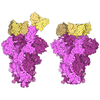
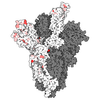
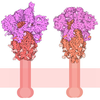
Supplemental images

Downloads & links

-
Map

FileDownload / File: emd_66856.map.gz / Format: CCP4 / Size: 178 MB / Type: IMAGE STORED AS FLOATING POINT NUMBER (4 BYTES)
Projections & slices

Image control

Size
Brightness
Contrast
Others
AxesZ (Sec.)Y (Row.)X (Col.)
1.08 Å/pix.
x 360 pix.
= 388.8 Å
1.08 Å/pix.
x 360 pix.
= 388.8 Å
1.08 Å/pix.
x 360 pix.
= 388.8 Å

Surface

Projections

Slices (1/3)

Slices (1/2)

Slices (2/3)

Images are generated by Spider.

Voxel sizeX=Y=Z: 1.08 Å
Density
Contour LevelBy AUTHOR: 0.413
Minimum - Maximum-2.0609517 - 3.0629096
Average (Standard dev.)0.0020809441 (±0.038490906)
SymmetrySpace group: 1
Details

EMDB XML:

Map geometry
Axis orderXYZ
Origin000
Dimensions360360360
Spacing360360360
CellA=B=C: 388.80002 Å
α=β=γ: 90.0 °

-
Supplemental data

-
Mask #1

Fileemd_66856_msk_1.map
Projections & Slices
AxesZYX

Projections

Slices (1/2)
Density Histograms

-
Additional map: #1

Fileemd_66856_additional_1.map
Projections & Slices
AxesZYX

Projections

Slices (1/2)
Density Histograms

-
Half map: #2

Fileemd_66856_half_map_1.map
Projections & Slices
AxesZYX

Projections

Slices (1/2)
Density Histograms

-
Half map: #1

Fileemd_66856_half_map_2.map
Projections & Slices
AxesZYX

Projections

Slices (1/2)
Density Histograms

-
Sample components

-
Entire : BD58-0730-S 6P trimer complex

EntireName: BD58-0730-S 6P trimer complex
Components
  • Complex: BD58-0730-S 6P trimer complex
    • Protein or peptide: BD58-0730 heavy chain
    • Protein or peptide: BD58-0730 light chain
    • Protein or peptide: Spike protein S1
    • Protein or peptide: Spike glycoprotein
  • Ligand: 2-acetamido-2-deoxy-beta-D-glucopyranose

-
Supramolecule #1: BD58-0730-S 6P trimer complex

SupramoleculeName: BD58-0730-S 6P trimer complex / type: complex / ID: 1 / Parent: 0 / Macromolecule list: #1-#4
Source (natural)Organism: Homo sapiens (human)

-
Macromolecule #1: BD58-0730 heavy chain

MacromoleculeName: BD58-0730 heavy chain / type: protein_or_peptide / ID: 1 / Number of copies: 1 / Enantiomer: LEVO
Source (natural)Organism: Homo sapiens (human)
Molecular weightTheoretical: 13.364939 KDa
Recombinant expressionOrganism: Homo sapiens (human)
SequenceString:
VQLVQSGAEV KKPGASVKVS CKASGYTFTS YYMHWVRQAP GQGLEWMGII NPSGGSTSNA QKFQGRVTMT RDTFTSTVYM ELSSLRSED TAVYYCARDI ARGIGEYYFD YWGQGTLVTV SS

-
Macromolecule #2: BD58-0730 light chain

MacromoleculeName: BD58-0730 light chain / type: protein_or_peptide / ID: 2 / Number of copies: 1 / Enantiomer: LEVO
Source (natural)Organism: Homo sapiens (human)
Molecular weightTheoretical: 11.718796 KDa
Recombinant expressionOrganism: Homo sapiens (human)
SequenceString:
QSALTQTASV SGSPGQSITI SCTGTSSDVG GYNYVSWYQQ HPGKAPKLMI YDVYKRPSGV SNRFSGSKSG NTASLTISGL QAEDEADYY CSSYTTSSTL LFGGGTKLTV LGQ

-
Macromolecule #3: Spike protein S1

MacromoleculeName: Spike protein S1 / type: protein_or_peptide / ID: 3 / Number of copies: 1 / Enantiomer: LEVO
Source (natural)Organism: Severe acute respiratory syndrome coronavirus 2
Molecular weightTheoretical: 32.433465 KDa
Recombinant expressionOrganism: Homo sapiens (human)
SequenceString: CVNLITRTQS YTNSFTRGVY YPDKVFRSSV LHSTQDLFLP FFSNVTWFHA IHVSGTNGTK RFDNPALPFN DGVYFASTEK SNIIRGWIF GTTLDSKTQS LLIVNNATNV VIKVCEFQFC NDPFLDVYQK NNKSWMESEF RVYSSANNCT FEYVSQPFLM D LEGKEGNF ...String:
CVNLITRTQS YTNSFTRGVY YPDKVFRSSV LHSTQDLFLP FFSNVTWFHA IHVSGTNGTK RFDNPALPFN DGVYFASTEK SNIIRGWIF GTTLDSKTQS LLIVNNATNV VIKVCEFQFC NDPFLDVYQK NNKSWMESEF RVYSSANNCT FEYVSQPFLM D LEGKEGNF KNLREFVFKN IDGYFKIYSK HTPINLERDL PQGFSALEPL VDLPIGINIT RFQTLLALHR SYLTPGDSSS GW TAGAAAY YVGYLQPRTF LLKYNENGTI TDAVDCALDP LSETKCTL

UniProtKB: Spike glycoprotein

-
Macromolecule #4: Spike glycoprotein

MacromoleculeName: Spike glycoprotein / type: protein_or_peptide / ID: 4 / Number of copies: 1 / Enantiomer: LEVO
Source (natural)Organism: Severe acute respiratory syndrome coronavirus 2
Molecular weightTheoretical: 25.110414 KDa
Recombinant expressionOrganism: Homo sapiens (human)
SequenceString: TESIVRFPNI TNLCPFHEVF NATTFASVYA WNRKRISNCV ADYSVIYNFA PFFAFKCYGV SPTKLNDLCF TNVYADSFVI RGNEVSQIA PGQTGNIADY NYKLPDDFTG CVIAWNSNKL DSKPSGNYNY LYRLFRKSKL KPFERDISTE IYQAGNKPCN G VAGPNCYS ...String:
TESIVRFPNI TNLCPFHEVF NATTFASVYA WNRKRISNCV ADYSVIYNFA PFFAFKCYGV SPTKLNDLCF TNVYADSFVI RGNEVSQIA PGQTGNIADY NYKLPDDFTG CVIAWNSNKL DSKPSGNYNY LYRLFRKSKL KPFERDISTE IYQAGNKPCN G VAGPNCYS PLQSYGFRPT YGVGHQPYRV VVLSFELLHA PATVCGPKKS TNLVKNKCVN FNFNG

UniProtKB: Spike glycoprotein

-
Macromolecule #5: 2-acetamido-2-deoxy-beta-D-glucopyranose

MacromoleculeName: 2-acetamido-2-deoxy-beta-D-glucopyranose / type: ligand / ID: 5 / Number of copies: 7 / Formula: NAG
Molecular weightTheoretical: 221.208 Da
Chemical component information

ChemComp-NAG:
2-acetamido-2-deoxy-beta-D-glucopyranose

-
Experimental details

-
Structure determination

Methodcryo EM
Processingsingle particle reconstruction
Aggregation stateparticle

-
Sample preparation

Concentration1.0 mg/mL
BufferpH: 7
VitrificationCryogen name: ETHANE

-
Electron microscopy

MicroscopeTFS KRIOS
Image recordingFilm or detector model: FEI FALCON IV (4k x 4k) / Average electron dose: 50.0 e/Å2
Electron beamAcceleration voltage: 300 kV / Electron source: FIELD EMISSION GUN
Electron opticsIllumination mode: FLOOD BEAM / Imaging mode: BRIGHT FIELD / Nominal defocus max: 2.0 µm / Nominal defocus min: 1.0 µm
Experimental equipment
Model: Titan Krios / Image courtesy: FEI Company

+
Image processing

CTF correctionType: PHASE FLIPPING ONLY
Startup modelType of model: NONE
Final reconstructionResolution.type: BY AUTHOR / Resolution: 3.77 Å / Resolution method: FSC 0.143 CUT-OFF / Software - Name: cryoSPARC / Number images used: 111000
Initial angle assignmentType: MAXIMUM LIKELIHOOD
Final angle assignmentType: MAXIMUM LIKELIHOOD
FSC plot (resolution estimation)

+
About Yorodumi

-
News

-
Feb 9, 2022. New format data for meta-information of EMDB entries

New format data for meta-information of EMDB entries

  • Version 3 of the EMDB header file is now the official format.
  • The previous official version 1.9 will be removed from the archive.

Related info.:EMDB header

External links:wwPDB to switch to version 3 of the EMDB data model

-
Aug 12, 2020. Covid-19 info

Covid-19 info

URL: https://pdbj.org/emnavi/covid19.php

New page: Covid-19 featured information page in EM Navigator.

Related info.:Covid-19 info / Mar 5, 2020. Novel coronavirus structure data

+
Mar 5, 2020. Novel coronavirus structure data

Novel coronavirus structure data

Related info.:Yorodumi Speices / Aug 12, 2020. Covid-19 info

External links:COVID-19 featured content - PDBj / Molecule of the Month (242):Coronavirus Proteases

+
Jan 31, 2019. EMDB accession codes are about to change! (news from PDBe EMDB page)

EMDB accession codes are about to change! (news from PDBe EMDB page)

  • The allocation of 4 digits for EMDB accession codes will soon come to an end. Whilst these codes will remain in use, new EMDB accession codes will include an additional digit and will expand incrementally as the available range of codes is exhausted. The current 4-digit format prefixed with “EMD-” (i.e. EMD-XXXX) will advance to a 5-digit format (i.e. EMD-XXXXX), and so on. It is currently estimated that the 4-digit codes will be depleted around Spring 2019, at which point the 5-digit format will come into force.
  • The EM Navigator/Yorodumi systems omit the EMD- prefix.

Related info.:Q: What is EMD? / ID/Accession-code notation in Yorodumi/EM Navigator

External links:EMDB Accession Codes are Changing Soon! / Contact to PDBj

+
Jul 12, 2017. Major update of PDB

Major update of PDB

  • wwPDB released updated PDB data conforming to the new PDBx/mmCIF dictionary.
  • This is a major update changing the version number from 4 to 5, and with Remediation, in which all the entries are updated.
  • In this update, many items about electron microscopy experimental information are reorganized (e.g. em_software).
  • Now, EM Navigator and Yorodumi are based on the updated data.

External links:wwPDB Remediation / Enriched Model Files Conforming to OneDep Data Standards Now Available in the PDB FTP Archive

-
Yorodumi

Thousand views of thousand structures

  • Yorodumi is a browser for structure data from EMDB, PDB, SASBDB, etc.
  • This page is also the successor to EM Navigator detail page, and also detail information page/front-end page for Omokage search.
  • The word "yorodu" (or yorozu) is an old Japanese word meaning "ten thousand". "mi" (miru) is to see.

Related info.:EMDB / PDB / SASBDB / Comparison of 3 databanks / Yorodumi Search / Aug 31, 2016. New EM Navigator & Yorodumi / Yorodumi Papers / Jmol/JSmol / Function and homology information / Changes in new EM Navigator and Yorodumi

Read more