Journal: iScience / Year: 2025 Title: An engineered VSV-vectored rabies vaccine with an RABV-G-L71S mutation. Authors: Mingxi Yue / Yuhe Zhu / Hongchao Wu / Siping Yan / Jinlei Zhang / Mengqi Chang / Liqin Liu / Hui Huang / Jie Lu / Wenrong Wu / Ruitong Chen / Shuyu Wu / Yibing Gao / Yujiao Cao / Hangtian ...Authors: Mingxi Yue / Yuhe Zhu / Hongchao Wu / Siping Yan / Jinlei Zhang / Mengqi Chang / Liqin Liu / Hui Huang / Jie Lu / Wenrong Wu / Ruitong Chen / Shuyu Wu / Yibing Gao / Yujiao Cao / Hangtian Ding / Qingbing Zheng / Yingbin Wang / Quan Yuan / Hualong Xiong / Kegong Tian / Tianying Zhang / Ningshao Xia / Abstract: A replicating recombinant rabies vaccine, rVSV-RABV, was constructed using vesicular stomatitis virus (VSV) expressing the rabies virus glycoprotein (RABV-G, SAD-B19 strain). A leucine-to-serine ...A replicating recombinant rabies vaccine, rVSV-RABV, was constructed using vesicular stomatitis virus (VSV) expressing the rabies virus glycoprotein (RABV-G, SAD-B19 strain). A leucine-to-serine mutation at position 71 (L71S) in the RABV-G extracellular domain significantly enhanced the viral titer and G protein expression. The derived strain, rVSV-RABV-L71S, demonstrated production and immunogenic advantages. As an inactivated vaccine formulated with GEL-02 adjuvant, it induced stronger neutralizing antibody responses, along with innate and Th1-biased T cell immunity in mice, compared to commercially inactivated vaccines. As a live vaccine, it conferred robust protection against the CVS-24 challenge in mice (NIH titer ∼4.8-fold higher than reference) and elicited superior neutralizing antibodies in dogs. Both inactivated and live rVSV-RABV-L71S formulations exhibited favorable safety profiles. rVSV-RABV-L71S represents a promising, low-cost, high-efficacy rabies vaccine candidate suitable for widespread use in developing countries.
In the structure databanks used in Yorodumi, some data are registered as the other names, "COVID-19 virus" and "2019-nCoV". Here are the details of the virus and the list of structure data.
Jan 31, 2019. EMDB accession codes are about to change! (news from PDBe EMDB page)
EMDB accession codes are about to change! (news from PDBe EMDB page)
The allocation of 4 digits for EMDB accession codes will soon come to an end. Whilst these codes will remain in use, new EMDB accession codes will include an additional digit and will expand incrementally as the available range of codes is exhausted. The current 4-digit format prefixed with “EMD-” (i.e. EMD-XXXX) will advance to a 5-digit format (i.e. EMD-XXXXX), and so on. It is currently estimated that the 4-digit codes will be depleted around Spring 2019, at which point the 5-digit format will come into force.
The EM Navigator/Yorodumi systems omit the EMD- prefix.
Related info.:Q: What is EMD? / ID/Accession-code notation in Yorodumi/EM Navigator
Yorodumi is a browser for structure data from EMDB, PDB, SASBDB, etc.
This page is also the successor to EM Navigator detail page, and also detail information page/front-end page for Omokage search.
The word "yorodu" (or yorozu) is an old Japanese word meaning "ten thousand". "mi" (miru) is to see.
Related info.:EMDB / PDB / SASBDB / Comparison of 3 databanks / Yorodumi Search / Aug 31, 2016. New EM Navigator & Yorodumi / Yorodumi Papers / Jmol/JSmol / Function and homology information / Changes in new EM Navigator and Yorodumi
 Movie
Movie Controller

 Yorodumi
 Open data
 Basic information
 Map data
 Sample
 Keywords
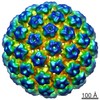 Human papillomavirus /
  Authors
 Citation
 Structure visualization
 Downloads & links
 EMDB map data format
 emd_66218.png
 https://data.pdbj.org/pub/emdb/structures/EMD-66218
 Z (Sec.)
 Y (Row.)
 X (Col.)


 Sample components
 Processing
 Electron microscopy
 FIELD EMISSION GUN
