 Movie
Movie Controller


+ Open data

- Basic information
| Entry |  | |||||||||
|---|---|---|---|---|---|---|---|---|---|---|
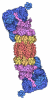
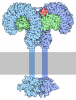
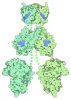
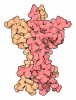
| Title | Structure of dimeric mouse NLRP14-KDM2A-SKP1 complex | |||||||||
 Map data Map data | ||||||||||
 Sample Sample |
| |||||||||
 Keywords Keywords | Cryo-EM / complex / NLRP14 / KDM2A / SKP1 / early embryonic development / CYTOSOLIC PROTEIN | |||||||||
| Function / homology |  Function and homology information Function and homology information[histone H3]-dimethyl-L-lysine36 demethylase / histone H3K36me/H3K36me2 demethylase activity / Prolactin receptor signaling / HDMs demethylate histones / neuroepithelial cell differentiation / SCF-beta-TrCP mediated degradation of Emi1 / Regulation of BACH1 activity / SCF(Skp2)-mediated degradation of p27/p21 / MAP3K8 (TPL2)-dependent MAPK1/3 activation / Regulation of RUNX2 expression and activity ...[histone H3]-dimethyl-L-lysine36 demethylase / histone H3K36me/H3K36me2 demethylase activity / Prolactin receptor signaling / HDMs demethylate histones / neuroepithelial cell differentiation / SCF-beta-TrCP mediated degradation of Emi1 / Regulation of BACH1 activity / SCF(Skp2)-mediated degradation of p27/p21 / MAP3K8 (TPL2)-dependent MAPK1/3 activation / Regulation of RUNX2 expression and activity / Degradation of GLI1 by the proteasome / GSK3B-mediated proteasomal degradation of PD-L1(CD274) / Cyclin D associated events in G1 / FBXL7 down-regulates AURKA during mitotic entry and in early mitosis / Orc1 removal from chromatin / GSK3B and BTRC:CUL1-mediated-degradation of NFE2L2 / Dectin-1 mediated noncanonical NF-kB signaling / NIK-->noncanonical NF-kB signaling / Degradation of beta-catenin by the destruction complex / Activation of NF-kappaB in B cells / Iron uptake and transport / CLEC7A (Dectin-1) signaling / FCERI mediated NF-kB activation / Interleukin-1 signaling / F-box domain binding / Downstream TCR signaling / histone H3K36 demethylase activity / GLI3 is processed to GLI3R by the proteasome / unmethylated CpG binding / Regulation of PLK1 Activity at G2/M Transition / Ubiquitin-Mediated Degradation of Phosphorylated Cdc25A / PcG protein complex / Neddylation / gap junction / maintenance of protein location in nucleus / positive regulation of epithelial cell apoptotic process / Cul7-RING ubiquitin ligase complex / Antigen processing: Ubiquitination & Proteasome degradation / ubiquitin ligase activator activity / heart looping / neural tube closure / multicellular organism growth / SCF ubiquitin ligase complex / SCF-dependent proteasomal ubiquitin-dependent protein catabolic process / histone demethylase activity / ubiquitin ligase complex scaffold activity / protein monoubiquitination / cullin family protein binding / ubiquitin-like ligase-substrate adaptor activity / protein K48-linked ubiquitination / in utero embryonic development / molecular function activator activity / transcription initiation-coupled chromatin remodeling / double-strand break repair via nonhomologous end joining / circadian regulation of gene expression / beta-catenin binding / regulation of circadian rhythm / transcription coregulator activity / protein polyubiquitination / neuron differentiation / cell differentiation / regulation of inflammatory response / spermatogenesis / ubiquitin-dependent protein catabolic process / proteasome-mediated ubiquitin-dependent protein catabolic process / protein ubiquitination / chromatin remodeling / apoptotic process / chromosome / negative regulation of gene expression / protein domain specific binding / centrosome / positive regulation of gene expression / regulation of transcription by RNA polymerase II / negative regulation of apoptotic process / chromatin / negative regulation of transcription by RNA polymerase II / zinc ion binding / nucleoplasm / ATP binding / nucleus / cytosol / cytoplasm Similarity search - Function | |||||||||
| Biological species |   Mus musculus (house mouse) Mus musculus (house mouse) | |||||||||
| Method | single particle reconstruction / cryo EM / Resolution: 3.35 Å | |||||||||
 Authors Authors | Liu S / Jiao H / Yan L / Qi Q / Chi P / Lu Y / Li JH / Li JL / Ju S / Wang X ...Liu S / Jiao H / Yan L / Qi Q / Chi P / Lu Y / Li JH / Li JL / Ju S / Wang X / Hu H / Deng D | |||||||||
| Funding support |  China, 1 items China, 1 items
| |||||||||
 Citation Citation | Journal: Nat Commun / Year: 2026 Title: NLRP14 modulates the activity of E3 ubiquitin ligases during the oocyte-to-embryo transition. Authors: Sibei Liu / Qianqian Qi / Pengliang Chi / Haizhan Jiao / Li Yan / Yuechao Lu / Rongrong Zhang / Jinhong Li / Sicheng Ju / Zhuo Han / Zihan Zhang / Qingting Liu / Guojin Ou / Jialu Li / Jing ...Authors: Sibei Liu / Qianqian Qi / Pengliang Chi / Haizhan Jiao / Li Yan / Yuechao Lu / Rongrong Zhang / Jinhong Li / Sicheng Ju / Zhuo Han / Zihan Zhang / Qingting Liu / Guojin Ou / Jialu Li / Jing Chen / Xiang Wang / Lei Li / Li Guo / Xue Jiao / Hongli Hu / Yongmei Jiang / Dong Deng / Abstract: NLRP14 is an essential maternal factor for mammalian embryonic development. Maternal ablation of NLRP14 in mice impairs DNA demethylation and calcium homeostasis in zygotes, causing early embryonic ...NLRP14 is an essential maternal factor for mammalian embryonic development. Maternal ablation of NLRP14 in mice impairs DNA demethylation and calcium homeostasis in zygotes, causing early embryonic arrest. However, the underlying biochemical events remain largely unknown. Here, we identified two binding partners (KDM2A and UHRF1) of NLRP14 and further solved structures of NLRP14-KDM2A-SKP1 and NLRP14-UHRF1. Structural analysis revealed that NLRP14 modulates the SKP1-CUL1-F-box (SCF) E3 ubiquitin ligase and the RING-type E3 ubiquitin ligase UHRF1 through two distinct mechanisms. Mechanistically, NLRP14 competitively inhibits KDM2A-mediated SCF assembly or allosterically inhibits the activity of UHRF1 by occupying the E2 ubiquitin-conjugating enzyme (UBE2D) binding site of the ubiquitin-like (UBL) domain. Deletion of NLRP14 in mice increases ubiquitination levels in oocytes during maturation and after fertilization. Collectively, our findings identify NLRP14 as a dual regulator that restrains E3 ubiquitin ligase-driven ubiquitination by limiting SCF complex assembly and attenuating UHRF1 activity. This regulatory role is required to prevent excessive protein ubiquitination and maintain proteostasis during the oocyte-to-embryo transition, thereby supporting early embryonic development. Our study uncovers maternal regulation of proteostasis in oocytes and suggests that dysregulating proteostasis is an important factor in the pathogenesis of reproductive disorders. | |||||||||
| History |
|
- Structure visualization
| Supplemental images |
|---|

- Downloads & links
-EMDB archive
| Map data | emd_66203.map.gz | 88.9 MB | EMDB map data format | |
|---|---|---|---|---|
| Header (meta data) | emd-66203-v30.xmlemd-66203.xml | 21.7 KB 21.7 KB | Display Display | EMDB header |
| FSC (resolution estimation) | emd_66203_fsc_1.xmlemd_66203_fsc_2.xml | 11.9 KB 11.9 KB | Display Display | FSC data file |
| Images |  emd_66203.png emd_66203.png | 71.3 KB | ||
| Filedesc metadata | emd-66203.cif.gz | 7.2 KB | ||
| Archive directory |  https://data.pdbj.org/pub/emdb/structures/EMD-66203ftp://data.pdbj.org/pub/emdb/structures/EMD-66203 https://data.pdbj.org/pub/emdb/structures/EMD-66203ftp://data.pdbj.org/pub/emdb/structures/EMD-66203 | HTTPS FTP |
-Related structure data
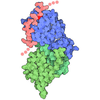
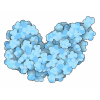
| Related structure data |  9wsqMC  9ln6C  9wsrC C: citing same article ( M: atomic model generated by this map |
|---|---|
| Similar structure data |


-Links
| EMDB pages | EMDB (EBI/PDBe) / EMDataResource |
|---|---|
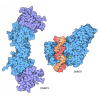
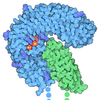
| Related items in Molecule of the Month |

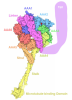
-Map
| File | Download / File: emd_66203.map.gz / Format: CCP4 / Size: 178 MB / Type: IMAGE STORED AS FLOATING POINT NUMBER (4 BYTES) | ||||||||||||||||||||||||||||||||||||
|---|---|---|---|---|---|---|---|---|---|---|---|---|---|---|---|---|---|---|---|---|---|---|---|---|---|---|---|---|---|---|---|---|---|---|---|---|---|
| Projections & slices | Image control
Images are generated by Spider. | ||||||||||||||||||||||||||||||||||||
| Voxel size | X=Y=Z: 0.85 Å | ||||||||||||||||||||||||||||||||||||
| Density |
| ||||||||||||||||||||||||||||||||||||
| Symmetry | Space group: 1 | ||||||||||||||||||||||||||||||||||||
| Details | EMDB XML:
|
 Z (Sec.)
 Y (Row.)
 X (Col.)


-Supplemental data
- Sample components
-Entire : Dimeric mouse NLRP14-KDM2A-SKP1 complex
| Entire | Name: Dimeric mouse NLRP14-KDM2A-SKP1 complex |
|---|---|
| Components |
|
-Supramolecule #1: Dimeric mouse NLRP14-KDM2A-SKP1 complex
| Supramolecule | Name: Dimeric mouse NLRP14-KDM2A-SKP1 complex / type: complex / ID: 1 / Parent: 0 / Macromolecule list: all |
|---|---|
| Source (natural) | Organism: Mus musculus (house mouse) |
-Macromolecule #1: Lysine-specific demethylase 2A
| Macromolecule | Name: Lysine-specific demethylase 2A / type: protein_or_peptide / ID: 1 / Details: KDM2A fused Strep tag at the N-terminal / Number of copies: 2 / Enantiomer: LEVO / EC number: [histone H3]-dimethyl-L-lysine36 demethylase |
|---|---|
| Source (natural) | Organism: Mus musculus (house mouse) |
| Molecular weight | Theoretical: 40.626574 KDa |
| Recombinant expression | Organism:  Homo sapiens (human) Homo sapiens (human) |
| Sequence | String: MWSHPQFEKG TIVPKLQAIT ASSANLRPNP RVLMQHCPAR NPQHGDEEGL GGEEEEEEEE EEDDSAEEGG AARLNGRGSW AQDGDESWM QREVWMSVFR YLSRKELCEC MRVCKTWYKW CCDKRLWTKI DLSRCKAIVP QALSGIIKRQ PVSLDLSWTN I SKKQLTWL ...String: MWSHPQFEKG TIVPKLQAIT ASSANLRPNP RVLMQHCPAR NPQHGDEEGL GGEEEEEEEE EEDDSAEEGG AARLNGRGSW AQDGDESWM QREVWMSVFR YLSRKELCEC MRVCKTWYKW CCDKRLWTKI DLSRCKAIVP QALSGIIKRQ PVSLDLSWTN I SKKQLTWL VNRLPGLKDL LLAGCSWSAV SALSTSSCPL LRTLDLRWAV GIKDPQIRDL LTPPTDKPGQ DNRSKLRNMT DF RLAGLDI TDATLRLIIR HMPLLSRLDL SHCSHLTDQS SNLLTAVGSS TRYSLTELNM AGCNKLTDQT LFFLRRIANV TLI DLRGCK QITRKACEHF ISDLSINSLY CLSDEKLIQK IS UniProtKB: Lysine-specific demethylase 2A |
-Macromolecule #2: S-phase kinase-associated protein 1
| Macromolecule | Name: S-phase kinase-associated protein 1 / type: protein_or_peptide / ID: 2 / Details: SKP1 fused Strep tag at the N-terminal / Number of copies: 2 / Enantiomer: LEVO |
|---|---|
| Source (natural) | Organism: Mus musculus (house mouse) |
| Molecular weight | Theoretical: 20.025492 KDa |
| Recombinant expression | Organism: Homo sapiens (human) |
| Sequence | String: MWSHPQFEKG TMPTIKLQSS DGEIFEVDVE IAKQSVTIKT MLEDLGMDDE GDDDPVPLPN VNAAILKKVI QWCTHHKDDP PPPEDDENK EKRTDDIPVW DQEFLKVDQG TLFELILAAN YLDIKGLLDV TCKTVANMIK GKTPEEIRKT FNIKNDFTEE E EAQVRKEN QWCEEK UniProtKB: S-phase kinase-associated protein 1 |
-Macromolecule #3: NACHT, LRR and PYD domains-containing protein 14
| Macromolecule | Name: NACHT, LRR and PYD domains-containing protein 14 / type: protein_or_peptide / ID: 3 / Details: NLRP14 fused Flag tag at the N-terminal / Number of copies: 2 / Enantiomer: LEVO |
|---|---|
| Source (natural) | Organism: Mus musculus (house mouse) |
| Molecular weight | Theoretical: 115.722227 KDa |
| Recombinant expression | Organism: Homo sapiens (human) |
| Sequence | String: DYKDDDDKGD YKDDDDKGSM KTEDDEMEYE ASKEETVSED KDFDDGIDYR TVIKENIFTM WYKTSLHGEF ATLNCVITPK DQNLLQHIF DEDIQTSEAP QTVVLQGAAG IGKTTLLKKA VLEWADGNLY QQFTHVFYLN GKEISQVKEK SFAQLISKHW P SSEGPIEQ ...String: DYKDDDDKGD YKDDDDKGSM KTEDDEMEYE ASKEETVSED KDFDDGIDYR TVIKENIFTM WYKTSLHGEF ATLNCVITPK DQNLLQHIF DEDIQTSEAP QTVVLQGAAG IGKTTLLKKA VLEWADGNLY QQFTHVFYLN GKEISQVKEK SFAQLISKHW P SSEGPIEQ VLSKPSSLLF IIDSFDELDF SFEEPQFALC KDWTQISPVS FLISSLLRKV MLPESYLLVA TRSTAWKRLV PL LQKPQRV KLSGLSKNAR MDYIHHLLKD KAWATSAIYS LRMNWRLFHM CHVCHMCQMI CAVLKGQVEK GGRVEETCKT STA LFTYYI CSLFPRIPVG CVTLPNETLL RSLCKAAVEG IWTMKHVLYQ QNLRKHELTR EDILLFLDAK VLQQDTEYEN CYMF THLHV QEFFAALFYL LRENLEEQDY PSEPFENLYL LLESNHIHDP HLEQMKCFLF GLLNKDRVRQ LEETFNLTIS MEVRE ELLA CLEGLEKDDS SLSQLRFQDL LHCIYETQDQ EFITQALMYF QKIIVRVDEE PQLRIYSFCL KHCHTLKTMR LTARAD LKN MLDTAEMCLE GAAVQVIHYW QDLFSVLHTN ESLIEMDLYE SRLDESLMKI LNEELSHPKC KLQKLIFRAV DFLNGCQ DF TFLASNKKVT HLDLKETDLG VNGLKTLCEA LKCKGCKLRV LRLASCDLNV ARCQKLSNAL QTNRSLVFLN LSLNNLSN D GVKSLCEVLE NPNSSLERLA LASCGLTKAG CKVLSSALTK SKRLTHLCLS DNVLEDEGIK LLSHTLKHPQ CTLQSLVLR SCSFTPIGSE HLSTALLHNR SLVHLDLGQN KLADNGVKLL CHSLQQPHCN LQELELMSCV LTSKACGDLA SVLVNNSNLW SLDLGHNIL DDAGLNILCD ALRNPNCHVQ RLGLENCGLT PGCCQDLLGI LSNNKSVIQM NLMKNALDHE SIKNLCKVLR S PTCKMEFL ALDKKEILKK KIKKFLVDVR INNPHLVIGP ECPNTESGCW WNYF UniProtKB: NACHT, LRR and PYD domains-containing protein 14 |
-Experimental details
-Structure determination
| Method | cryo EM |
|---|---|
 Processing Processing | single particle reconstruction |
| Aggregation state | particle |
-Sample preparation
| Concentration | 1.0 mg/mL |
|---|---|
| Buffer | pH: 8 |
| Vitrification | Cryogen name: ETHANE / Chamber humidity: 100 % |
- Electron microscopy
| Microscope | TFS KRIOS |
|---|---|
| Image recording | Film or detector model: GATAN K3 BIOQUANTUM (6k x 4k) / Average electron dose: 53.633 e/Å2 |
| Electron beam | Acceleration voltage: 300 kV / Electron source:  FIELD EMISSION GUN FIELD EMISSION GUN |
| Electron optics | C2 aperture diameter: 100.0 µm / Illumination mode: FLOOD BEAM / Imaging mode: BRIGHT FIELD / Cs: 2.7 mm / Nominal defocus max: 1.8 µm / Nominal defocus min: 1.2 µm / Nominal magnification: 105000 |
| Experimental equipment |  Model: Titan Krios / Image courtesy: FEI Company |

