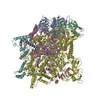
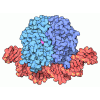
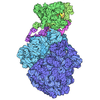
Journal: Nucleic Acids Res / Year: 2026 Title: Structural insights into σ28-dependent transcription initiation and its regulation by anti-sigma factor in Pseudomonas aeruginosa. Authors: Sheenu / Vineet Kumar / Pankaj Kumar Sahoo / Eaazhisai Kandiah / Deepti Jain / Abstract: Late flagellar genes in Pseudomonas aeruginosa are transcribed by the group 3 sigma factor, FliA (σ28). σ28 drives the expression of flagellin, which assembles into the flagellar filament in this ...Late flagellar genes in Pseudomonas aeruginosa are transcribed by the group 3 sigma factor, FliA (σ28). σ28 drives the expression of flagellin, which assembles into the flagellar filament in this monoflagellated bacterium. This function is suppressed by the anti-sigma factor FlgM. Here, we present the 1.95Å resolution crystal structure of σ28-FlgM complex, along with a 3.4Å structure of σ28RNAP open promoter complex determined using single particle cryo-electron microscopy from P. aeruginosa. The σ28 adopts a compact conformation upon binding to the anti-sigma factor FlgM, which contacts all three domains of the sigma factor. This conformation is neither conducive to interactions with RNA polymerase nor the promoter DNA. The cryo-EM structure reveals base-specific interactions of σ28 domain 4 (σ4) with -35 element, flipping of -11 base of the template strand, novel interactions of template strand with domain 2 (σ2) and 3 (σ3), and partial insertion of sigma finger into the active site cleft, offering unique features of group 3 sigma interactions with promoter DNA. Perturbation of key residues affects transcription in vitro and flagellar phenotypes as well as bacterial motility in vivo. Analysis of the structural data presented here reveals new insights into transcription regulation of late flagellar genes.
In the structure databanks used in Yorodumi, some data are registered as the other names, "COVID-19 virus" and "2019-nCoV". Here are the details of the virus and the list of structure data.
Jan 31, 2019. EMDB accession codes are about to change! (news from PDBe EMDB page)
EMDB accession codes are about to change! (news from PDBe EMDB page)
The allocation of 4 digits for EMDB accession codes will soon come to an end. Whilst these codes will remain in use, new EMDB accession codes will include an additional digit and will expand incrementally as the available range of codes is exhausted. The current 4-digit format prefixed with “EMD-” (i.e. EMD-XXXX) will advance to a 5-digit format (i.e. EMD-XXXXX), and so on. It is currently estimated that the 4-digit codes will be depleted around Spring 2019, at which point the 5-digit format will come into force.
The EM Navigator/Yorodumi systems omit the EMD- prefix.
Related info.:Q: What is EMD? / ID/Accession-code notation in Yorodumi/EM Navigator
Yorodumi is a browser for structure data from EMDB, PDB, SASBDB, etc.
This page is also the successor to EM Navigator detail page, and also detail information page/front-end page for Omokage search.
The word "yorodu" (or yorozu) is an old Japanese word meaning "ten thousand". "mi" (miru) is to see.
Related info.:EMDB / PDB / SASBDB / Comparison of 3 databanks / Yorodumi Search / Aug 31, 2016. New EM Navigator & Yorodumi / Yorodumi Papers / Jmol/JSmol / Function and homology information / Changes in new EM Navigator and Yorodumi
 Movie
Movie Controller

 Yorodumi
 Open data
 Basic information
 Map data
 Sample
 Keywords
 Function and homology information
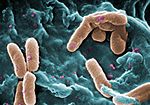 Pseudomonas aeruginosa (bacteria)
 Authors
 India, 2 items
  Citation
 Structure visualization
 Downloads & links
 emd_66199.png
 https://data.pdbj.org/pub/emdb/structures/EMD-66199


 X (Sec.)
 Y (Row.)
 Z (Col.)


 Sample components
 Escherichia coli (E. coli)
 Processing
 Electron microscopy
 FIELD EMISSION GUN