 Movie
Movie Controller

[English] 日本語
 Yorodumi
- EMDB-66011: Structural Analysis of a Plant Glycoside Hydrolase Family 116 Glu... -
+ Open data

- Basic information
| Entry |  | |||||||||
|---|---|---|---|---|---|---|---|---|---|---|
| Title | Structural Analysis of a Plant Glycoside Hydrolase Family 116 Glucosyl Ceramidase by Cryogenic Electron Microscopy (Cryo-EM) | |||||||||
 Map data Map data | ||||||||||
 Sample Sample |
| |||||||||
 Keywords Keywords | Glucosylceramide / AtGCD3 / plant / GH116 / GBA2 / glucosylceramidase / HYDROLASE | |||||||||
| Function / homology |  Function and homology information Function and homology informationglucosylceramidase / glucosylceramide catabolic process / glucosylceramidase activity / sphingolipid metabolic process / plant-type vacuole / beta-glucosidase activity / carbohydrate metabolic process / endoplasmic reticulum / plasma membrane Similarity search - Function | |||||||||
| Biological species |   Arabidopsis thaliana (thale cress) Arabidopsis thaliana (thale cress) | |||||||||
| Method | single particle reconstruction / cryo EM / Resolution: 4.9 Å | |||||||||
 Authors Authors | Choknud S / Rungsarityotin W / Ounjai P / Mo-mai P / Wangkanont K / Arthanareeswaran K / Beagbandee C / Ketudat-Cairns JR | |||||||||
| Funding support |  Thailand, 1 items Thailand, 1 items
| |||||||||
 Citation Citation | Journal: Int J Biol Macromol / Year: 2026 Title: Structural analysis of the plant glycoside hydrolase family 116 glucosylceramidase AtGCD3 by cryogenic electron microscopy. Authors: Sunaree Choknud / Karunambigai Arthanareeswaran / Wasinee Rungsarityotin / Chamaipon Beagbandee / Surapoj Sanram / Nuntaporn Kamonsutthipaijit / Pornphawit Mo-Mai / Rung-Yi Lai / Wipa ...Authors: Sunaree Choknud / Karunambigai Arthanareeswaran / Wasinee Rungsarityotin / Chamaipon Beagbandee / Surapoj Sanram / Nuntaporn Kamonsutthipaijit / Pornphawit Mo-Mai / Rung-Yi Lai / Wipa Suginta / Kittikhun Wangkanont / Puey Ounjai / James R Ketudat Cairns / Abstract: Glucosylceramide (GlcCer) is a common glycosphingolipid that accumulates in cells in response to Gaucher disease, diabetes, and skin disorders in humans and is also found in plants. In animals, ...Glucosylceramide (GlcCer) is a common glycosphingolipid that accumulates in cells in response to Gaucher disease, diabetes, and skin disorders in humans and is also found in plants. In animals, GlcCer is catabolized by glucosylcerebrosidase 1 and 2 (GBA1 and GBA2). GBA1 is a lysosomal enzyme in glycoside hydrolase (GH) family GH30, while GBA2 is a membrane-associated cytoplasmic protein in family GH116. Currently, there are no experimental structures of eukaryotic GH116 homologues. Although the bacterial TxGH116 β-glucosidase structure was determined by X-ray crystallography, TxGH116 does not hydrolyze glucosylceramides, unlike the animal and plant enzymes. Therefore, we have investigated the structure of plant GH116 (AtGCD3) by cryogenic electron microscopy (Cryo-EM) single-particle analysis. The recombinant AtGCD3 protein was produced in Escherichia coli and purified by immobilized-metal affinity chromatography followed by size-exclusion chromatography. The Cryo-EM structure revealed a unique hexameric arrangement, composed of a dimer of trimers. Hydrophobic interactions and hydrogen bonds stabilize each trimer at the trimer interface. The two trimers stack face-to-face with a slight twist, with salt bridges and hydrogen bonding at their interface. Two α-helices not found in previously described GH116 structures cover the active site, forming two hydrophobic channels that may be involved in glucosylceramide binding. Molecular dynamics simulations showed that glucosylceramide can bind stably in the active site with its lipid tails in these channels. This first eukaryotic structure of a GH116 enzyme generates a template for improved modeling of human GBA2, with implications for treating human diseases, such as Gaucher disease and hereditary spastic paraplegia. | |||||||||
| History |
|
- Structure visualization
| Supplemental images |
|---|

- Downloads & links
-EMDB archive
| Map data | emd_66011.map.gz | 134.8 MB | EMDB map data format | |
|---|---|---|---|---|
| Header (meta data) | emd-66011-v30.xmlemd-66011.xml | 22 KB 22 KB | Display Display | EMDB header |
| FSC (resolution estimation) | emd_66011_fsc.xml | 19.1 KB | Display | FSC data file |
| Images |  emd_66011.png emd_66011.png | 121.1 KB | ||
| Masks | emd_66011_msk_1.map | 274.6 MB | Mask map | |
| Filedesc metadata | emd-66011.cif.gz | 6.9 KB | ||
| Others | emd_66011_half_map_1.map.gzemd_66011_half_map_2.map.gz | 255 MB 255 MB | ||
| Archive directory |  http://ftp.pdbj.org/pub/emdb/structures/EMD-66011ftp://ftp.pdbj.org/pub/emdb/structures/EMD-66011 http://ftp.pdbj.org/pub/emdb/structures/EMD-66011ftp://ftp.pdbj.org/pub/emdb/structures/EMD-66011 | HTTPS FTP |
-Related structure data
| Related structure data |  9wizMC M: atomic model generated by this map C: citing same article ( |
|---|---|
| Similar structure data |
-Links
| EMDB pages | EMDB (EBI/PDBe) / EMDataResource |
|---|---|
| Related items in Molecule of the Month |
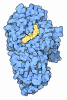
-Map
| File | Download / File: emd_66011.map.gz / Format: CCP4 / Size: 274.6 MB / Type: IMAGE STORED AS FLOATING POINT NUMBER (4 BYTES) | ||||||||||||||||||||||||||||||||||||
|---|---|---|---|---|---|---|---|---|---|---|---|---|---|---|---|---|---|---|---|---|---|---|---|---|---|---|---|---|---|---|---|---|---|---|---|---|---|
| Projections & slices | Image control
Images are generated by Spider. | ||||||||||||||||||||||||||||||||||||
| Voxel size | X=Y=Z: 0.95 Å | ||||||||||||||||||||||||||||||||||||
| Density |
| ||||||||||||||||||||||||||||||||||||
| Symmetry | Space group: 1 | ||||||||||||||||||||||||||||||||||||
| Details | EMDB XML:
|
 Z (Sec.)
 Y (Row.)
 X (Col.)


-Supplemental data
-Mask #1
| File | emd_66011_msk_1.map | ||||||||||||
|---|---|---|---|---|---|---|---|---|---|---|---|---|---|
| Projections & Slices |
| ||||||||||||
| Density Histograms |


-Half map: #2
| File | emd_66011_half_map_1.map | ||||||||||||
|---|---|---|---|---|---|---|---|---|---|---|---|---|---|
| Projections & Slices |
| ||||||||||||
| Density Histograms |


-Half map: #1
| File | emd_66011_half_map_2.map | ||||||||||||
|---|---|---|---|---|---|---|---|---|---|---|---|---|---|
| Projections & Slices |
| ||||||||||||
| Density Histograms |


- Sample components
-Entire : Plant Glycoside Hydrolase Family 116 Glucosyl Ceramidase Hexameri...
| Entire | Name: Plant Glycoside Hydrolase Family 116 Glucosyl Ceramidase Hexameric Complex |
|---|---|
| Components |
|
-Supramolecule #1: Plant Glycoside Hydrolase Family 116 Glucosyl Ceramidase Hexameri...
| Supramolecule | Name: Plant Glycoside Hydrolase Family 116 Glucosyl Ceramidase Hexameric Complex type: complex / ID: 1 / Parent: 0 / Macromolecule list: all |
|---|---|
| Source (natural) | Organism: Arabidopsis thaliana (thale cress) |
-Macromolecule #1: Non-lysosomal glucosylceramidase
| Macromolecule | Name: Non-lysosomal glucosylceramidase / type: protein_or_peptide / ID: 1 / Number of copies: 6 / Enantiomer: LEVO / EC number: glucosylceramidase |
|---|---|
| Source (natural) | Organism: Arabidopsis thaliana (thale cress) |
| Molecular weight | Theoretical: 104.640656 KDa |
| Recombinant expression | Organism:   Escherichia coli BL21(DE3) (bacteria) Escherichia coli BL21(DE3) (bacteria) |
| Sequence | String: GGGMEKNGHT ESELQTQMVG NERLPQVTWQ RKLNSKVKNP SEFKMSIRDV LHLFPLGYRL WRYTKEEAKK GRFSMYDIFK KRHVRGDHG VPLGGIGGGS IGRSYKGEFQ QFKLFPKICE EAPILTNQFS VFVSRPGGLS YSTVLCPTKP KSVKGKTEDL G IESWDWNM ...String: GGGMEKNGHT ESELQTQMVG NERLPQVTWQ RKLNSKVKNP SEFKMSIRDV LHLFPLGYRL WRYTKEEAKK GRFSMYDIFK KRHVRGDHG VPLGGIGGGS IGRSYKGEFQ QFKLFPKICE EAPILTNQFS VFVSRPGGLS YSTVLCPTKP KSVKGKTEDL G IESWDWNM EGDKSTYHAL YPRSWTVYNE PDPELRIVSR QVSPFIPHNY KESSLPVSVF EFTMSNLGKE EATVTLLFTW EN SVGGASG LTGEHFNSTI MERDGVHAIV LHHKTGNGHP PVTYAIAAQE TEDVHVSECP CFLVSGHSPK EITAKEMWDE IKK NKSFDE LNSEPGSPSR PGTSIGAAIA AKVKVPPGCD RTVTFSLSWD CPEVRFNEKT YHRRYTKFYG NLGDAAVKMA RDAL LNYVD WESQIEAWQS PILSDTTLPD WYRVTLFNEL YYFNSGGTIW TDGLPPKESI ERSKVTNTEQ NDIVIDLFQK INAVC EQIY SPQSSNSEEN IGQFIYLEGI EYLMYNTYDV HFYSSFALLS LFPKLALSIQ RDFAATVLIQ DPTKKKIMSS GEWVTR KLL GSVPHDIGLN DPWLELNEYN FFNTDRWKDL NAKFVLQVYR DVVATNDQSF AKAVWPSVYT AVAYLDQFDK DEDGMIE NE GFPDQTYDAW SVTGVSAYCG GLWVAALQAA SAFASIVGEN AVAIYFNAKY EKAKIVYEKL WNGSYFNYDD SGSGSSSS I LADQLAGQWY ARACGLKPIT KEEWIKKALE TIYEFNVMKV KGGTRGAVNG MSTEGKVDTN SLVSKEVWAG TTYSVAACM IQEGQREKGF QTASGIYEAI WSDRGLSCSF QTPEAWNMND EYRSLCYMRP LAIWAIQWAL TRTQSFGEEK QKLVAGDEEE ESNLLLRQH KGFKDVARFV KIVPTSNVHR SRLQHTYETV LKTLRL UniProtKB: Non-lysosomal glucosylceramidase |
-Experimental details
-Structure determination
| Method | cryo EM |
|---|---|
 Processing Processing | single particle reconstruction |
| Aggregation state | particle |
-Sample preparation
| Concentration | 0.1 mg/mL | ||||||||||||||||||
|---|---|---|---|---|---|---|---|---|---|---|---|---|---|---|---|---|---|---|---|
| Buffer | pH: 7.5 Component:
Details: 50mM potassium phosphate, 150mM KCl, 1mM DTT, 1mM EDTA, 10% glycerol | ||||||||||||||||||
| Grid | Model: EMS Lacey Carbon / Material: COPPER / Mesh: 300 / Support film - Material: CARBON / Support film - topology: HOLEY / Support film - Film thickness: 1200 / Pretreatment - Type: GLOW DISCHARGE / Pretreatment - Time: 10 sec. | ||||||||||||||||||
| Vitrification | Cryogen name: ETHANE / Chamber temperature: 274 K / Instrument: FEI VITROBOT MARK IV |
- Electron microscopy
| Microscope | TFS GLACIOS |
|---|---|
| Image recording | Film or detector model: FEI FALCON III (4k x 4k) / Average electron dose: 38.64 e/Å2 |
| Electron beam | Acceleration voltage: 200 kV / Electron source:  FIELD EMISSION GUN FIELD EMISSION GUN |
| Electron optics | Illumination mode: OTHER / Imaging mode: BRIGHT FIELD / Cs: 2.7 mm / Nominal defocus max: 3.9 µm / Nominal defocus min: 1.5 µm / Nominal magnification: 150000 |
| Sample stage | Cooling holder cryogen: NITROGEN |
+Image processing

-Atomic model buiding 1
| Initial model | Chain - Source name: AlphaFold / Chain - Initial model type: in silico model |
|---|---|
| Software | Name: UCSF ChimeraX (ver. 1.10) |
| Refinement | Space: REAL / Protocol: AB INITIO MODEL |
| Output model | PDB-9wiz: |
