Movie
Movie Controller

[English] 日本語
 Yorodumi
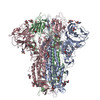
- EMDB-65803: Immune complex of P5-1C8 Fab binding the RBD of Omicron JN.1 6p s... -
+ Open data

- Basic information
| Entry |  | |||||||||
|---|---|---|---|---|---|---|---|---|---|---|
| Title | Immune complex of P5-1C8 Fab binding the RBD of Omicron JN.1 6p spike protein | |||||||||
 Map data Map data | Immune complex of P5-1C8 Fab binding the RBD of Omicron JN.1 6p spike protein | |||||||||
 Sample Sample |
| |||||||||
 Keywords Keywords | SARS-CoV-2 / antibody / complex / RBD / VIRAL PROTEIN | |||||||||
| Biological species |   Severe acute respiratory syndrome coronavirus 2 / Severe acute respiratory syndrome coronavirus 2 /  Homo sapiens (human) Homo sapiens (human) | |||||||||
| Method | single particle reconstruction / negative staining / Resolution: 25.0 Å | |||||||||
 Authors Authors | Lv NN / Yang RY | |||||||||
| Funding support | 2 items
| |||||||||
 Citation Citation | Journal: Adv Sci (Weinh) / Year: 2026 Title: IgG-Bridging-Seeded Synergistic Aggregation of SARS-CoV-2 Spikes Underlies Potent Neutralization by a Low-Affinity Antibody. Authors: Niannian Lv / Peng Chen / Xiaobin Dai / Hu Xu / Ziheng Li / Zelin Shan / Jinqian Li / Fenglin Guo / Yuanfang Chen / Jiayi Li / Yiqian Huang / Guizhi Dong / Yifan Jiang / Liang Chen / Xuanyu ...Authors: Niannian Lv / Peng Chen / Xiaobin Dai / Hu Xu / Ziheng Li / Zelin Shan / Jinqian Li / Fenglin Guo / Yuanfang Chen / Jiayi Li / Yiqian Huang / Guizhi Dong / Yifan Jiang / Liang Chen / Xuanyu Nan / Hanjun Zhao / Kang Zhang / Shilong Fan / Yuanchen Dong / Dongsheng Liu / Xinquan Wang / Deli Huang / Xiaojing Pan / Chunying Chen / Zhihua Liu / Li-Tang Yan / Qi Zhang / Linqi Zhang / Yuliang Zhao / Yuhe Renee Yang /   Abstract: Mechanistic studies of viral neutralization typically prioritize high-affinity antibodies, relegating low-affinity binders to the sidelines. P5‑1C8, a Class 1 SARS-CoV-2 antibody that exemplifies ...Mechanistic studies of viral neutralization typically prioritize high-affinity antibodies, relegating low-affinity binders to the sidelines. P5‑1C8, a Class 1 SARS-CoV-2 antibody that exemplifies this underexplored "low‑affinity yet high‑potency" phenotype is reported, retaining strong neutralization of Omicron JN.1 despite markedly weakened trimer binding (K = 225 nM; IC = 0.06 nM). Structural and biophysical analyses reveal that P5-1C8 engages WT and BA.1 spikes through canonical intra-spike bivalency, but with JN.1 it induces aggregation. Using virion-like nanoparticles displaying multiple spikes, it is shown that IgG remains bound with no detectable dissociation and triggers pronounced aggregation. Coarse-grained molecular dynamics delineate the stepwise pathway in which weak IgG-spike contacts seed aggregation via transient inter-spike bridging. Together, these findings establish the first mechanistic framework demonstrating how weak-binding antibodies can nonetheless achieve potent neutralization through higher-order aggregation, thereby expanding the conceptual landscape of antibody function and opening new directions for antibody evaluation and design. | |||||||||
| History |
|
- Structure visualization
| Supplemental images |
|---|

- Downloads & links
-EMDB archive
| Map data | emd_65803.map.gz | 20.7 MB |  EMDB map data format EMDB map data format | |
|---|---|---|---|---|
| Header (meta data) | emd-65803-v30.xmlemd-65803.xml | 16.9 KB 16.9 KB | Display Display | EMDB header |
| Images |  emd_65803.png emd_65803.png | 13.8 KB | ||
| Filedesc metadata | emd-65803.cif.gz | 4.4 KB | ||
| Others | emd_65803_half_map_1.map.gzemd_65803_half_map_2.map.gz | 20.7 MB 20.7 MB | ||
| Archive directory |  https://data.pdbj.org/pub/emdb/structures/EMD-65803ftp://data.pdbj.org/pub/emdb/structures/EMD-65803 https://data.pdbj.org/pub/emdb/structures/EMD-65803ftp://data.pdbj.org/pub/emdb/structures/EMD-65803 | HTTPS FTP |
-Related structure data


-Links
| EMDB pages | EMDB (EBI/PDBe) / EMDataResource |
|---|
-Map
| File | Download / File: emd_65803.map.gz / Format: CCP4 / Size: 27 MB / Type: IMAGE STORED AS FLOATING POINT NUMBER (4 BYTES) | ||||||||||||||||||||||||||||||||||||
|---|---|---|---|---|---|---|---|---|---|---|---|---|---|---|---|---|---|---|---|---|---|---|---|---|---|---|---|---|---|---|---|---|---|---|---|---|---|
| Annotation | Immune complex of P5-1C8 Fab binding the RBD of Omicron JN.1 6p spike protein | ||||||||||||||||||||||||||||||||||||
| Projections & slices | Image control
Images are generated by Spider. | ||||||||||||||||||||||||||||||||||||
| Voxel size | X=Y=Z: 2.21 Å | ||||||||||||||||||||||||||||||||||||
| Density |
| ||||||||||||||||||||||||||||||||||||
| Symmetry | Space group: 1 | ||||||||||||||||||||||||||||||||||||
| Details | EMDB XML:
|
 Z (Sec.)
 Y (Row.)
 X (Col.)


-Supplemental data
-Half map: Immune complex of P5-1C8 Fab binding the RBD...
| File | emd_65803_half_map_1.map | ||||||||||||
|---|---|---|---|---|---|---|---|---|---|---|---|---|---|
| Annotation | Immune complex of P5-1C8 Fab binding the RBD of Omicron JN.1 6p spike protein | ||||||||||||
| Projections & Slices |
| ||||||||||||
| Density Histograms |


-Half map: Immune complex of P5-1C8 Fab binding the RBD...
| File | emd_65803_half_map_2.map | ||||||||||||
|---|---|---|---|---|---|---|---|---|---|---|---|---|---|
| Annotation | Immune complex of P5-1C8 Fab binding the RBD of Omicron JN.1 6p spike protein | ||||||||||||
| Projections & Slices |
| ||||||||||||
| Density Histograms |


- Sample components
-Entire : SARS-CoV-2 WT 6p in complex with P5-1C8 IgG
| Entire | Name: SARS-CoV-2 WT 6p in complex with P5-1C8 IgG |
|---|---|
| Components |
|
-Supramolecule #1: SARS-CoV-2 WT 6p in complex with P5-1C8 IgG
| Supramolecule | Name: SARS-CoV-2 WT 6p in complex with P5-1C8 IgG / type: complex / ID: 1 / Parent: 0 Details: Immune complex of P5-1C8 IgG binding the RBD of SARS-CoV-2 WT 6p spike protein |
|---|---|
| Source (natural) | Organism: Severe acute respiratory syndrome coronavirus 2 |
-Supramolecule #2: Omicron JN.1 6p
| Supramolecule | Name: Omicron JN.1 6p / type: complex / ID: 2 / Parent: 1 / Details: Omicron JN.1 6p spike protein |
|---|---|
| Source (natural) | Organism: Severe acute respiratory syndrome coronavirus 2 |
-Supramolecule #3: P5-1C8 Fab
| Supramolecule | Name: P5-1C8 Fab / type: complex / ID: 3 / Parent: 1 / Details: P5-1C8 Fab |
|---|---|
| Source (natural) | Organism: Homo sapiens (human) |
-Experimental details
-Structure determination
| Method | negative staining |
|---|---|
 Processing Processing | single particle reconstruction |
| Aggregation state | particle |
-Sample preparation
| Buffer | pH: 7.4 |
|---|---|
| Staining | Type: NEGATIVE / Material: Uranyl Acetate |
- Electron microscopy
| Microscope | JEOL 2100F |
|---|---|
| Image recording | Film or detector model: OTHER / Average electron dose: 25.0 e/Å2 |
| Electron beam | Acceleration voltage: 200 kV / Electron source:  FIELD EMISSION GUN FIELD EMISSION GUN |
| Electron optics | Illumination mode: FLOOD BEAM / Imaging mode: BRIGHT FIELD / Cs: 2.7 mm / Nominal defocus max: 1.5 µm / Nominal defocus min: 1.5 µm |