 Movie
Movie Controller

[English] 日本語
 Yorodumi
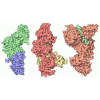
- EMDB-65621: The structure of odorant-bound mouse class II odorant receptor-mi... -
+ Open data

- Basic information
| Entry |  | |||||||||
|---|---|---|---|---|---|---|---|---|---|---|
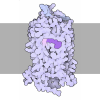
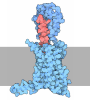
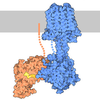
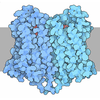
| Title | The structure of odorant-bound mouse class II odorant receptor-miniGs complex | |||||||||
 Map data Map data | Composite map | |||||||||
 Sample Sample |
| |||||||||
 Keywords Keywords | Odorant receptor / MEMBRANE PROTEIN / MEMBRANE PROTEIN-IMMUNE SYSTEM complex | |||||||||
| Function / homology |  Function and homology information Function and homology informationOlfactory Signaling Pathway / olfactory receptor activity / G protein-coupled receptor activity / G-protein beta/gamma-subunit complex binding / Olfactory Signaling Pathway / Activation of the phototransduction cascade / G protein-coupled acetylcholine receptor signaling pathway / sensory perception of smell / G beta:gamma signalling through PLC beta / Presynaptic function of Kainate receptors ...Olfactory Signaling Pathway / olfactory receptor activity / G protein-coupled receptor activity / G-protein beta/gamma-subunit complex binding / Olfactory Signaling Pathway / Activation of the phototransduction cascade / G protein-coupled acetylcholine receptor signaling pathway / sensory perception of smell / G beta:gamma signalling through PLC beta / Presynaptic function of Kainate receptors / Thromboxane signalling through TP receptor / Activation of G protein gated Potassium channels / Inhibition of voltage gated Ca2+ channels via Gbeta/gamma subunits / G-protein activation / Glucagon signaling in metabolic regulation / G beta:gamma signalling through CDC42 / Prostacyclin signalling through prostacyclin receptor / Synthesis, secretion, and inactivation of Glucagon-like Peptide-1 (GLP-1) / photoreceptor disc membrane / G beta:gamma signalling through BTK / ADP signalling through P2Y purinoceptor 12 / Sensory perception of sweet, bitter, and umami (glutamate) taste / Glucagon-type ligand receptors / Adrenaline,noradrenaline inhibits insulin secretion / Vasopressin regulates renal water homeostasis via Aquaporins / G alpha (z) signalling events / Glucagon-like Peptide-1 (GLP1) regulates insulin secretion / cellular response to catecholamine stimulus / ADP signalling through P2Y purinoceptor 1 / G beta:gamma signalling through PI3Kgamma / ADORA2B mediated anti-inflammatory cytokines production / adenylate cyclase-activating dopamine receptor signaling pathway / cellular response to prostaglandin E stimulus / Cooperation of PDCL (PhLP1) and TRiC/CCT in G-protein beta folding / GPER1 signaling / heterotrimeric G-protein complex / Inactivation, recovery and regulation of the phototransduction cascade / G alpha (12/13) signalling events / G-protein beta-subunit binding / extracellular vesicle / Thrombin signalling through proteinase activated receptors (PARs) / signaling receptor complex adaptor activity / GTPase binding / Ca2+ pathway / High laminar flow shear stress activates signaling by PIEZO1 and PECAM1:CDH5:KDR in endothelial cells / G alpha (i) signalling events / G alpha (s) signalling events / G alpha (q) signalling events / Ras protein signal transduction / Extra-nuclear estrogen signaling / G protein-coupled receptor signaling pathway / lysosomal membrane / GTPase activity / synapse / GTP binding / protein-containing complex binding / signal transduction / extracellular exosome / membrane / metal ion binding / identical protein binding / plasma membrane / cytosol / cytoplasm Similarity search - Function | |||||||||
| Biological species |  Homo sapiens (human) / Homo sapiens (human) /   Lama glama (llama) / Lama glama (llama) /  Mus musculus (house mouse) Mus musculus (house mouse) | |||||||||
| Method | single particle reconstruction / cryo EM / Resolution: 3.2 Å | |||||||||
 Authors Authors | Choi CW / Gil MS / Choi H-J | |||||||||
| Funding support |  Korea, Republic Of, 2 items Korea, Republic Of, 2 items
| |||||||||
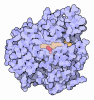
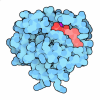
 Citation Citation | Journal: Sci Adv / Year: 2026 Title: Structural basis of odorant recognition by a mammalian class II odorant receptor. Authors: Minsu Gil / Chulwon Choi / Minseok Kim / Minsik Bae / Hajin Lee / Intae Choi / Wonpil Im / Hee-Jung Choi /  Abstract: Mammalian odorant receptors (ORs) sense diverse environmental chemicals, yet structural insights into odorant recognition by mammalian class II ORs remain limited. Here, we present the cryo-EM ...Mammalian odorant receptors (ORs) sense diverse environmental chemicals, yet structural insights into odorant recognition by mammalian class II ORs remain limited. Here, we present the cryo-EM structure of a native mammalian class II OR, mouse Olfr412, a human OR1D2 ortholog, bound to the odorant methyl--cinnamate and the G protein. The odorant-binding pocket of Olfr412 is located deeper within the transmembrane domain than that of the class I OR OR51E2 and is largely composed of poorly conserved hydrophobic residues, providing a structural basis for broad odorant recognition in class II ORs. Structural and molecular dynamics analyses suggest that the conserved Y plays a key role in odorant recognition and activation, functionally paralleling R in class I ORs and is further stabilized by intramolecular interaction with the conserved ECL2 residue E. Together, our findings uncover structural mechanisms underlying odorant recognition and activation in class II ORs. | |||||||||
| History |
|
- Structure visualization
| Supplemental images |
|---|

- Downloads & links
-EMDB archive
| Map data | emd_65621.map.gz | 229.4 MB | EMDB map data format | |
|---|---|---|---|---|
| Header (meta data) | emd-65621-v30.xmlemd-65621.xml | 22.1 KB 22.1 KB | Display Display | EMDB header |
| Images |  emd_65621.png emd_65621.png | 139.5 KB | ||
| Filedesc metadata | emd-65621.cif.gz | 7 KB | ||
| Archive directory |  http://ftp.pdbj.org/pub/emdb/structures/EMD-65621ftp://ftp.pdbj.org/pub/emdb/structures/EMD-65621 http://ftp.pdbj.org/pub/emdb/structures/EMD-65621ftp://ftp.pdbj.org/pub/emdb/structures/EMD-65621 | HTTPS FTP |
-Related structure data
| Related structure data |  9w45MC C: citing same article ( M: atomic model generated by this map |
|---|---|
| Similar structure data |


-Links
| EMDB pages | EMDB (EBI/PDBe) / EMDataResource |
|---|---|
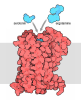
| Related items in Molecule of the Month |
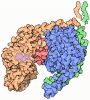

-Map
| File | Download / File: emd_65621.map.gz / Format: CCP4 / Size: 244.1 MB / Type: IMAGE STORED AS FLOATING POINT NUMBER (4 BYTES) | ||||||||||||||||||||||||||||||||||||
|---|---|---|---|---|---|---|---|---|---|---|---|---|---|---|---|---|---|---|---|---|---|---|---|---|---|---|---|---|---|---|---|---|---|---|---|---|---|
| Annotation | Composite map | ||||||||||||||||||||||||||||||||||||
| Projections & slices | Image control
Images are generated by Spider. | ||||||||||||||||||||||||||||||||||||
| Voxel size | X=Y=Z: 0.828 Å | ||||||||||||||||||||||||||||||||||||
| Density |
| ||||||||||||||||||||||||||||||||||||
| Symmetry | Space group: 1 | ||||||||||||||||||||||||||||||||||||
| Details | EMDB XML:
|
 Z (Sec.)
 Y (Row.)
 X (Col.)




-Supplemental data
- Sample components
+Entire : Complex of Odorant-bound Olfr412 and heterotrimeric G protein
+Supramolecule #1: Complex of Odorant-bound Olfr412 and heterotrimeric G protein
+Supramolecule #2: mini G
+Supramolecule #3: G protein
+Supramolecule #4: nanobody
+Supramolecule #5: receptor
+Macromolecule #1: Guanine nucleotide-binding protein G(s) subunit alpha
+Macromolecule #2: Guanine nucleotide-binding protein G(I)/G(S)/G(T) subunit beta-1

 Spodoptera frugiperda (fall armyworm)
+Macromolecule #3: Guanine nucleotide-binding protein G(I)/G(S)/G(O) subunit gamma-2
+Macromolecule #4: Nanobody 35

 Escherichia coli (E. coli)
+Macromolecule #5: Olfactory receptor
+Macromolecule #6: Methyl cinnamate
-Experimental details
-Structure determination
| Method | cryo EM |
|---|---|
 Processing Processing | single particle reconstruction |
| Aggregation state | particle |
-Sample preparation
| Buffer | pH: 8 |
|---|---|
| Vitrification | Cryogen name: ETHANE |
- Electron microscopy
| Microscope | TFS KRIOS |
|---|---|
| Image recording | Film or detector model: GATAN K3 BIOQUANTUM (6k x 4k) / Average electron dose: 62.2 e/Å2 |
| Electron beam | Acceleration voltage: 300 kV / Electron source:  FIELD EMISSION GUN FIELD EMISSION GUN |
| Electron optics | Illumination mode: OTHER / Imaging mode: OTHER / Nominal defocus max: 1.7 µm / Nominal defocus min: 0.8 µm |
| Experimental equipment |  Model: Titan Krios / Image courtesy: FEI Company |
