 Movie
Movie Controller

[English] 日本語
 Yorodumi
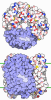
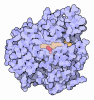
- EMDB-65549: Cryo-EM structure of neurokinin A (NKA)-bound neurokinin 2 recept... -
+ Open data

- Basic information
| Entry |  | |||||||||
|---|---|---|---|---|---|---|---|---|---|---|
| Title | Cryo-EM structure of neurokinin A (NKA)-bound neurokinin 2 receptor (NK2R) in complex with miniGs/q70 | |||||||||
 Map data Map data | ||||||||||
 Sample Sample |
| |||||||||
 Keywords Keywords | GPCR / Neurokinin A (NKA) / Neurokinin 2 Receptor (NK2R) / Active State / MEMBRANE PROTEIN | |||||||||
| Function / homology |  Function and homology information Function and homology informationsubstance K receptor activity / positive regulation of corticosterone secretion / prolactin secretion / substance P receptor binding / tachykinin receptor activity / positive regulation of flagellated sperm motility / intestine smooth muscle contraction / insemination / Tachykinin receptors bind tachykinins / positive regulation of uterine smooth muscle contraction ...substance K receptor activity / positive regulation of corticosterone secretion / prolactin secretion / substance P receptor binding / tachykinin receptor activity / positive regulation of flagellated sperm motility / intestine smooth muscle contraction / insemination / Tachykinin receptors bind tachykinins / positive regulation of uterine smooth muscle contraction / positive regulation of monoatomic ion transport / detection of abiotic stimulus / positive regulation of acute inflammatory response / operant conditioning / positive regulation of lymphocyte proliferation / tachykinin receptor signaling pathway / sperm head / negative regulation of luteinizing hormone secretion / phospholipase C-activating tachykinin receptor signaling pathway / positive regulation of action potential / positive regulation of smooth muscle contraction / positive regulation of synaptic transmission, GABAergic / positive regulation of acetylcholine secretion, neurotransmission / positive regulation of vascular permeability / positive regulation of ossification / positive regulation of synaptic transmission, cholinergic / negative regulation of heart rate / positive regulation of epithelial cell migration / associative learning / response to electrical stimulus / positive regulation of stress fiber assembly / long-term memory / sperm flagellum / neuronal dense core vesicle / response to hormone / muscle contraction / sperm midpiece / regulation of blood pressure / Olfactory Signaling Pathway / Activation of the phototransduction cascade / G protein-coupled acetylcholine receptor signaling pathway / G beta:gamma signalling through PLC beta / Presynaptic function of Kainate receptors / Thromboxane signalling through TP receptor / Activation of G protein gated Potassium channels / Inhibition of voltage gated Ca2+ channels via Gbeta/gamma subunits / G-protein activation / Glucagon signaling in metabolic regulation / G beta:gamma signalling through CDC42 / Prostacyclin signalling through prostacyclin receptor / Synthesis, secretion, and inactivation of Glucagon-like Peptide-1 (GLP-1) / photoreceptor disc membrane / G beta:gamma signalling through BTK / ADP signalling through P2Y purinoceptor 12 / Sensory perception of sweet, bitter, and umami (glutamate) taste / Glucagon-type ligand receptors / Adrenaline,noradrenaline inhibits insulin secretion / cell-cell signaling / Vasopressin regulates renal water homeostasis via Aquaporins / G alpha (z) signalling events / Glucagon-like Peptide-1 (GLP1) regulates insulin secretion / ADP signalling through P2Y purinoceptor 1 / cellular response to catecholamine stimulus / G beta:gamma signalling through PI3Kgamma / ADORA2B mediated anti-inflammatory cytokines production / adenylate cyclase-activating dopamine receptor signaling pathway / cellular response to prostaglandin E stimulus / Cooperation of PDCL (PhLP1) and TRiC/CCT in G-protein beta folding / GPER1 signaling / heterotrimeric G-protein complex / G alpha (12/13) signalling events / Inactivation, recovery and regulation of the phototransduction cascade / G-protein beta-subunit binding / response to lipopolysaccharide / extracellular vesicle / positive regulation of cytosolic calcium ion concentration / Thrombin signalling through proteinase activated receptors (PARs) / adenylate cyclase-activating G protein-coupled receptor signaling pathway / signaling receptor complex adaptor activity / GTPase binding / Ca2+ pathway / High laminar flow shear stress activates signaling by PIEZO1 and PECAM1:CDH5:KDR in endothelial cells / G alpha (i) signalling events / G alpha (s) signalling events / G alpha (q) signalling events / Ras protein signal transduction / inflammatory response / Extra-nuclear estrogen signaling / G protein-coupled receptor signaling pathway / lysosomal membrane / GTPase activity / synapse / protein-containing complex binding / signal transduction / extracellular exosome / extracellular region / membrane / plasma membrane / cytosol Similarity search - Function | |||||||||
| Biological species |  Homo sapiens (human) / Homo sapiens (human) /   Lama glama (llama) Lama glama (llama) | |||||||||
| Method | single particle reconstruction / cryo EM / Resolution: 2.97 Å | |||||||||
 Authors Authors | Ren Y / Pavlovskyil A / Liu X / Gerhart-Hines Z | |||||||||
| Funding support |  China, 1 items China, 1 items
| |||||||||
 Citation Citation | Journal: To Be Published Title: Mechanistic basis for activation and selectivity of NK2R by endogenous and synthetic peptide agonists Authors: Ren Y / Pavlovskyil A / Liu X / Gerhart-Hines Z | |||||||||
| History |
|
- Structure visualization
| Supplemental images |
|---|

- Downloads & links
-EMDB archive
| Map data | emd_65549.map.gz | 59.6 MB | EMDB map data format | |
|---|---|---|---|---|
| Header (meta data) | emd-65549-v30.xmlemd-65549.xml | 20.6 KB 20.6 KB | Display Display | EMDB header |
| Images |  emd_65549.png emd_65549.png | 58.5 KB | ||
| Filedesc metadata | emd-65549.cif.gz | 6.6 KB | ||
| Others | emd_65549_half_map_1.map.gzemd_65549_half_map_2.map.gz | 59.5 MB 59.5 MB | ||
| Archive directory |  https://data.pdbj.org/pub/emdb/structures/EMD-65549ftp://data.pdbj.org/pub/emdb/structures/EMD-65549 https://data.pdbj.org/pub/emdb/structures/EMD-65549ftp://data.pdbj.org/pub/emdb/structures/EMD-65549 | HTTPS FTP |
-Related structure data
| Related structure data |  9w1jMC  9w2gC  9w2hC  9w2iC  9w2jC M: atomic model generated by this map C: citing same article ( |
|---|---|
| Similar structure data |


-Links
| EMDB pages | EMDB (EBI/PDBe) / EMDataResource |
|---|---|
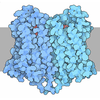
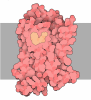
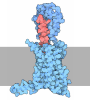
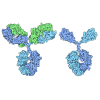
| Related items in Molecule of the Month |
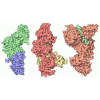
-Map
| File | Download / File: emd_65549.map.gz / Format: CCP4 / Size: 64 MB / Type: IMAGE STORED AS FLOATING POINT NUMBER (4 BYTES) | ||||||||||||||||||||||||||||||||||||
|---|---|---|---|---|---|---|---|---|---|---|---|---|---|---|---|---|---|---|---|---|---|---|---|---|---|---|---|---|---|---|---|---|---|---|---|---|---|
| Projections & slices | Image control
Images are generated by Spider. | ||||||||||||||||||||||||||||||||||||
| Voxel size | X=Y=Z: 1.0825 Å | ||||||||||||||||||||||||||||||||||||
| Density |
| ||||||||||||||||||||||||||||||||||||
| Symmetry | Space group: 1 | ||||||||||||||||||||||||||||||||||||
| Details | EMDB XML:
|
 Z (Sec.)
 Y (Row.)
 X (Col.)


-Supplemental data
-Half map: #2
| File | emd_65549_half_map_1.map | ||||||||||||
|---|---|---|---|---|---|---|---|---|---|---|---|---|---|
| Projections & Slices |
| ||||||||||||
| Density Histograms |


-Half map: #1
| File | emd_65549_half_map_2.map | ||||||||||||
|---|---|---|---|---|---|---|---|---|---|---|---|---|---|
| Projections & Slices |
| ||||||||||||
| Density Histograms |


- Sample components
-Entire : Cryo-EM structure of neurokinin A (NKA)-bound neurokinin 2 recept...
| Entire | Name: Cryo-EM structure of neurokinin A (NKA)-bound neurokinin 2 receptor (NK2R) in complex with miniGs/q70 |
|---|---|
| Components |
|
-Supramolecule #1: Cryo-EM structure of neurokinin A (NKA)-bound neurokinin 2 recept...
| Supramolecule | Name: Cryo-EM structure of neurokinin A (NKA)-bound neurokinin 2 receptor (NK2R) in complex with miniGs/q70 type: complex / ID: 1 / Parent: 0 / Macromolecule list: all |
|---|---|
| Source (natural) | Organism: Homo sapiens (human) |
-Macromolecule #1: Guanine nucleotide-binding protein G(s) subunit alpha isoforms short
| Macromolecule | Name: Guanine nucleotide-binding protein G(s) subunit alpha isoforms short type: protein_or_peptide / ID: 1 Details: Guanine nucleotide-binding protein G(s) subunit alpha isoforms short, with certain residues mutated to match Guanine nucleotide-binding protein G(q) subunit Number of copies: 1 / Enantiomer: LEVO |
|---|---|
| Source (natural) | Organism: Homo sapiens (human) |
| Molecular weight | Theoretical: 26.450961 KDa |
| Recombinant expression | Organism: Homo sapiens (human) |
| Sequence | String: GIEKQLQKDK QVYRATHRLL LLGADNSGKS TIVKQMRILH GGSGGSGGTS GIFETKFQVD KVNFHMFDVG GQRDERRKWI QCFNDVTAI IFVVDSSDYN RLQEALNDFK SIWNNRWLRT ISVILFLNKQ DLLAEKVLAG KSKIEDYFPE FARYTTPEDA T PEPGEDPR ...String: GIEKQLQKDK QVYRATHRLL LLGADNSGKS TIVKQMRILH GGSGGSGGTS GIFETKFQVD KVNFHMFDVG GQRDERRKWI QCFNDVTAI IFVVDSSDYN RLQEALNDFK SIWNNRWLRT ISVILFLNKQ DLLAEKVLAG KSKIEDYFPE FARYTTPEDA T PEPGEDPR VTRAKYFIRD EFLRISTASG DGRHYCYPHF TCAVDTENAR RIFNDCKDII LQMNLREYNL V |
-Macromolecule #2: Guanine nucleotide-binding protein G(I)/G(S)/G(O) subunit gamma-2
| Macromolecule | Name: Guanine nucleotide-binding protein G(I)/G(S)/G(O) subunit gamma-2 type: protein_or_peptide / ID: 2 / Number of copies: 1 / Enantiomer: LEVO |
|---|---|
| Source (natural) | Organism: Homo sapiens (human) |
| Molecular weight | Theoretical: 7.861143 KDa |
| Recombinant expression | Organism:  Trichoplusia ni (cabbage looper) Trichoplusia ni (cabbage looper) |
| Sequence | String: MASNNTASIA QARKLVEQLK MEANIDRIKV SKAAADLMAY CEAHAKEDPL LTPVPASENP FREKKFFCAI L UniProtKB: Guanine nucleotide-binding protein G(I)/G(S)/G(O) subunit gamma-2 |
-Macromolecule #3: Protachykinin-1
| Macromolecule | Name: Protachykinin-1 / type: protein_or_peptide / ID: 3 / Number of copies: 1 / Enantiomer: LEVO |
|---|---|
| Source (natural) | Organism: Homo sapiens (human) |
| Molecular weight | Theoretical: 1.207399 KDa |
| Sequence | String: HKTDSFVGLM A UniProtKB: Protachykinin-1 |
-Macromolecule #4: Nanobody 35
| Macromolecule | Name: Nanobody 35 / type: protein_or_peptide / ID: 4 / Number of copies: 1 / Enantiomer: LEVO |
|---|---|
| Source (natural) | Organism: Lama glama (llama) |
| Molecular weight | Theoretical: 14.71432 KDa |
| Recombinant expression | Organism:   Escherichia coli (E. coli) Escherichia coli (E. coli) |
| Sequence | String: QVQLQESGGG LVQPGGSLRL SCAASGFTFS NYKMNWVRQA PGKGLEWVSD ISQSGASISY TGSVKGRFTI SRDNAKNTLY LQMNSLKPE DTAVYYCARC PAPFTRDCFD VTSTTYAYRG QGTQVTVSSH HHHHH |
-Macromolecule #5: Substance-K receptor
| Macromolecule | Name: Substance-K receptor / type: protein_or_peptide / ID: 5 / Number of copies: 1 / Enantiomer: LEVO |
|---|---|
| Source (natural) | Organism: Homo sapiens (human) |
| Molecular weight | Theoretical: 45.419812 KDa |
| Recombinant expression | Organism: Homo sapiens (human) |
| Sequence | String: DYKDDDDAMG TCDIVTEANI SSGPESNTTG ITAFSMPSWQ LALWATAYLA LVLVAVTGNA IVIWIILAHR RMRTVTNYFI VNLALADLC MAAFNAAFNF VYASHNIWYF GRAFCYFQNL FPITAMFVSI YSMTAIAADR YMAIVHPFQP RLSAPSTKAV I AGIWLVAL ...String: DYKDDDDAMG TCDIVTEANI SSGPESNTTG ITAFSMPSWQ LALWATAYLA LVLVAVTGNA IVIWIILAHR RMRTVTNYFI VNLALADLC MAAFNAAFNF VYASHNIWYF GRAFCYFQNL FPITAMFVSI YSMTAIAADR YMAIVHPFQP RLSAPSTKAV I AGIWLVAL ALASPQCFYS TVTMDQGATK CVVAWPEDSG GKTLLLYHLV VIALIYFLPL AVMFVAYSVI GLTLWRRAVP GH QAHGANL RHLQAMKKFV KTMVLVVLTF AICWLPYHLY FILGSFQEDI YCHKFIQQVY LALFWLAMSS TMYNPIIYCC LNH RFRSGF RLAFRCCPWV TPTKEDKLEL TPTTSLSTRV NRCHTKETLF MAGDTAPSEA TSGEAGRPQD GSGLWFGYGL LAPT KTHVE I UniProtKB: Substance-K receptor |
-Macromolecule #6: Guanine nucleotide-binding protein G(I)/G(S)/G(T) subunit beta-1
| Macromolecule | Name: Guanine nucleotide-binding protein G(I)/G(S)/G(T) subunit beta-1 type: protein_or_peptide / ID: 6 / Number of copies: 1 / Enantiomer: LEVO |
|---|---|
| Source (natural) | Organism: Homo sapiens (human) |
| Molecular weight | Theoretical: 39.418086 KDa |
| Recombinant expression | Organism: Trichoplusia ni (cabbage looper) |
| Sequence | String: MHHHHHHLEV LFQGPGSSGS ELDQLRQEAE QLKNQIRDAR KACADATLSQ ITNNIDPVGR IQMRTRRTLR GHLAKIYAMH WGTDSRLLV SASQDGKLII WDSYTTNKVH AIPLRSSWVM TCAYAPSGNY VACGGLDNIC SIYNLKTREG NVRVSRELAG H TGYLSCCR ...String: MHHHHHHLEV LFQGPGSSGS ELDQLRQEAE QLKNQIRDAR KACADATLSQ ITNNIDPVGR IQMRTRRTLR GHLAKIYAMH WGTDSRLLV SASQDGKLII WDSYTTNKVH AIPLRSSWVM TCAYAPSGNY VACGGLDNIC SIYNLKTREG NVRVSRELAG H TGYLSCCR FLDDNQIVTS SGDTTCALWD IETGQQTTTF TGHTGDVMSL SLAPDTRLFV SGACDASAKL WDVREGMCRQ TF TGHESDI NAICFFPNGN AFATGSDDAT CRLFDLRADQ ELMTYSHDNI ICGITSVSFS KSGRLLLAGY DDFNCNVWDA LKA DRAGVL AGHDNRVSCL GVTDDGMAVA TGSWDSFLKI WN UniProtKB: Guanine nucleotide-binding protein G(I)/G(S)/G(T) subunit beta-1 |
-Experimental details
-Structure determination
| Method | cryo EM |
|---|---|
 Processing Processing | single particle reconstruction |
| Aggregation state | particle |
-Sample preparation
| Buffer | pH: 7.5 |
|---|---|
| Vitrification | Cryogen name: ETHANE |
- Electron microscopy
| Microscope | TFS KRIOS |
|---|---|
| Image recording | Film or detector model: GATAN K3 (6k x 4k) / Average electron dose: 50.0 e/Å2 |
| Electron beam | Acceleration voltage: 300 kV / Electron source:  FIELD EMISSION GUN FIELD EMISSION GUN |
| Electron optics | Illumination mode: FLOOD BEAM / Imaging mode: BRIGHT FIELD / Nominal defocus max: 1.6 µm / Nominal defocus min: 1.3 µm |
| Experimental equipment |  Model: Titan Krios / Image courtesy: FEI Company |
