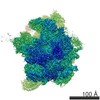
Journal: Mol Cell / Year: 2025 Title: Monitoring the complexity and dynamics of mitochondrial translation. Authors: Taisei Wakigawa / Mari Mito / Yushin Ando / Haruna Yamashiro / Kotaro Tomuro / Haruna Tani / Kazuhito Tomizawa / Takeshi Chujo / Asuteka Nagao / Takeo Suzuki / Osamu Nureki / Fan-Yan Wei / ...Authors: Taisei Wakigawa / Mari Mito / Yushin Ando / Haruna Yamashiro / Kotaro Tomuro / Haruna Tani / Kazuhito Tomizawa / Takeshi Chujo / Asuteka Nagao / Takeo Suzuki / Osamu Nureki / Fan-Yan Wei / Yuichi Shichino / Yuzuru Itoh / Tsutomu Suzuki / Shintaro Iwasaki / Abstract: Since mitochondrial translation leads to the synthesis of the essential oxidative phosphorylation (OXPHOS) subunits, exhaustive and quantitative delineation of mitoribosome traversal is needed. Here, ...Since mitochondrial translation leads to the synthesis of the essential oxidative phosphorylation (OXPHOS) subunits, exhaustive and quantitative delineation of mitoribosome traversal is needed. Here, we developed a variety of high-resolution mitochondrial ribosome profiling derivatives and revealed the intricate regulation of mammalian mitochondrial translation. Harnessing a translation inhibitor, retapamulin, our approach assessed the stoichiometry and kinetics of mitochondrial translation flux, such as the number of mitoribosomes on a transcript, the elongation rate, and the initiation rate. We also surveyed the impacts of modifications at the anticodon stem loop in mitochondrial tRNAs (mt-tRNAs), including all possible modifications at the 34th position, in cells deleting the corresponding enzymes and derived from patients, as well as in mouse tissues. Moreover, a retapamulin-assisted derivative and mito-disome profiling revealed mitochondrial translation initiation factor (mtIF) 3-mediated translation initiation from internal open reading frames (ORFs) and programmed mitoribosome collision sites across the mitochondrial transcriptome. Our work provides a useful platform for investigating protein synthesis within the energy powerhouse of the cell.
In the structure databanks used in Yorodumi, some data are registered as the other names, "COVID-19 virus" and "2019-nCoV". Here are the details of the virus and the list of structure data.
Jan 31, 2019. EMDB accession codes are about to change! (news from PDBe EMDB page)
EMDB accession codes are about to change! (news from PDBe EMDB page)
The allocation of 4 digits for EMDB accession codes will soon come to an end. Whilst these codes will remain in use, new EMDB accession codes will include an additional digit and will expand incrementally as the available range of codes is exhausted. The current 4-digit format prefixed with “EMD-” (i.e. EMD-XXXX) will advance to a 5-digit format (i.e. EMD-XXXXX), and so on. It is currently estimated that the 4-digit codes will be depleted around Spring 2019, at which point the 5-digit format will come into force.
The EM Navigator/Yorodumi systems omit the EMD- prefix.
Related info.:Q: What is EMD? / ID/Accession-code notation in Yorodumi/EM Navigator
Yorodumi is a browser for structure data from EMDB, PDB, SASBDB, etc.
This page is also the successor to EM Navigator detail page, and also detail information page/front-end page for Omokage search.
The word "yorodu" (or yorozu) is an old Japanese word meaning "ten thousand". "mi" (miru) is to see.
Related info.:EMDB / PDB / SASBDB / Comparison of 3 databanks / Yorodumi Search / Aug 31, 2016. New EM Navigator & Yorodumi / Yorodumi Papers / Jmol/JSmol / Function and homology information / Changes in new EM Navigator and Yorodumi
 Movie
Movie Controller


 Open data
 Basic information
 Map data
 Sample
 Keywords
 Homo sapiens (human)
 Authors
 Japan, 2 items
  Citation
 Structure visualization
 Downloads & links
 EMDB map data format
 emd_64899.png
 https://data.pdbj.org/pub/emdb/structures/EMD-64899


 Z (Sec.)
 Y (Row.)
 X (Col.)


 Sample components
 Processing
 Electron microscopy
 FIELD EMISSION GUN