[English] 日本語
Yorodumi
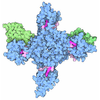
- EMDB-64755: Nav1.5 in complex with quinidine-azo -

+
Open data


ID or keywords:

Loading...

-
Basic information

Entry
Database: EMDB / ID: EMD-64755
TitleNav1.5 in complex with quinidine-azo
Map dataFull map
Sample
  • Complex: Nav1.5 in complex with quinidine-azo
    • Protein or peptide: Sodium channel protein type 5 subunit alpha
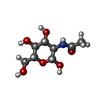
  • Ligand: 2-acetamido-2-deoxy-beta-D-glucopyranose
  • Ligand: (~{S})-[(1~{S},2~{R},4~{S},5~{R})-5-ethenyl-1-azabicyclo[2.2.2]octan-2-yl]-[6-methoxy-3-[4-(2-phenylhydrazinyl)phenyl]quinolin-4-yl]methanol
  • Ligand: SODIUM ION
KeywordsVoltage-gated sodium channe Nav1.5 / MEMBRANE PROTEIN
Function / homology
Function and homology information


voltage-gated sodium channel activity involved in AV node cell action potential / voltage-gated sodium channel activity involved in bundle of His cell action potential / voltage-gated sodium channel activity involved in Purkinje myocyte action potential / voltage-gated sodium channel activity involved in SA node cell action potential / bundle of His cell action potential / regulation of ventricular cardiac muscle cell membrane depolarization / AV node cell action potential / SA node cell action potential / AV node cell to bundle of His cell communication / membrane depolarization during SA node cell action potential ...voltage-gated sodium channel activity involved in AV node cell action potential / voltage-gated sodium channel activity involved in bundle of His cell action potential / voltage-gated sodium channel activity involved in Purkinje myocyte action potential / voltage-gated sodium channel activity involved in SA node cell action potential / bundle of His cell action potential / regulation of ventricular cardiac muscle cell membrane depolarization / AV node cell action potential / SA node cell action potential / AV node cell to bundle of His cell communication / membrane depolarization during SA node cell action potential / response to denervation involved in regulation of muscle adaptation / membrane depolarization during atrial cardiac muscle cell action potential / regulation of atrial cardiac muscle cell membrane repolarization / cardiac ventricle development / voltage-gated sodium channel activity involved in cardiac muscle cell action potential / brainstem development / membrane depolarization during AV node cell action potential / regulation of atrial cardiac muscle cell membrane depolarization / positive regulation of action potential / membrane depolarization during bundle of His cell action potential / atrial cardiac muscle cell action potential / membrane depolarization during Purkinje myocyte cell action potential / cardiac conduction system development / telencephalon development / membrane depolarization during cardiac muscle cell action potential / positive regulation of sodium ion transport / membrane depolarization during action potential / regulation of sodium ion transmembrane transport / ventricular cardiac muscle cell action potential / regulation of ventricular cardiac muscle cell membrane repolarization / cardiac muscle cell action potential involved in contraction / voltage-gated sodium channel complex / regulation of cardiac muscle cell contraction / Interaction between L1 and Ankyrins / voltage-gated sodium channel activity / ankyrin binding / odontogenesis of dentin-containing tooth / sodium ion transport / Phase 0 - rapid depolarisation / regulation of heart rate by cardiac conduction / fibroblast growth factor binding / nitric-oxide synthase binding / intercalated disc / lateral plasma membrane / membrane depolarization / cardiac muscle contraction / T-tubule / regulation of heart rate / cellular response to calcium ion / cerebellum development / positive regulation of epithelial cell proliferation / sodium ion transmembrane transport / sarcolemma / caveola / Z disc / scaffold protein binding / transmembrane transporter binding / calmodulin binding / protein domain specific binding / ubiquitin protein ligase binding / protein kinase binding / nucleolus / perinuclear region of cytoplasm / enzyme binding / cell surface / endoplasmic reticulum / nucleoplasm / membrane / plasma membrane
Similarity search - Function
Voltage gated sodium channel, alpha-5 subunit / Voltage-gated Na+ ion channel, cytoplasmic domain / Cytoplasmic domain of voltage-gated Na+ ion channel / : / Sodium ion transport-associated / Voltage-gated sodium channel alpha subunit, inactivation gate / Sodium ion transport-associated / SCN5A-like, C-terminal IQ motif / Voltage gated sodium channel, alpha subunit / Voltage-gated cation channel calcium and sodium ...Voltage gated sodium channel, alpha-5 subunit / Voltage-gated Na+ ion channel, cytoplasmic domain / Cytoplasmic domain of voltage-gated Na+ ion channel / : / Sodium ion transport-associated / Voltage-gated sodium channel alpha subunit, inactivation gate / Sodium ion transport-associated / SCN5A-like, C-terminal IQ motif / Voltage gated sodium channel, alpha subunit / Voltage-gated cation channel calcium and sodium / Voltage-dependent channel domain superfamily / Ion transport domain / Ion transport protein
Similarity search - Domain/homology
Sodium channel protein type 5 subunit alpha
Similarity search - Component
Biological speciesHomo sapiens (human)
Methodsingle particle reconstruction / cryo EM / Resolution: 3.0 Å
AuthorsHuang Z / Li Z / Liu S
Funding support China, 1 items
OrganizationGrant numberCountry
National Natural Science Foundation of China (NSFC)82271498 China
CitationJournal: Nat Commun / Year: 2026
Title: Optical control of the cardiac rhythm with photoswitchable Na1.5 channel blockers.
Authors: Shiqi Liu / Weiqiang Guan / Zhangqiang Li / Wei Wang / Huifang Song / Jia'ao Li / Junjie Hou / Huan Wang / JingWei Xiong / Min Yang / Nieng Yan / Xin Tian / Houhua Li / Zhuo Huang /
Abstract: Voltage-gated sodium channel Na1.5 is essential for cardiac excitability, mediating the rapid depolarization phase of the cardiac action potential (AP) and ensuring proper electrical conduction in ...Voltage-gated sodium channel Na1.5 is essential for cardiac excitability, mediating the rapid depolarization phase of the cardiac action potential (AP) and ensuring proper electrical conduction in the heart. Dysfunction of Na1.5 is implicated in life-threatening arrhythmias, making it a critical therapeutic target. Acting as a Na1.5 open-state blocker, quinidine demonstrates efficacy in arrhythmia treatment, but its low specificity restricts its clinical application. Here, we report an optopharmacological strategy that enables a precise and optical control of Na1.5 function by means of photoswitchable quinidine derivatives. Through systematic structural optimization, we identify azo-Q2a as a high-performance photoswitchable inhibitor, exhibiting low activity in the dark or under 480 nm light irradiation (trans isomer), while approximately 7-fold higher efficacy is observed under 365 nm light irradiation (cis isomer). Of note, azo-Q2a demonstrates exceptional selectivity for Na1.5 over cardiac ion channels and other Na1 subtypes, minimizing potential off-target effects. Furthermore, by solving the cryo-EM structure of the Na1.5 in complex with the cis-active isomer azo-Q2a (3.0 Å resolution), we reveal the essential binding site that is responsible for the optical control of Na1.5. Finally, azo-Q2a also attenuates the heart rate of living zebrafish larvae with light, showing its potential in cardiac-related research and treatment. Our work not only establishes azo-Q2a as a robust photoswitchable inhibitor for Na1.5 but also provides a structural blueprint for the rational design of next-generation optopharmacological antiarrhythmic agents.
History
DepositionMay 22, 2025-
Header (metadata) releaseApr 1, 2026-
Map releaseApr 1, 2026-
UpdateApr 1, 2026-
Current statusApr 1, 2026Processing site: PDBc / Status: Released

-
Structure visualization

Supplemental images

Downloads & links

-
Map

FileDownload / File: emd_64755.map.gz / Format: CCP4 / Size: 64 MB / Type: IMAGE STORED AS FLOATING POINT NUMBER (4 BYTES)
AnnotationFull map
Projections & slices

Image control

Size
Brightness
Contrast
Others
AxesZ (Sec.)Y (Row.)X (Col.)
1.07 Å/pix.
x 256 pix.
= 274.995 Å
1.07 Å/pix.
x 256 pix.
= 274.995 Å
1.07 Å/pix.
x 256 pix.
= 274.995 Å

Surface

Projections

Slices (1/3)

Slices (1/2)

Slices (2/3)

Images are generated by Spider.

Voxel sizeX=Y=Z: 1.0742 Å
Density
Contour LevelBy AUTHOR: 0.23
Minimum - Maximum-2.4607258 - 3.7246838
Average (Standard dev.)0.0023309283 (±0.07711897)
SymmetrySpace group: 1
Details

EMDB XML:

Map geometry
Axis orderXYZ
Origin000
Dimensions256256256
Spacing256256256
CellA=B=C: 274.9952 Å
α=β=γ: 90.0 °

-
Supplemental data

-
Half map: Half map A

Fileemd_64755_half_map_1.map
AnnotationHalf map A
Projections & Slices
AxesZYX

Projections

Slices (1/2)
Density Histograms

-
Half map: Half map B

Fileemd_64755_half_map_2.map
AnnotationHalf map B
Projections & Slices
AxesZYX

Projections

Slices (1/2)
Density Histograms

-
Sample components

-
Entire : Nav1.5 in complex with quinidine-azo

EntireName: Nav1.5 in complex with quinidine-azo
Components
  • Complex: Nav1.5 in complex with quinidine-azo
    • Protein or peptide: Sodium channel protein type 5 subunit alpha
  • Ligand: 2-acetamido-2-deoxy-beta-D-glucopyranose
  • Ligand: (~{S})-[(1~{S},2~{R},4~{S},5~{R})-5-ethenyl-1-azabicyclo[2.2.2]octan-2-yl]-[6-methoxy-3-[4-(2-phenylhydrazinyl)phenyl]quinolin-4-yl]methanol
  • Ligand: SODIUM ION

-
Supramolecule #1: Nav1.5 in complex with quinidine-azo

SupramoleculeName: Nav1.5 in complex with quinidine-azo / type: complex / ID: 1 / Parent: 0 / Macromolecule list: #1
Source (natural)Organism: Homo sapiens (human)

-
Macromolecule #1: Sodium channel protein type 5 subunit alpha

MacromoleculeName: Sodium channel protein type 5 subunit alpha / type: protein_or_peptide / ID: 1 / Number of copies: 1 / Enantiomer: LEVO
Source (natural)Organism: Homo sapiens (human)
Molecular weightTheoretical: 184.033438 KDa
Recombinant expressionOrganism: Homo sapiens (human)
SequenceString: MASWSHPQFE KGGGARGGSG GGSWSHPQFE KGFDYKDDDD KGTMANFLLP RGTSSFRRFT RESLAAIEKR MAEKQARGST TLQESREGL PEEEAPRPQL DLQASKKLPD LYGNPPQELI GEPLEDLDPF YSTQKTFIVL NKGKTIFRFS ATNALYVLSP F HPIRRAAV ...String:
MASWSHPQFE KGGGARGGSG GGSWSHPQFE KGFDYKDDDD KGTMANFLLP RGTSSFRRFT RESLAAIEKR MAEKQARGST TLQESREGL PEEEAPRPQL DLQASKKLPD LYGNPPQELI GEPLEDLDPF YSTQKTFIVL NKGKTIFRFS ATNALYVLSP F HPIRRAAV KILVHSLFNM LIMCTILTNC VFMAQHDPPP WTKYVEYTFT AIYTFESLVK ILARGFCLHA FTFLRDPWNW LD FSVIIMA YTTEFVDLGN VSALRTFRVL RALKTISVIS GLKTIVGALI QSVKKLADVM VLTVFCLSVF ALIGLQLFMG NLR HKCVRN FTALNGTNGS VEADGLVWES LDLYLSDPEN YLLKNGTSDV LLCGNSSDAG TCPEGYRCLK AGENPDHGYT SFDS FAWAF LALFRLMTQD CWERLYQQTL RSAGKIYMIF FMLVIFLGSF YLVNLILAVV AMAYEEQNQA TIAETEEKEK RFQEA MEML KKEHEALTIR GVDTVSRSSA RQRALSAVSV LTSALEELEE SRHKCPPCWN RLAQRYLIWE CCPLWMSIKQ GVKLVV MDP FTDLTITMCI VLNTLFMALE HYNMTSEFEE MLQVGNLVFT GIFTAEMTFK IIALDPYYYF QQGWNIFDSI IVILSLM EL GLSRMSNLSV LRSFRLLRVF KLAKSWPTLN TLIKIIGNSV GALGNLTLVL AIIVFIFAVV GMQLFGKNYS ELRDSDSG L LPRWHMMDFF HAFLIIFRIL CGEWIETMWD CMEVSGQSLC LLVFLLVMVI GNLVVLNLFL ALLLSSFSAD NLTAPDEDR EMNNLQLALA RIQRGLRFVK RTTWDFCCGL LRQRPQKPAA LAAQGQLPSC IATPYSPPPP ETEKVPPTRK ETRFEEGEQP GQGTPGDPE PVCVPIAVAE SDTDDQEEDE ENGKVWWRLR KTCYHIVEHS WFETFIIFMI LLSSGALAFE DIYLEERKTI K VLLEYADK MFTYVFVLEM LLKWVAYGFK KYFTNAWCWL DFLIVDVSLV SLVANTLGFA EMGPIKSLRT LRALRPLRAL SR FEGMRVV VNALVGAIPS IMNVLLVCLI FWLIFSIMGV NLFAGKFGRC INQTEGDLPL NYTIVNNKSQ CESLNLTGEL YWT KVKVNF DNVGAGYLAL LQVATFKGWM DIMYAAVDSR GYEEQPQWEY NLYMYIYFVI FIIFGSFFTL NLFIGVIIDN FNQQ KKKLG GQDIFMTEEQ KKYYNAMKKL GSKKPQKPIP RPLNKYQGFI FDIVTKQAFD VTIMFLICLN MVTMMVETDD QSPEK INIL AKINLLFVAI FTGECIVKLA ALRHYYFTNS WNIFDFVVVI LSIVGTVLSD IIQKYFFSPT LFRVIRLARI GRILRL IRG AKGIRTLLFA LMMSLPALFN IGLLLFLVMF IYSIFGMANF AYVKWEAGID DMFNFQTFAN SMLCLFQITT SAGWDGL LS PILNTGPPYC DPTLPNSNGS RGDCGSPAVG ILFFTTYIII SFLIVVNMYI AIILENFSVA TEESTEPLSE DDFDMFYE I WEKFDPEATQ FIEYSVLSDF ADALSEPLRI AKPNQISLIN MDLPMVSGDR IHCMDILFAF TKRVLGESGE MDALKIQME EKFMAANPSK ISYEPITT

UniProtKB: Sodium channel protein type 5 subunit alpha, Sodium channel protein type 5 subunit alpha, Sodium channel protein type 5 subunit alpha

-
Macromolecule #2: 2-acetamido-2-deoxy-beta-D-glucopyranose

MacromoleculeName: 2-acetamido-2-deoxy-beta-D-glucopyranose / type: ligand / ID: 2 / Number of copies: 9 / Formula: NAG
Molecular weightTheoretical: 221.208 Da
Chemical component information

ChemComp-NAG:
2-acetamido-2-deoxy-beta-D-glucopyranose

-
Macromolecule #3: (~{S})-[(1~{S},2~{R},4~{S},5~{R})-5-ethenyl-1-azabicyclo[2.2.2]oc...

MacromoleculeName: (~{S})-[(1~{S},2~{R},4~{S},5~{R})-5-ethenyl-1-azabicyclo[2.2.2]octan-2-yl]-[6-methoxy-3-[4-(2-phenylhydrazinyl)phenyl]quinolin-4-yl]methanol
type: ligand / ID: 3 / Number of copies: 1 / Formula: A1EQU
Molecular weightTheoretical: 506.638 Da

-
Macromolecule #4: SODIUM ION

MacromoleculeName: SODIUM ION / type: ligand / ID: 4 / Number of copies: 1
Molecular weightTheoretical: 22.99 Da

-
Experimental details

-
Structure determination

Methodcryo EM
Processingsingle particle reconstruction
Aggregation stateparticle

-
Sample preparation

BufferpH: 7.5
VitrificationCryogen name: ETHANE

-
Electron microscopy

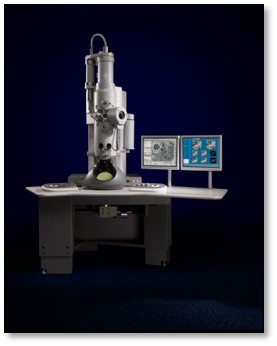
MicroscopeFEI TECNAI SPIRIT
Image recordingFilm or detector model: GATAN K3 BIOQUANTUM (6k x 4k) / Average electron dose: 50.0 e/Å2
Electron beamAcceleration voltage: 300 kV / Electron source: FIELD EMISSION GUN
Electron opticsIllumination mode: FLOOD BEAM / Imaging mode: BRIGHT FIELD / Nominal defocus max: 1.8 µm / Nominal defocus min: 1.5 µm
Experimental equipment
Model: Tecnai Spirit / Image courtesy: FEI Company

+
Image processing

CTF correctionType: PHASE FLIPPING AND AMPLITUDE CORRECTION
Startup modelType of model: NONE
Final reconstructionResolution.type: BY AUTHOR / Resolution: 3.0 Å / Resolution method: FSC 0.143 CUT-OFF / Number images used: 287376
Initial angle assignmentType: MAXIMUM LIKELIHOOD
Final angle assignmentType: MAXIMUM LIKELIHOOD

+
About Yorodumi

-
News

-
Feb 9, 2022. New format data for meta-information of EMDB entries

New format data for meta-information of EMDB entries

  • Version 3 of the EMDB header file is now the official format.
  • The previous official version 1.9 will be removed from the archive.

Related info.:EMDB header

External links:wwPDB to switch to version 3 of the EMDB data model

-
Aug 12, 2020. Covid-19 info

Covid-19 info

URL: https://pdbj.org/emnavi/covid19.php

New page: Covid-19 featured information page in EM Navigator.

Related info.:Covid-19 info / Mar 5, 2020. Novel coronavirus structure data

+
Mar 5, 2020. Novel coronavirus structure data

Novel coronavirus structure data

Related info.:Yorodumi Speices / Aug 12, 2020. Covid-19 info

External links:COVID-19 featured content - PDBj / Molecule of the Month (242):Coronavirus Proteases

+
Jan 31, 2019. EMDB accession codes are about to change! (news from PDBe EMDB page)

EMDB accession codes are about to change! (news from PDBe EMDB page)

  • The allocation of 4 digits for EMDB accession codes will soon come to an end. Whilst these codes will remain in use, new EMDB accession codes will include an additional digit and will expand incrementally as the available range of codes is exhausted. The current 4-digit format prefixed with “EMD-” (i.e. EMD-XXXX) will advance to a 5-digit format (i.e. EMD-XXXXX), and so on. It is currently estimated that the 4-digit codes will be depleted around Spring 2019, at which point the 5-digit format will come into force.
  • The EM Navigator/Yorodumi systems omit the EMD- prefix.

Related info.:Q: What is EMD? / ID/Accession-code notation in Yorodumi/EM Navigator

External links:EMDB Accession Codes are Changing Soon! / Contact to PDBj

+
Jul 12, 2017. Major update of PDB

Major update of PDB

  • wwPDB released updated PDB data conforming to the new PDBx/mmCIF dictionary.
  • This is a major update changing the version number from 4 to 5, and with Remediation, in which all the entries are updated.
  • In this update, many items about electron microscopy experimental information are reorganized (e.g. em_software).
  • Now, EM Navigator and Yorodumi are based on the updated data.

External links:wwPDB Remediation / Enriched Model Files Conforming to OneDep Data Standards Now Available in the PDB FTP Archive

-
Yorodumi

Thousand views of thousand structures

  • Yorodumi is a browser for structure data from EMDB, PDB, SASBDB, etc.
  • This page is also the successor to EM Navigator detail page, and also detail information page/front-end page for Omokage search.
  • The word "yorodu" (or yorozu) is an old Japanese word meaning "ten thousand". "mi" (miru) is to see.

Related info.:EMDB / PDB / SASBDB / Comparison of 3 databanks / Yorodumi Search / Aug 31, 2016. New EM Navigator & Yorodumi / Yorodumi Papers / Jmol/JSmol / Function and homology information / Changes in new EM Navigator and Yorodumi

Read more