 Movie
Movie Controller


+ Open data

- Basic information
| Entry |  | |||||||||
|---|---|---|---|---|---|---|---|---|---|---|
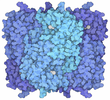
| Title | A combined cryo_EM structure of Cagrilintide-CTR-Gs complex | |||||||||
 Map data Map data | ||||||||||
 Sample Sample |
| |||||||||
 Keywords Keywords | GPCR / CTR / MEMBRANE PROTEIN | |||||||||
| Function / homology |  Function and homology information Function and homology informationcalcitonin binding / calcitonin family receptor activity / amylin receptor complex 1 / amylin receptor complex 2 / calcitonin family receptor signaling pathway / amylin receptor complex 3 / amylin receptor activity / calcitonin receptor activity / calcitonin gene-related peptide receptor signaling pathway / calcitonin gene-related peptide receptor activity ...calcitonin binding / calcitonin family receptor activity / amylin receptor complex 1 / amylin receptor complex 2 / calcitonin family receptor signaling pathway / amylin receptor complex 3 / amylin receptor activity / calcitonin receptor activity / calcitonin gene-related peptide receptor signaling pathway / calcitonin gene-related peptide receptor activity / amylin receptor 3 signaling pathway / amylin receptor 2 signaling pathway / amylin receptor 1 signaling pathway / amylin receptor signaling pathway / Calcitonin-like ligand receptors / positive regulation of cAMP/PKA signal transduction / response to amyloid-beta / positive regulation of calcium-mediated signaling / response to glucocorticoid / acrosomal vesicle / Olfactory Signaling Pathway / Activation of the phototransduction cascade / G protein-coupled acetylcholine receptor signaling pathway / G beta:gamma signalling through PLC beta / Presynaptic function of Kainate receptors / Thromboxane signalling through TP receptor / Activation of G protein gated Potassium channels / Inhibition of voltage gated Ca2+ channels via Gbeta/gamma subunits / G-protein activation / Glucagon signaling in metabolic regulation / G beta:gamma signalling through CDC42 / cilium / Prostacyclin signalling through prostacyclin receptor / Synthesis, secretion, and inactivation of Glucagon-like Peptide-1 (GLP-1) / photoreceptor disc membrane / G beta:gamma signalling through BTK / ADP signalling through P2Y purinoceptor 12 / Sensory perception of sweet, bitter, and umami (glutamate) taste / Glucagon-type ligand receptors / Adrenaline,noradrenaline inhibits insulin secretion / Vasopressin regulates renal water homeostasis via Aquaporins / G alpha (z) signalling events / Glucagon-like Peptide-1 (GLP1) regulates insulin secretion / cellular response to catecholamine stimulus / ADP signalling through P2Y purinoceptor 1 / G beta:gamma signalling through PI3Kgamma / ADORA2B mediated anti-inflammatory cytokines production / adenylate cyclase-activating dopamine receptor signaling pathway / cellular response to prostaglandin E stimulus / Cooperation of PDCL (PhLP1) and TRiC/CCT in G-protein beta folding / amyloid-beta binding / positive regulation of cytosolic calcium ion concentration / GPER1 signaling / heterotrimeric G-protein complex / Inactivation, recovery and regulation of the phototransduction cascade / G alpha (12/13) signalling events / G-protein beta-subunit binding / extracellular vesicle / Thrombin signalling through proteinase activated receptors (PARs) / adenylate cyclase-activating G protein-coupled receptor signaling pathway / signaling receptor complex adaptor activity / GTPase binding / Ca2+ pathway / High laminar flow shear stress activates signaling by PIEZO1 and PECAM1:CDH5:KDR in endothelial cells / positive regulation of phosphatidylinositol 3-kinase/protein kinase B signal transduction / G alpha (i) signalling events / G alpha (s) signalling events / G alpha (q) signalling events / Ras protein signal transduction / positive regulation of ERK1 and ERK2 cascade / cell surface receptor signaling pathway / Extra-nuclear estrogen signaling / G protein-coupled receptor signaling pathway / axon / lysosomal membrane / positive regulation of gene expression / GTPase activity / synapse / protein-containing complex binding / signal transduction / extracellular exosome / membrane / plasma membrane / cytosol / cytoplasm Similarity search - Function | |||||||||
| Biological species |  Homo sapiens (human) Homo sapiens (human) | |||||||||
| Method | single particle reconstruction / cryo EM / Resolution: 3.1 Å | |||||||||
 Authors Authors | Zhao L / Gu Y / Yuan Q | |||||||||
| Funding support |  China, 1 items China, 1 items
| |||||||||
 Citation Citation | Journal: Acta Pharmacol Sin / Year: 2026 Title: Structural and mechanistic insights into dual activation of cagrilintide in amylin and calcitonin receptors. Authors: Yi-Min Gu / Qing-Ning Yuan / Xin Li / Qian He / H Eric Xu / Li-Hua Zhao / Abstract: The global obesity epidemic and its associated metabolic disorders urgently require more effective therapeutic interventions, particularly multi-pathway targeting therapies. Cagrilintide (Cagri), ...The global obesity epidemic and its associated metabolic disorders urgently require more effective therapeutic interventions, particularly multi-pathway targeting therapies. Cagrilintide (Cagri), functioning as a dual amylin receptor (AMYRs) and calcitonin receptor (CTR) agonist (DACRA), demonstrates significant efficacy in obesity treatment, although its structural activation mechanism remains unclear. This study elucidates the non-selective activation mechanism by determining cryo-EM structures of Cagri bound to AMYR-G and CTR-G complexes. Cagri adopts similar "bypass" binding modes in both receptors, which is distinct from other existing DACRAs that primarily achieve extended half-life through N-terminal lipid modification. Key molecular features include the F23 residue anchoring the peptide at the receptor transmembrane (TM) bundle level and the micelle, an E14-R17 intramolecular salt bridge enhancing helical stability, and C-terminal P37 interaction with the receptor ECD. These features collectively enable non-specific binding and activation across different receptors. Both structural and functional analyses revealed Cagri's non-selective activation of G signaling pathways through CTR and AMYR. These findings provide a comprehensive structural framework for developing next-generation anti-obesity drugs based on dual receptor activation mechanisms. | |||||||||
| History |
|
- Structure visualization
| Supplemental images |
|---|

- Downloads & links
-EMDB archive
| Map data | emd_64560.map.gz | 166.7 MB | EMDB map data format | |
|---|---|---|---|---|
| Header (meta data) | emd-64560-v30.xmlemd-64560.xml | 16.6 KB 16.6 KB | Display Display | EMDB header |
| Images |  emd_64560.png emd_64560.png | 50.6 KB | ||
| Filedesc metadata | emd-64560.cif.gz | 6.2 KB | ||
| Archive directory |  https://data.pdbj.org/pub/emdb/structures/EMD-64560ftp://data.pdbj.org/pub/emdb/structures/EMD-64560 https://data.pdbj.org/pub/emdb/structures/EMD-64560ftp://data.pdbj.org/pub/emdb/structures/EMD-64560 | HTTPS FTP |
-Related structure data
| Related structure data |  9uwmMC  9uwqC C: citing same article ( M: atomic model generated by this map |
|---|---|
| Similar structure data |


-Links
| EMDB pages | EMDB (EBI/PDBe) / EMDataResource |
|---|---|
| Related items in Molecule of the Month |



-Map
| File | Download / File: emd_64560.map.gz / Format: CCP4 / Size: 178 MB / Type: IMAGE STORED AS FLOATING POINT NUMBER (4 BYTES) | ||||||||||||||||||||||||||||||||||||
|---|---|---|---|---|---|---|---|---|---|---|---|---|---|---|---|---|---|---|---|---|---|---|---|---|---|---|---|---|---|---|---|---|---|---|---|---|---|
| Projections & slices | Image control
Images are generated by Spider. | ||||||||||||||||||||||||||||||||||||
| Voxel size | X=Y=Z: 0.73 Å | ||||||||||||||||||||||||||||||||||||
| Density |
| ||||||||||||||||||||||||||||||||||||
| Symmetry | Space group: 1 | ||||||||||||||||||||||||||||||||||||
| Details | EMDB XML:
|
 Z (Sec.)
 Y (Row.)
 X (Col.)


-Supplemental data
- Sample components
-Entire : A combined cryo_EM structure of Cagrilintide-CTR-Gs complex
| Entire | Name: A combined cryo_EM structure of Cagrilintide-CTR-Gs complex |
|---|---|
| Components |
|
-Supramolecule #1: A combined cryo_EM structure of Cagrilintide-CTR-Gs complex
| Supramolecule | Name: A combined cryo_EM structure of Cagrilintide-CTR-Gs complex type: complex / ID: 1 / Parent: 0 / Macromolecule list: all |
|---|---|
| Source (natural) | Organism: Homo sapiens (human) |
-Macromolecule #1: Guanine nucleotide-binding protein g(s) subunit alpha
| Macromolecule | Name: Guanine nucleotide-binding protein g(s) subunit alpha / type: protein_or_peptide / ID: 1 / Number of copies: 1 / Enantiomer: LEVO |
|---|---|
| Source (natural) | Organism: Homo sapiens (human) |
| Molecular weight | Theoretical: 41.879465 KDa |
| Recombinant expression | Organism:   Spodoptera frugiperda (fall armyworm) Spodoptera frugiperda (fall armyworm) |
| Sequence | String: MGCTLSAEDK AAVERSKMIE KQLQKDKQVY RATHRLLLLG ADNSGKSTIV KQMRIYHVNG YSEEECKQYK AVVYSNTIQS IIAIIRAMG RLKIDFGDSA RADDARQLFV LAGAAEEGFM TAELAGVIKR LWKDSGVQAC FNRSREYQLN DSAAYYLNDL D RIAQPNYI ...String: MGCTLSAEDK AAVERSKMIE KQLQKDKQVY RATHRLLLLG ADNSGKSTIV KQMRIYHVNG YSEEECKQYK AVVYSNTIQS IIAIIRAMG RLKIDFGDSA RADDARQLFV LAGAAEEGFM TAELAGVIKR LWKDSGVQAC FNRSREYQLN DSAAYYLNDL D RIAQPNYI PTQQDVLRTR VKTSGIFETK FQVDKVNFHM FDVGAQRDER RKWIQCFNDV TAIIFVVDSS DYNRLQEALN DF KSIWNNR WLRTISVILF LNKQDLLAEK VLAGKSKIED YFPEFARYTT PEDATPEPGE DPRVTRAKYF IRDEFLRIST ASG DGRHYC YPHFTCSVDT ENARRIFNDC RDIIQRMHLR QYELL |
-Macromolecule #2: Guanine nucleotide-binding protein G(I)/G(S)/G(T) subunit beta-1
| Macromolecule | Name: Guanine nucleotide-binding protein G(I)/G(S)/G(T) subunit beta-1 type: protein_or_peptide / ID: 2 / Number of copies: 1 / Enantiomer: LEVO |
|---|---|
| Source (natural) | Organism: Homo sapiens (human) |
| Molecular weight | Theoretical: 39.728426 KDa |
| Recombinant expression | Organism: Spodoptera frugiperda (fall armyworm) |
| Sequence | String: MSELDQLRQE AEQLKNQIRD ARKACADATL SQITNNIDPV GRIQMRTRRT LRGHLAKIYA MHWGTDSRLL VSASQDGKLI IWDSYTTNK VHAIPLRSSW VMTCAYAPSG NYVACGGLDN ICSIYNLKTR EGNVRVSREL AGHTGYLSCC RFLDDNQIVT S SGDTTCAL ...String: MSELDQLRQE AEQLKNQIRD ARKACADATL SQITNNIDPV GRIQMRTRRT LRGHLAKIYA MHWGTDSRLL VSASQDGKLI IWDSYTTNK VHAIPLRSSW VMTCAYAPSG NYVACGGLDN ICSIYNLKTR EGNVRVSREL AGHTGYLSCC RFLDDNQIVT S SGDTTCAL WDIETGQQTT TFTGHTGDVM SLSLAPDTRL FVSGACDASA KLWDVREGMC RQTFTGHESD INAICFFPNG NA FATGSDD ATCRLFDLRA DQELMTYSHD NIICGITSVS FSKSGRLLLA GYDDFNCNVW DALKADRAGV LAGHDNRVSC LGV TDDGMA VATGSWDSFL KIWNGSSGGG GSGGGGSSGV SGWRLFKKIS UniProtKB: Guanine nucleotide-binding protein G(I)/G(S)/G(T) subunit beta-1 |
-Macromolecule #3: Cagrilintide
| Macromolecule | Name: Cagrilintide / type: protein_or_peptide / ID: 3 / Number of copies: 1 / Enantiomer: LEVO |
|---|---|
| Source (natural) | Organism: Homo sapiens (human) |
| Molecular weight | Theoretical: 3.865315 KDa |
| Recombinant expression | Organism: Spodoptera frugiperda (fall armyworm) |
| Sequence | String: KCNTATCATQ RLAEFLRHSS NNFGPILPPT NVGSNT |
-Macromolecule #4: Guanine nucleotide-binding protein G(I)/G(S)/G(O) subunit gamma-2
| Macromolecule | Name: Guanine nucleotide-binding protein G(I)/G(S)/G(O) subunit gamma-2 type: protein_or_peptide / ID: 4 / Number of copies: 1 / Enantiomer: LEVO |
|---|---|
| Source (natural) | Organism: Homo sapiens (human) |
| Molecular weight | Theoretical: 7.861143 KDa |
| Recombinant expression | Organism: Spodoptera frugiperda (fall armyworm) |
| Sequence | String: MASNNTASIA QARKLVEQLK MEANIDRIKV SKAAADLMAY CEAHAKEDPL LTPVPASENP FREKKFFCAI L UniProtKB: Guanine nucleotide-binding protein G(I)/G(S)/G(O) subunit gamma-2 |
-Macromolecule #5: Calcitonin receptor
| Macromolecule | Name: Calcitonin receptor / type: protein_or_peptide / ID: 5 / Number of copies: 1 / Enantiomer: LEVO |
|---|---|
| Source (natural) | Organism: Homo sapiens (human) |
| Molecular weight | Theoretical: 52.615969 KDa |
| Recombinant expression | Organism: Spodoptera frugiperda (fall armyworm) |
| Sequence | String: AFSNQTYPTI EPKPFLYVVG RKKMMDAQYK CYDRMQQLPA YQGEGPYCNR TWDGWLCWDD TPAGVLSYQF CPDYFPDFDP SEKVTKYCD EKGVWFKHPE NNRTWSNYTM CNAFTPEKLK NAYVLYYLAI VGHSLSIFTL VISLGIFVFF RSLGCQRVTL H KNMFLTYI ...String: AFSNQTYPTI EPKPFLYVVG RKKMMDAQYK CYDRMQQLPA YQGEGPYCNR TWDGWLCWDD TPAGVLSYQF CPDYFPDFDP SEKVTKYCD EKGVWFKHPE NNRTWSNYTM CNAFTPEKLK NAYVLYYLAI VGHSLSIFTL VISLGIFVFF RSLGCQRVTL H KNMFLTYI LNSMIIIIHL VEVVPNGELV RRDPVSCKIL HFFHQYMMAC NYFWMLCEGI YLHTLIVVAV FTEKQRLRWY YL LGWGFPL VPTTIHAITR AVYFNDNCWL SVETHLLYII HGPVMAALVV NFFFLLNIVR VLVTKMRETH EAESHMYLKA VKA TMILVP LLGIQFVVFP WRPSNKMLGK IYDYVMHSLI HFQGFFVATI YCFCNNEVQT TVKRQWAQFK IQWNQRWGRR PSNR SARAA AAAAEAGDIP IYICHQELRN EPANNQGEES AEIIPLNIIE QESSA UniProtKB: Calcitonin receptor |
-Experimental details
-Structure determination
| Method | cryo EM |
|---|---|
 Processing Processing | single particle reconstruction |
| Aggregation state | particle |
-Sample preparation
| Buffer | pH: 7.04 |
|---|---|
| Vitrification | Cryogen name: ETHANE |
- Electron microscopy
| Microscope | TFS KRIOS |
|---|---|
| Image recording | Film or detector model: FEI FALCON IV (4k x 4k) / Average electron dose: 50.0 e/Å2 |
| Electron beam | Acceleration voltage: 300 kV / Electron source:  FIELD EMISSION GUN FIELD EMISSION GUN |
| Electron optics | Illumination mode: FLOOD BEAM / Imaging mode: BRIGHT FIELD / Nominal defocus max: 18.0 µm / Nominal defocus min: 8.0 µm |
| Experimental equipment |  Model: Titan Krios / Image courtesy: FEI Company |
