substrate / transport / heterodimer / TRANSPORT PROTEIN
Function / homology
Function and homology information
bile acid secretion / bile acid transmembrane transporter activity / Recycling of bile acids and salts / bile acid and bile salt transport / transmembrane transporter activity / basolateral plasma membrane / protein heterodimerization activity / endoplasmic reticulum membrane / protein homodimerization activity / protein-containing complex ...bile acid secretion / bile acid transmembrane transporter activity / Recycling of bile acids and salts / bile acid and bile salt transport / transmembrane transporter activity / basolateral plasma membrane / protein heterodimerization activity / endoplasmic reticulum membrane / protein homodimerization activity / protein-containing complex / membrane / plasma membrane Similarity search - Function
National Natural Science Foundation of China (NSFC)
China
Citation
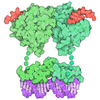
Journal: Nature / Year: 2026 Title: Structures of Ostα/β reveal a unique fold and bile acid transport mechanism. Authors: Xuemei Yang / Nana Cui / Tianyu Li / Xinheng He / Heng Zhang / Canrong Wu / Yang Li / Xiong Ma / H Eric Xu / Abstract: Bile acid and steroid hormone homeostasis are critical for human health, with disruptions linked to metabolic and endocrine disorders. The organic solute transporter Ostα/β, essential for bile acid ...Bile acid and steroid hormone homeostasis are critical for human health, with disruptions linked to metabolic and endocrine disorders. The organic solute transporter Ostα/β, essential for bile acid efflux in enterohepatic circulation, has long defied mechanistic elucidation. Here we present cryogenic electron microscopy structures of human Ostα/β in apo and substrate-bound states at 2.6-3.1 Å resolution, revealing a distinctive membrane protein architecture that defines a new transporter class. Ostα/β forms a symmetric tetramer of heterodimers, with each Ostα subunit showing a new seven-transmembrane fold, augmented by a single transmembrane helix of Ostβ. This architecture is stabilized by extensive lipid modifications, including a palmitoylated cysteine-rich motif that forms a lateral substrate-binding groove. The structures uncover a unique transport pathway featuring two substrate-binding sites connected by an amphipathic helix-gated conduit. This design, conserved in the evolutionarily related TMEM184 family, suggests an ancient mechanism for substrate translocation. Electrophysiological studies demonstrate voltage-sensitive, bidirectional transport driven by electrochemical gradients, elucidating the efflux role of Ostα/β in vivo. Lipid interactions, notably palmitoylation-dependent trafficking, emerge as critical for stability and function. These findings clarify the molecular mechanism of Ostα/β, provide a structural basis for disease-associated mutations and establish a paradigm for lipid-modified membrane transport.
In the structure databanks used in Yorodumi, some data are registered as the other names, "COVID-19 virus" and "2019-nCoV". Here are the details of the virus and the list of structure data.
Jan 31, 2019. EMDB accession codes are about to change! (news from PDBe EMDB page)
EMDB accession codes are about to change! (news from PDBe EMDB page)
The allocation of 4 digits for EMDB accession codes will soon come to an end. Whilst these codes will remain in use, new EMDB accession codes will include an additional digit and will expand incrementally as the available range of codes is exhausted. The current 4-digit format prefixed with “EMD-” (i.e. EMD-XXXX) will advance to a 5-digit format (i.e. EMD-XXXXX), and so on. It is currently estimated that the 4-digit codes will be depleted around Spring 2019, at which point the 5-digit format will come into force.
The EM Navigator/Yorodumi systems omit the EMD- prefix.
Related info.:Q: What is EMD? / ID/Accession-code notation in Yorodumi/EM Navigator
Yorodumi is a browser for structure data from EMDB, PDB, SASBDB, etc.
This page is also the successor to EM Navigator detail page, and also detail information page/front-end page for Omokage search.
The word "yorodu" (or yorozu) is an old Japanese word meaning "ten thousand". "mi" (miru) is to see.
Related info.:EMDB / PDB / SASBDB / Comparison of 3 databanks / Yorodumi Search / Aug 31, 2016. New EM Navigator & Yorodumi / Yorodumi Papers / Jmol/JSmol / Function and homology information / Changes in new EM Navigator and Yorodumi
 Movie
Movie Controller

 Yorodumi
 Open data
 Basic information
 Map data
 Sample
 Keywords
 Function and homology information
 Homo sapiens (human)
 Authors
 China, 1 items
  Citation
 Structure visualization
 Downloads & links
 emd_64369.png
 https://data.pdbj.org/pub/emdb/structures/EMD-64369


 Z (Sec.)
 Y (Row.)
 X (Col.)


 Sample components
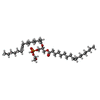

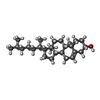
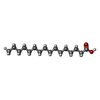
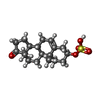

 Processing
 Electron microscopy
 FIELD EMISSION GUN

