Journal: Biochem Biophys Res Commun / Year: 2025 Title: Structural basis for substrate selectivity and evolutionary insights into human choline phosphotransferase 1. Authors: Yonglin He / Yufan Yang / Meng Yang / Hongwu Qian / Abstract: Phosphatidylcholine (PC) and phosphatidylethanolamine (PE), the core phospholipids maintaining eukaryotic membrane structure and function, are predominantly synthesized through the Kennedy pathway. ...Phosphatidylcholine (PC) and phosphatidylethanolamine (PE), the core phospholipids maintaining eukaryotic membrane structure and function, are predominantly synthesized through the Kennedy pathway. The final step of this pathway is catalyzed by choline phosphotransferase 1 (CHPT1) and choline ethanolamine phosphotransferase 1 (CEPT1). Notably, although these enzymes show high sequence homology, CHPT1 specifically synthesizes PC while CEPT1 catalyzes both PC and PE production, and the mechanism of this substrate selectivity remains unclear. Here, we report the 3.7 Å cryo-EM structure of human CHPT1 (hCHPT1), revealing a homodimer in which each monomer consists of an N-terminal domain, a catalytic domain, and a dimerization domain. Through structural and sequence analyses, along with biochemical characterizations, we identified important residues in the catalytic domain that regulate substrate selectivity. Moreover, cross-species sequence alignment showed ovipara CHPT1 conserves important substrate selectivity residues with CEPT1. This residues conservation may endow ovipara CHPT1 with catalytic bifunctionality comparable to CEPT1. These findings not only elucidate the structural basis for substrate selectivity between CHPT1 and CEPT1, but also provide novel evolutionary perspectives on phospholipid synthase adaptation.
In the structure databanks used in Yorodumi, some data are registered as the other names, "COVID-19 virus" and "2019-nCoV". Here are the details of the virus and the list of structure data.
Jan 31, 2019. EMDB accession codes are about to change! (news from PDBe EMDB page)
EMDB accession codes are about to change! (news from PDBe EMDB page)
The allocation of 4 digits for EMDB accession codes will soon come to an end. Whilst these codes will remain in use, new EMDB accession codes will include an additional digit and will expand incrementally as the available range of codes is exhausted. The current 4-digit format prefixed with “EMD-” (i.e. EMD-XXXX) will advance to a 5-digit format (i.e. EMD-XXXXX), and so on. It is currently estimated that the 4-digit codes will be depleted around Spring 2019, at which point the 5-digit format will come into force.
The EM Navigator/Yorodumi systems omit the EMD- prefix.
Related info.:Q: What is EMD? / ID/Accession-code notation in Yorodumi/EM Navigator
Yorodumi is a browser for structure data from EMDB, PDB, SASBDB, etc.
This page is also the successor to EM Navigator detail page, and also detail information page/front-end page for Omokage search.
The word "yorodu" (or yorozu) is an old Japanese word meaning "ten thousand". "mi" (miru) is to see.
Related info.:EMDB / PDB / SASBDB / Comparison of 3 databanks / Yorodumi Search / Aug 31, 2016. New EM Navigator & Yorodumi / Yorodumi Papers / Jmol/JSmol / Function and homology information / Changes in new EM Navigator and Yorodumi
 Movie
Movie Controller


 Open data
 Basic information
 Map data
 Sample
 Keywords
 Function and homology information
 Homo sapiens (human)
 Authors
 China, 1 items
  Citation
 Structure visualization
 Downloads & links
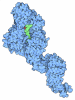
 emd_64091.png
 http://ftp.pdbj.org/pub/emdb/structures/EMD-64091
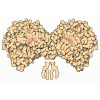
 Z (Sec.)
 Y (Row.)
 X (Col.)


 Sample components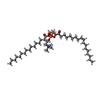
 Processing
 Electron microscopy
 FIELD EMISSION GUN
