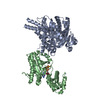
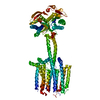
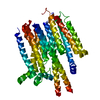
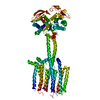
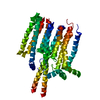
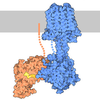
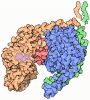
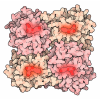
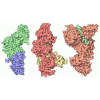
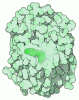
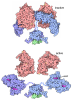
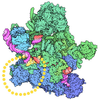
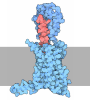
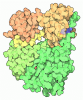
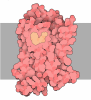
Journal: J Struct Biol / Year: 2025 Title: Structural insights into human adenylyl cyclase 9 in complex with Gαs by cryo-EM. Authors: Risa Nomura / Shota Suzuki / Koki Nishikawa / Hiroshi Suzuki / Yoshinori Fujiyoshi / Abstract: Adenylyl cyclase 9 (AC9) regulates many physiologic functions through the production of cAMP, an important second messenger that regulates downstream effectors. The activation of AC9 is highly ...Adenylyl cyclase 9 (AC9) regulates many physiologic functions through the production of cAMP, an important second messenger that regulates downstream effectors. The activation of AC9 is highly regulated by GPCR signaling. For example, AC9 is activated by the binding of Gαs, which, in turn, is activated by Gs-driven GPCRs. The structure of bovine AC9 (bAC9) was reported in 2019 using single-particle cryo-electron microscopy (cryo-EM). The structure of human AC9 (hAC9), however, has not been reported to date despite its potential benefit for drug development. Here, we analyzed the structures of hAC9 and hAC9 in complex with Gαs (hAC9-Gαs) using single-particle cryo-EM. The soluble domain of AC9-Gαs, the transmembrane (TM) domain of AC9-Gαs, and AC9 alone were analyzed at resolutions of 2.7 Å, 3.4 Å, and 3.2 Å, respectively. The results revealed three key aspects of the activation mechanism of hAC9 and its cAMP-generating function. First, a conformational change of the soluble domain was observed upon Gαs binding, resulting in a widely open catalytic site. Second, we analyzed the exact position of the C-terminus occluding the catalytic site in the hAC9-Gαs complex. Finally, we unexpectedly identified an elongated density suggestive of a single acyl chain in the TM domain. Consistent with recent reports on the allosteric regulation of AC by lipids, this finding suggests that the TM domain could serve as a potential drug target.These structural findings enhance our understanding of the structure and function of AC9 and other ACs and will provide a foundation for future AC-target drug discovery.
In the structure databanks used in Yorodumi, some data are registered as the other names, "COVID-19 virus" and "2019-nCoV". Here are the details of the virus and the list of structure data.
Jan 31, 2019. EMDB accession codes are about to change! (news from PDBe EMDB page)
EMDB accession codes are about to change! (news from PDBe EMDB page)
The allocation of 4 digits for EMDB accession codes will soon come to an end. Whilst these codes will remain in use, new EMDB accession codes will include an additional digit and will expand incrementally as the available range of codes is exhausted. The current 4-digit format prefixed with “EMD-” (i.e. EMD-XXXX) will advance to a 5-digit format (i.e. EMD-XXXXX), and so on. It is currently estimated that the 4-digit codes will be depleted around Spring 2019, at which point the 5-digit format will come into force.
The EM Navigator/Yorodumi systems omit the EMD- prefix.
Related info.:Q: What is EMD? / ID/Accession-code notation in Yorodumi/EM Navigator
Yorodumi is a browser for structure data from EMDB, PDB, SASBDB, etc.
This page is also the successor to EM Navigator detail page, and also detail information page/front-end page for Omokage search.
The word "yorodu" (or yorozu) is an old Japanese word meaning "ten thousand". "mi" (miru) is to see.
Related info.:EMDB / PDB / SASBDB / Comparison of 3 databanks / Yorodumi Search / Aug 31, 2016. New EM Navigator & Yorodumi / Yorodumi Papers / Jmol/JSmol / Function and homology information / Changes in new EM Navigator and Yorodumi
 Movie
Movie Controller


 Open data
 Basic information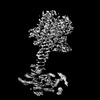
 Map data
 Sample
 Keywords
 Function and homology information
 Homo sapiens (human) /
  Human respiratory syncytial virus
 Authors
 Japan, 2 items
  Citation
 Structure visualization
 Downloads & links
 emd_63824.png
 http://ftp.pdbj.org/pub/emdb/structures/EMD-63824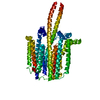



 Z (Sec.)
 Y (Row.)
 X (Col.)


 Sample components
 Processing
 Electron microscopy
 FIELD EMISSION GUN
