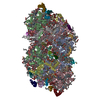
- EMDB-63639: cryo-EM structure of PSII D1-V185T from Thermosynechococcus vesti... -
+
Open data
ID or keywords:
Loading...
-
Basic information
Entry
Database: EMDB / ID: EMD-63639
Title
cryo-EM structure of PSII D1-V185T from Thermosynechococcus vestitus BP-1
Map data
primary map
Sample
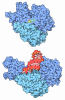
Complex: cryo-EM structure of psbA3 PSII D1-V185T from Thermosynechococcus vestitus BP-1
Protein or peptide: x 19 types
Ligand: x 20 types
Keywords
PSII mutation / PHOTOSYNTHESIS
Function / homology
Function and homology information
oxidoreductase activity, acting on diphenols and related substances as donors, oxygen as acceptor / response to herbicide / photosystem II oxygen evolving complex / photosystem II assembly / oxygen evolving activity / photosystem II stabilization / photosystem II reaction center / photosystem II / photosynthetic electron transport chain / photosystem II ...oxidoreductase activity, acting on diphenols and related substances as donors, oxygen as acceptor / response to herbicide / photosystem II oxygen evolving complex / photosystem II assembly / oxygen evolving activity / photosystem II stabilization / photosystem II reaction center / photosystem II / photosynthetic electron transport chain / photosystem II / extrinsic component of membrane / chlorophyll binding / photosynthetic electron transport in photosystem II / plasma membrane-derived thylakoid membrane / photosynthesis, light reaction / phosphate ion binding / photosynthesis / respiratory electron transport chain / electron transfer activity / protein stabilization / iron ion binding / heme binding Similarity search - Function
Photosystem II PsbU, oxygen evolving complex / Photosystem II 12 kDa extrinsic protein (PsbU) / Photosystem II PsbV, cytochrome c-550 precursor / Photosystem II cytochrome c-550 precursor / Cytochrome c-550 domain / Cytochrome c-550 domain / Photosystem II PsbX, type 1 subfamily / Photosystem II reaction centre protein Ycf12 / Photosystem II complex subunit Ycf12 / Photosystem II PsbJ ...Photosystem II PsbU, oxygen evolving complex / Photosystem II 12 kDa extrinsic protein (PsbU) / Photosystem II PsbV, cytochrome c-550 precursor / Photosystem II cytochrome c-550 precursor / Cytochrome c-550 domain / Cytochrome c-550 domain / Photosystem II PsbX, type 1 subfamily / Photosystem II reaction centre protein Ycf12 / Photosystem II complex subunit Ycf12 / Photosystem II PsbJ / Photosystem II PsbJ superfamily / PsbJ / Photosystem II PsbO, manganese-stabilising / Manganese-stabilising protein / photosystem II polypeptide / Photosystem II reaction centre M protein (PsbM) / Photosystem II PsbM superfamily / Photosystem II PsbM / Photosystem II PsbZ, reaction centre / Photosystem II PsbZ superfamily / YCF9 / Photosystem II PsbX / Photosystem II reaction centre X protein (PsbX) / Photosystem II PsbT / Photosystem II PsbL / Photosystem II CP43 reaction centre protein / Photosystem II PsbL superfamily / Photosystem II PsbT superfamily / Photosystem II CP43 reaction centre protein superfamily / Photosystem II reaction centre T protein / PsbL protein / Photosystem II PsbK / Photosystem II PsbK superfamily / Photosystem II 4 kDa reaction centre component / Photosystem II PsbI / Photosystem II CP47 reaction centre protein / Photosystem II PsbI superfamily / Photosystem II reaction centre I protein (PSII 4.8 kDa protein) / Photosystem II reaction centre protein H / Photosystem II protein D1 / Photosystem II reaction centre protein H superfamily / Photosystem II 10 kDa phosphoprotein / Photosystem II D2 protein / Photosystem II cytochrome b559, conserved site / Photosystem II cytochrome b559, alpha subunit / Photosystem II cytochrome b559, beta subunit / Photosystem II cytochrome b559, N-terminal / Photosystem II cytochrome b559, alpha subunit, lumenal region / Photosystem II cytochrome b559, alpha subunit superfamily / Cytochrome b559, alpha (gene psbE) and beta (gene psbF)subunits / Lumenal portion of Cytochrome b559, alpha (gene psbE) subunit / Cytochrome b559 subunits heme-binding site signature. / : / Photosystem antenna protein-like / Photosystem antenna protein-like superfamily / Photosystem II protein / Outer membrane protein/outer membrane enzyme PagP, beta-barrel / : / Photosynthetic reaction centre, L/M / Photosystem II protein D1/D2 superfamily / Photosynthetic reaction centre protein / Photosynthetic reaction center proteins signature. / Cytochrome c family profile. / Cytochrome c-like domain / Cytochrome c-like domain superfamily Similarity search - Domain/homology
Photosystem II extrinsic protein V / Photosystem II extrinsic protein O / Photosystem II reaction center protein J / Photosystem II D2 protein / Photosystem II reaction center protein M / Photosystem II reaction center protein Z / Photosystem II CP43 reaction center protein / Photosystem II reaction center protein L / Cytochrome b559 subunit beta / Cytochrome b559 subunit alpha ...Photosystem II extrinsic protein V / Photosystem II extrinsic protein O / Photosystem II reaction center protein J / Photosystem II D2 protein / Photosystem II reaction center protein M / Photosystem II reaction center protein Z / Photosystem II CP43 reaction center protein / Photosystem II reaction center protein L / Cytochrome b559 subunit beta / Cytochrome b559 subunit alpha / Photosystem II reaction center protein T / Photosystem II CP47 reaction center protein / Photosystem II protein D1 3 / Photosystem II reaction center protein H / Photosystem II reaction center protein Psb30 / Photosystem II reaction center protein I / Photosystem II reaction center protein K / Photosystem II extrinsic protein U / Photosystem II reaction center protein X Similarity search - Component
Journal: Biochim Biophys Acta Bioenerg / Year: 2026 Title: Cryo-EM structure of photosystem II D1-V185T mutant from Thermosynechococcus vestitus. Authors: Haowei Jiang / Yoshiki Nakajima / Fusamichi Akita / Hongjie Li / Koji Kato / Miwa Sugiura / Jian-Ren Shen / Abstract: Photosystem II (PSII) catalyzes water oxidation into electrons, protons and dioxygen at its catalytic center, a MnCaO cluster, utilizing light energy. An amino acid residue D1-V185 in the D1 protein ...Photosystem II (PSII) catalyzes water oxidation into electrons, protons and dioxygen at its catalytic center, a MnCaO cluster, utilizing light energy. An amino acid residue D1-V185 in the D1 protein is located close to the MnCaO cluster, and plays a critical role in its catalytic function. In this research we purified PSII dimers from a D1-V185T mutant of Thermosynechococcus vestitus and analyzed its structure using low-damage cryo-electron microscopy (cryo-EM) at a resolution of 1.88 Å. The results revealed the presence of multi-conformations at the mutation site. Unlike the wild-type valine, which does not allow water molecules to be able to form hydrogen-bonds with it, both conformations of the mutant formed hydrogen bonds with nearby water molecules, which leads to rearrangement of the hydrogen bond networks in the O1 and Cl-1 channels. In conformation-A, the mutated Thr residue forms a hydrogen bond with a water molecule W6, which creates a new channel that bypasses the original O1 channel. Due to the hydrophilic OH group of Thr, the side-chain of D1-Glu189 was attracted and shifted toward the mutant Thr residue. In conformation-B, it forms a hydrogen bond with a water molecule W9 in the Cl-1 channel, bringing W9 closer and thereby disrupting the hydrogen bond network of the Cl-1 channel. In addition, multi-conformations of D2-K317, which is a ligand of Cl-1, were found in the mutant. These changes alter the environment surrounding the Cl-1 ion and MnCaO, thereby affecting the PSII water-oxidation activity.
In the structure databanks used in Yorodumi, some data are registered as the other names, "COVID-19 virus" and "2019-nCoV". Here are the details of the virus and the list of structure data.
Jan 31, 2019. EMDB accession codes are about to change! (news from PDBe EMDB page)
EMDB accession codes are about to change! (news from PDBe EMDB page)
The allocation of 4 digits for EMDB accession codes will soon come to an end. Whilst these codes will remain in use, new EMDB accession codes will include an additional digit and will expand incrementally as the available range of codes is exhausted. The current 4-digit format prefixed with “EMD-” (i.e. EMD-XXXX) will advance to a 5-digit format (i.e. EMD-XXXXX), and so on. It is currently estimated that the 4-digit codes will be depleted around Spring 2019, at which point the 5-digit format will come into force.
The EM Navigator/Yorodumi systems omit the EMD- prefix.
Related info.:Q: What is EMD? / ID/Accession-code notation in Yorodumi/EM Navigator
Yorodumi is a browser for structure data from EMDB, PDB, SASBDB, etc.
This page is also the successor to EM Navigator detail page, and also detail information page/front-end page for Omokage search.
The word "yorodu" (or yorozu) is an old Japanese word meaning "ten thousand". "mi" (miru) is to see.
Related info.:EMDB / PDB / SASBDB / Comparison of 3 databanks / Yorodumi Search / Aug 31, 2016. New EM Navigator & Yorodumi / Yorodumi Papers / Jmol/JSmol / Function and homology information / Changes in new EM Navigator and Yorodumi
 Movie
Movie Controller

 Yorodumi
 Open data
 Basic information
 Map data
 Sample
 Keywords
 Function and homology information
 Thermosynechococcus vestitus (bacteria) /
  Authors
 Citation

 Structure visualization
 Downloads & links
 emd_63639.png
 https://data.pdbj.org/pub/emdb/structures/EMD-63639
 Z (Sec.)
 Y (Row.)
 X (Col.)


 Sample components



 Processing
 Electron microscopy
 FIELD EMISSION GUN