 Movie
Movie Controller

[English] 日本語
 Yorodumi
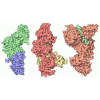
- EMDB-63614: Structure-based discovery of potent agonists of the orphan recept... -
+ Open data

- Basic information
| Entry |  | |||||||||
|---|---|---|---|---|---|---|---|---|---|---|
| Title | Structure-based discovery of potent agonists of the orphan receptor GPR139 | |||||||||
 Map data Map data | ||||||||||
 Sample Sample |
| |||||||||
 Keywords Keywords | GPR139 / Complex / G protein / STRUCTURAL PROTEIN | |||||||||
| Function / homology |  Function and homology information Function and homology informationneuropeptide receptor activity / endo-1,4-beta-xylanase / endo-1,4-beta-xylanase activity / xylan catabolic process / adenylate cyclase-activating G protein-coupled bile acid receptor signaling pathway / adenylate cyclase-activating serotonin receptor signaling pathway / intracellular transport / regulation of skeletal muscle contraction / hair follicle placode formation / developmental growth ...neuropeptide receptor activity / endo-1,4-beta-xylanase / endo-1,4-beta-xylanase activity / xylan catabolic process / adenylate cyclase-activating G protein-coupled bile acid receptor signaling pathway / adenylate cyclase-activating serotonin receptor signaling pathway / intracellular transport / regulation of skeletal muscle contraction / hair follicle placode formation / developmental growth / PKA activation in glucagon signalling / renal water homeostasis / D1 dopamine receptor binding / vascular endothelial cell response to laminar fluid shear stress / Hedgehog 'off' state / activation of adenylate cyclase activity / adenylate cyclase-activating adrenergic receptor signaling pathway / cellular response to acidic pH / ovarian follicle development / cellular response to glucagon stimulus / intracellular glucose homeostasis / adenylate cyclase activator activity / positive regulation of insulin secretion involved in cellular response to glucose stimulus / positive regulation of insulin secretion / trans-Golgi network membrane / negative regulation of inflammatory response to antigenic stimulus / response to prostaglandin E / bone development / platelet aggregation / cognition / G-protein beta/gamma-subunit complex binding / Olfactory Signaling Pathway / phospholipase C-activating G protein-coupled receptor signaling pathway / Activation of the phototransduction cascade / sensory perception of smell / G protein-coupled acetylcholine receptor signaling pathway / G beta:gamma signalling through PLC beta / Presynaptic function of Kainate receptors / Thromboxane signalling through TP receptor / Activation of G protein gated Potassium channels / Inhibition of voltage gated Ca2+ channels via Gbeta/gamma subunits / G-protein activation / Glucagon signaling in metabolic regulation / G beta:gamma signalling through CDC42 / Prostacyclin signalling through prostacyclin receptor / Synthesis, secretion, and inactivation of Glucagon-like Peptide-1 (GLP-1) / photoreceptor disc membrane / G beta:gamma signalling through BTK / ADP signalling through P2Y purinoceptor 12 / Sensory perception of sweet, bitter, and umami (glutamate) taste / Glucagon-type ligand receptors / Adrenaline,noradrenaline inhibits insulin secretion / Vasopressin regulates renal water homeostasis via Aquaporins / G alpha (z) signalling events / Glucagon-like Peptide-1 (GLP1) regulates insulin secretion / ADP signalling through P2Y purinoceptor 1 / cellular response to catecholamine stimulus / G beta:gamma signalling through PI3Kgamma / ADORA2B mediated anti-inflammatory cytokines production / adenylate cyclase-activating dopamine receptor signaling pathway / positive regulation of cold-induced thermogenesis / cellular response to prostaglandin E stimulus / Cooperation of PDCL (PhLP1) and TRiC/CCT in G-protein beta folding / GPER1 signaling / heterotrimeric G-protein complex / G alpha (12/13) signalling events / Inactivation, recovery and regulation of the phototransduction cascade / G-protein beta-subunit binding / extracellular vesicle / Thrombin signalling through proteinase activated receptors (PARs) / adenylate cyclase-activating G protein-coupled receptor signaling pathway / signaling receptor complex adaptor activity / GTPase binding / G protein activity / Ca2+ pathway / High laminar flow shear stress activates signaling by PIEZO1 and PECAM1:CDH5:KDR in endothelial cells / G alpha (i) signalling events / G alpha (s) signalling events / G alpha (q) signalling events / Hydrolases; Acting on acid anhydrides; Acting on GTP to facilitate cellular and subcellular movement / cytoplasmic side of plasma membrane / Ras protein signal transduction / Extra-nuclear estrogen signaling / G protein-coupled receptor signaling pathway / lysosomal membrane / GTPase activity / GTP binding / synapse / protein-containing complex binding / signal transduction / extracellular exosome / membrane / identical protein binding / plasma membrane / cytosol / cytoplasm Similarity search - Function | |||||||||
| Biological species |  Homo sapiens (human) Homo sapiens (human) | |||||||||
| Method | single particle reconstruction / cryo EM / Resolution: 3.2 Å | |||||||||
 Authors Authors | Cabezadevaca I / Trapkov B / Shen L / Pezeshki M / Zhang XH / Liu Z / Hauser AS / Carlsson J | |||||||||
| Funding support | 1 items
| |||||||||
 Citation Citation | Journal: Nat Commun / Year: 2025 Title: Ultra-large virtual screening unveils potent agonists of the neuromodulatory orphan receptor GPR139. Authors: Israel Cabeza de Vaca / Boris Trapkov / Ling Shen / Duy Duc Vo / Xiaoqun Zhang / Yunting Yang / Mitra Pezeshki / Xuehan Zhang / Frida Bällgren / Aljona Saleh / Andrii V Tarnovskiy / Dmytro ...Authors: Israel Cabeza de Vaca / Boris Trapkov / Ling Shen / Duy Duc Vo / Xiaoqun Zhang / Yunting Yang / Mitra Pezeshki / Xuehan Zhang / Frida Bällgren / Aljona Saleh / Andrii V Tarnovskiy / Dmytro S Radchenko / Yurii S Moroz / Hans Bräuner-Osborne / Per Svenningsson / Jan Kihlberg / Zhi-Jie Liu / Alexander Sebastian Hauser / Jens Carlsson /     Abstract: The orphan G protein-coupled receptor (GPCR) GPR139 attracts interest as a target for neuropsychiatric disorders. Whereas the physiological functions of GPR139 remain elusive, a high-resolution ...The orphan G protein-coupled receptor (GPCR) GPR139 attracts interest as a target for neuropsychiatric disorders. Whereas the physiological functions of GPR139 remain elusive, a high-resolution receptor structure is now available. To assess whether structural information enables ligand discovery, we computationally dock 235 million compounds to the GPR139 binding site. Of 68 top-ranked compounds evaluated experimentally, five are full agonists with potencies ranging from 160 nM to 3.6 µM. Structure-guided optimization identifies one of the most potent GPR139 agonists, and a cryo-EM structure of the receptor-ligand complex confirms the predicted binding mode. Functional characterization provides insights into GPR139 signalling, and one agonist elicits behavioural effects in mice. We also explore the potential to replace experimental structure determination with the deep-learning method AlphaFold3, revealing a limited capability of artificial intelligence to model receptor-ligand interactions for understudied GPCRs. The results demonstrate how high-resolution GPCR structures combined with large-library docking can accelerate drug discovery. | |||||||||
| History |
|
- Structure visualization
| Supplemental images |
|---|

- Downloads & links
-EMDB archive
| Map data | emd_63614.map.gz | 56.5 MB | EMDB map data format | |
|---|---|---|---|---|
| Header (meta data) | emd-63614-v30.xmlemd-63614.xml | 22.6 KB 22.6 KB | Display Display | EMDB header |
| FSC (resolution estimation) | emd_63614_fsc.xml | 8.5 KB | Display | FSC data file |
| Images |  emd_63614.png emd_63614.png | 59.7 KB | ||
| Filedesc metadata | emd-63614.cif.gz | 7.3 KB | ||
| Others | emd_63614_half_map_1.map.gzemd_63614_half_map_2.map.gz | 59.3 MB 59.3 MB | ||
| Archive directory |  https://data.pdbj.org/pub/emdb/structures/EMD-63614ftp://data.pdbj.org/pub/emdb/structures/EMD-63614 https://data.pdbj.org/pub/emdb/structures/EMD-63614ftp://data.pdbj.org/pub/emdb/structures/EMD-63614 | HTTPS FTP |
-Related structure data
| Related structure data |  9m42MC M: atomic model generated by this map C: citing same article ( |
|---|---|
| Similar structure data |
-Links
| EMDB pages | EMDB (EBI/PDBe) / EMDataResource |
|---|---|
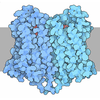
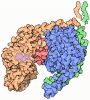
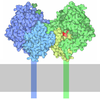
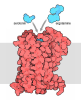
| Related items in Molecule of the Month |

-Map
| File | Download / File: emd_63614.map.gz / Format: CCP4 / Size: 64 MB / Type: IMAGE STORED AS FLOATING POINT NUMBER (4 BYTES) | ||||||||||||||||||||||||||||||||||||
|---|---|---|---|---|---|---|---|---|---|---|---|---|---|---|---|---|---|---|---|---|---|---|---|---|---|---|---|---|---|---|---|---|---|---|---|---|---|
| Projections & slices | Image control
Images are generated by Spider. | ||||||||||||||||||||||||||||||||||||
| Voxel size | X=Y=Z: 0.96 Å | ||||||||||||||||||||||||||||||||||||
| Density |
| ||||||||||||||||||||||||||||||||||||
| Symmetry | Space group: 1 | ||||||||||||||||||||||||||||||||||||
| Details | EMDB XML:
|
 Z (Sec.)
 Y (Row.)
 X (Col.)


-Supplemental data
-Half map: #2
| File | emd_63614_half_map_1.map | ||||||||||||
|---|---|---|---|---|---|---|---|---|---|---|---|---|---|
| Projections & Slices |
| ||||||||||||
| Density Histograms |


-Half map: #1
| File | emd_63614_half_map_2.map | ||||||||||||
|---|---|---|---|---|---|---|---|---|---|---|---|---|---|
| Projections & Slices |
| ||||||||||||
| Density Histograms |


- Sample components
-Entire : GPR139_Gs/q
| Entire | Name: GPR139_Gs/q |
|---|---|
| Components |
|
-Supramolecule #1: GPR139_Gs/q
| Supramolecule | Name: GPR139_Gs/q / type: complex / ID: 1 / Parent: 0 / Macromolecule list: #1-#5 |
|---|---|
| Source (natural) | Organism: Homo sapiens (human) |
-Macromolecule #1: Guanine nucleotide-binding protein G(s) subunit alpha isoforms short
| Macromolecule | Name: Guanine nucleotide-binding protein G(s) subunit alpha isoforms short type: protein_or_peptide / ID: 1 / Number of copies: 1 / Enantiomer: LEVO EC number: Hydrolases; Acting on acid anhydrides; Acting on GTP to facilitate cellular and subcellular movement |
|---|---|
| Source (natural) | Organism: Homo sapiens (human) |
| Molecular weight | Theoretical: 30.59551 KDa |
| Recombinant expression | Organism:   Escherichia coli (E. coli) Escherichia coli (E. coli) |
| Sequence | String: MHHHHHHENL YFQGNSKTED QRNEEKAQRE ANKKIEKQLQ KDKQVYRATH RLLLLGADNS GKSTIVKQMR ILHGGSGGSG GTSGIFETK FQVDKVNFHM FDVGGQRDER RKWIQCFNDV TAIIFVVDSS DYNRLQEALN LFKSIWNNRW LRTISVILFL N KQDLLAEK ...String: MHHHHHHENL YFQGNSKTED QRNEEKAQRE ANKKIEKQLQ KDKQVYRATH RLLLLGADNS GKSTIVKQMR ILHGGSGGSG GTSGIFETK FQVDKVNFHM FDVGGQRDER RKWIQCFNDV TAIIFVVDSS DYNRLQEALN LFKSIWNNRW LRTISVILFL N KQDLLAEK VLAGKSKIED YFPEFARYTT PEDATPEPGE DPRVTRAKYF IRDEFLRIST ASGDGRHYCY PHFTCAVDTE NA RRIFNDC KDIILQMNLR EYNLV UniProtKB: Guanine nucleotide-binding protein G(s) subunit alpha isoforms short, Guanine nucleotide-binding protein G(s) subunit alpha isoforms short |
-Macromolecule #2: Guanine nucleotide-binding protein G(I)/G(S)/G(T) subunit beta-1
| Macromolecule | Name: Guanine nucleotide-binding protein G(I)/G(S)/G(T) subunit beta-1 type: protein_or_peptide / ID: 2 / Number of copies: 1 / Enantiomer: LEVO |
|---|---|
| Source (natural) | Organism: Homo sapiens (human) |
| Molecular weight | Theoretical: 37.564102 KDa |
| Recombinant expression | Organism:   Spodoptera frugiperda (fall armyworm) Spodoptera frugiperda (fall armyworm) |
| Sequence | String: FMSELDQLRQ EAEQLKNQIR DARKACADAT LSQITNNIDP VGRIQMRTRR TLRGHLAKIY AMHWGTDSRL LVSASQDGKL IIWDSYTTN KVHAIPLRSS WVMTCAYAPS GNYVACGGLD NICSIYNLKT REGNVRVSRE LAGHTGYLSC CRFLDDNQIV T SSGDTTCA ...String: FMSELDQLRQ EAEQLKNQIR DARKACADAT LSQITNNIDP VGRIQMRTRR TLRGHLAKIY AMHWGTDSRL LVSASQDGKL IIWDSYTTN KVHAIPLRSS WVMTCAYAPS GNYVACGGLD NICSIYNLKT REGNVRVSRE LAGHTGYLSC CRFLDDNQIV T SSGDTTCA LWDIETGQQT TTFTGHTGDV MSLSLAPDTR LFVSGACDAS AKLWDVREGM CRQTFTGHES DINAICFFPN GN AFATGSD DATCRLFDLR ADQELMTYSH DNIICGITSV SFSKSGRLLL AGYDDFNCNV WDALKADRAG VLAGHDNRVS CLG VTDDGM AVATGSWDSF LKIWN UniProtKB: Guanine nucleotide-binding protein G(I)/G(S)/G(T) subunit beta-1 |
-Macromolecule #3: Guanine nucleotide-binding protein G(I)/G(S)/G(O) subunit gamma-2
| Macromolecule | Name: Guanine nucleotide-binding protein G(I)/G(S)/G(O) subunit gamma-2 type: protein_or_peptide / ID: 3 / Number of copies: 1 / Enantiomer: LEVO |
|---|---|
| Source (natural) | Organism: Homo sapiens (human) |
| Molecular weight | Theoretical: 10.49796 KDa |
| Recombinant expression | Organism: Spodoptera frugiperda (fall armyworm) |
| Sequence | String: MHHHHHHGGG SDSLEFIASK LAGGGSMASN NTASIAQARK LVEQLKMEAN IDRIKVSKAA ADLMAYCEAH AKEDPLLTPV PASENPFRE KKFFSAIL UniProtKB: Guanine nucleotide-binding protein G(I)/G(S)/G(O) subunit gamma-2 |
-Macromolecule #4: Nanobody 35
| Macromolecule | Name: Nanobody 35 / type: protein_or_peptide / ID: 4 / Number of copies: 1 / Enantiomer: LEVO |
|---|---|
| Source (natural) | Organism: Homo sapiens (human) |
| Molecular weight | Theoretical: 17.483693 KDa |
| Recombinant expression | Organism: Escherichia coli (E. coli) |
| Sequence | String: MKYLLPTAAA GLLLLAAQPA MAMQVQLQES GGGLVQPGGS LRLSCAASGF TFSNYKMNWV RQAPGKGLEW VSDISQSGAS ISYTGSVKG RFTISRDNAK NTLYLQMNSL KPEDTAVYYC ARCPAPFTRD CFDVTSTTYA YRGQGTQVTV SSHHHHHHEP E A |
-Macromolecule #5: Endo-1,4-beta-xylanase,Probable G-protein coupled receptor 139
| Macromolecule | Name: Endo-1,4-beta-xylanase,Probable G-protein coupled receptor 139 type: protein_or_peptide / ID: 5 Details: Chimera of Endo-1,4-beta-xylanase and Probable G-protein coupled receptor 139 Number of copies: 1 / Enantiomer: LEVO / EC number: endo-1,4-beta-xylanase |
|---|---|
| Source (natural) | Organism: Homo sapiens (human) |
| Molecular weight | Theoretical: 60.964281 KDa |
| Recombinant expression | Organism: Spodoptera frugiperda (fall armyworm) |
| Sequence | String: MKHHHHHHHH HHDYKDDDDA ENLYFQSPAS TDYWQNWTFG GGIVNAVNGS GGNYSVNWSN TGNFVVGKGW TTGSPFRTIN YNAGVWAPN GNGYLTLYGW TRSPLIEYYV VDSWGTYRPT GTYKGTVKSD GGTYDIYTTT RYNAPSIDGD DTTFTQYWSV R QSKRPTGS ...String: MKHHHHHHHH HHDYKDDDDA ENLYFQSPAS TDYWQNWTFG GGIVNAVNGS GGNYSVNWSN TGNFVVGKGW TTGSPFRTIN YNAGVWAPN GNGYLTLYGW TRSPLIEYYV VDSWGTYRPT GTYKGTVKSD GGTYDIYTTT RYNAPSIDGD DTTFTQYWSV R QSKRPTGS NATITFTNHV NAWKSHGMNL GSNWAYQVMA TEGYQSSGSS NVTVWEHTHA HLAANSSLSW WSPGSACGLG FV PVVYYSL LLCLGLPANI LTVIILSQLV ARRQKSVYNY LLALAAADIL VLFFIVFVDF LLEDFILNMQ MPQVPDKIIE VLE FSSIHT SIWITVPLTI DRYIAVCHPL KYHTVSYPAR TRKVIVSVYI TCFLTSIPYY WWPNIWTEDY ISTSVHHVLI WIHC FTVYL VPCSIFFILN SIIVYKLRRK SNFRLRGYST GKTTAILFTI TSIFATLWAP RIIMILYHLY GAPIQNRWLV HIMSD IANM LALLNTAINF FLYCFISKRF RTMAAATLKA FFKCQKQPVQ FYTNHNFSI UniProtKB: Endo-1,4-beta-xylanase, Probable G protein-coupled receptor 139 |
-Macromolecule #6: 2-[5-(4-methylthiophen-3-yl)-1,2,4-oxadiazol-3-yl]-~{N}-[(1~{S})-...
| Macromolecule | Name: 2-[5-(4-methylthiophen-3-yl)-1,2,4-oxadiazol-3-yl]-~{N}-[(1~{S})-1-phenylethyl]ethanamide type: ligand / ID: 6 / Number of copies: 1 / Formula: A1L8O |
|---|---|
| Molecular weight | Theoretical: 327.401 Da |
-Macromolecule #7: water
| Macromolecule | Name: water / type: ligand / ID: 7 / Number of copies: 1 / Formula: HOH |
|---|---|
| Molecular weight | Theoretical: 18.015 Da |
| Chemical component information |  ChemComp-HOH: |
-Experimental details
-Structure determination
| Method | cryo EM |
|---|---|
 Processing Processing | single particle reconstruction |
| Aggregation state | particle |
-Sample preparation
| Buffer | pH: 7.5 |
|---|---|
| Vitrification | Cryogen name: ETHANE |
- Electron microscopy
| Microscope | FEI TALOS ARCTICA |
|---|---|
| Image recording | Film or detector model: GATAN K3 BIOQUANTUM (6k x 4k) / Average electron dose: 60.0 e/Å2 |
| Electron beam | Acceleration voltage: 300 kV / Electron source:  FIELD EMISSION GUN FIELD EMISSION GUN |
| Electron optics | Illumination mode: FLOOD BEAM / Imaging mode: BRIGHT FIELD / Nominal defocus max: 2.0 µm / Nominal defocus min: 1.2 µm |
| Experimental equipment | 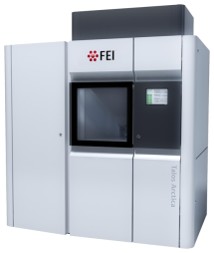 Model: Talos Arctica / Image courtesy: FEI Company |

