- EMDB-63405: PSI-4 LHCI dimer supercomplex from M. polymorpha -
+
Open data
ID or keywords:
Loading...
-
Basic information
Entry
Database: EMDB / ID: EMD-63405
Title
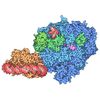
PSI-4 LHCI dimer supercomplex from M. polymorpha
Map data
Sample
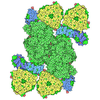
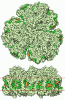
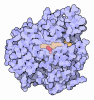
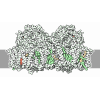
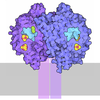
Complex: Photosystem I-4 LHCI dimer supercomplex from liverwort
Protein or peptide: x 17 types
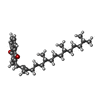
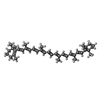
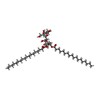
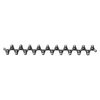
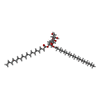
Ligand: x 12 types
Keywords
Photosystem I / PHOTOSYNTHESIS
Function / homology
Function and homology information
chloroplast photosystem I / response to low light intensity stimulus / plastid thylakoid membrane / thylakoid membrane / response to high light intensity / photosynthesis, light harvesting in photosystem I / chloroplast thylakoid lumen / photosystem I reaction center / photosystem I / photosynthetic electron transport in photosystem I ...chloroplast photosystem I / response to low light intensity stimulus / plastid thylakoid membrane / thylakoid membrane / response to high light intensity / photosynthesis, light harvesting in photosystem I / chloroplast thylakoid lumen / photosystem I reaction center / photosystem I / photosynthetic electron transport in photosystem I / photosystem I / photosystem II / chlorophyll binding / chloroplast thylakoid membrane / response to light stimulus / response to cold / photosynthesis / chloroplast / 4 iron, 4 sulfur cluster binding / electron transfer activity / oxidoreductase activity / protein domain specific binding / mRNA binding / magnesium ion binding / metal ion binding Similarity search - Function
Photosystem I PsaH, reaction centre subunit VI / Photosystem I reaction centre subunit VI / Photosystem I reaction center subunit V / Photosystem I reaction center subunit psaK, plant / Photosystem I reaction center subunit V/PsaK, plant / Photosystem I PsaG/PsaK domain, chloroplastic / Photosystem I PsaM, reaction centre superfamily / Photosystem I PsaM, reaction centre / Photosystem I protein M (PsaM) / Photosystem I psaG and psaK proteins signature. ...Photosystem I PsaH, reaction centre subunit VI / Photosystem I reaction centre subunit VI / Photosystem I reaction center subunit V / Photosystem I reaction center subunit psaK, plant / Photosystem I reaction center subunit V/PsaK, plant / Photosystem I PsaG/PsaK domain, chloroplastic / Photosystem I PsaM, reaction centre superfamily / Photosystem I PsaM, reaction centre / Photosystem I protein M (PsaM) / Photosystem I psaG and psaK proteins signature. / Photosystem I reaction center subunit V/PsaK / Photosystem I psaG / psaK / Photosystem I PsaL, reaction centre subunit XI / Photosystem I, reaction centre subunit XI / Photosystem I PsaL, reaction centre subunit XI superfamily / Photosystem I reaction centre subunit XI / Photosystem I reaction centre subunit VIII / Photosystem I reaction centre subunit VIII / Chlorophyll A-B binding protein, plant and chromista / Chlorophyll A-B binding protein / Chlorophyll A-B binding protein / Photosystem I reaction centre subunit VIII superfamily / Photosystem I PsaF, reaction centre subunit III / Photosystem I PsaF, reaction centre subunit III superfamily / Photosystem I reaction centre subunit III / Photosystem I PsaD / Photosystem I, reaction centre subunit PsaD superfamily / PsaD / Photosystem I PsaE, reaction centre subunit IV / Photosystem I reaction centre subunit IV / PsaE / Photosystem I PsaJ, reaction centre subunit IX superfamily / Photosystem I PsaJ, reaction centre subunit IX / Photosystem I reaction centre subunit IX / PsaJ / Photosystem I protein PsaC / Photosystem I PsaA / Photosystem I PsaB / Photosystem I PsaA/PsaB, conserved site / Photosystem I psaA and psaB proteins signature. / : / Photosystem I PsaA/PsaB / Photosystem I PsaA/PsaB superfamily / Photosystem I psaA/psaB protein / Electron transport accessory-like domain superfamily / 4Fe-4S dicluster domain / 4Fe-4S ferredoxin, iron-sulphur binding, conserved site / 4Fe-4S ferredoxin-type iron-sulfur binding region signature. / 4Fe-4S ferredoxin-type iron-sulfur binding domain profile. / 4Fe-4S ferredoxin-type, iron-sulphur binding domain Similarity search - Domain/homology
Photosystem I reaction center subunit II, chloroplastic / PSI-K / Photosystem I reaction center subunit XI, chloroplastic / Photosystem I reaction center subunit III / Uncharacterized protein / Photosystem I reaction center subunit V, chloroplastic / Photosystem I reaction center subunit VI, chloroplastic / Photosystem I P700 chlorophyll a apoprotein A2 / Photosystem I iron-sulfur center / Photosystem I P700 chlorophyll a apoprotein A1 ...Photosystem I reaction center subunit II, chloroplastic / PSI-K / Photosystem I reaction center subunit XI, chloroplastic / Photosystem I reaction center subunit III / Uncharacterized protein / Photosystem I reaction center subunit V, chloroplastic / Photosystem I reaction center subunit VI, chloroplastic / Photosystem I P700 chlorophyll a apoprotein A2 / Photosystem I iron-sulfur center / Photosystem I P700 chlorophyll a apoprotein A1 / Chlorophyll a-b binding protein, chloroplastic / Chlorophyll a-b binding protein, chloroplastic / Chlorophyll a-b binding protein, chloroplastic / Chlorophyll a-b binding protein, chloroplastic / Photosystem I reaction center subunit VIII / Photosystem I reaction center subunit IX / Photosystem I reaction center subunit XII Similarity search - Component
Biological species
Marchantia polymorpha (common liverwort)
Method
single particle reconstruction / cryo EM / Resolution: 2.52 Å
Journal: Commun Biol / Year: 2026 Title: Structural study of monomeric and dimeric photosystem I-LHCI supercomplexes from a bryophyte. Authors: Pi-Cheng Tsai / Romain La Rocca / Hiroyasu Motose / Jian-Ren Shen / Fusamichi Akita / Abstract: Photosystem I (PSI) is one of the two photosystems conserved from cyanobacteria to vascular plants, and associates with multiple light-harvesting complexes (LHCs) that capture and transfer solar ...Photosystem I (PSI) is one of the two photosystems conserved from cyanobacteria to vascular plants, and associates with multiple light-harvesting complexes (LHCs) that capture and transfer solar energy. Liverworts such as Marchantia polymorpha occupy an early evolutionary position among land plants and faced major challenges during terrestrial adaptation, including desiccation, strong light, and UV radiation. We reveal the cryo-electron microscopic structures of PSI-LHCI monomer and homodimer from the liverwort M. polymorpha at resolutions of 1.94 and 2.52 Å, respectively. The high-resolution map allows identification of the cofactors of the monomer and reveal differences between the liverwort and moss, another clade of bryophytes. The PSI-LHCI monomer-monomer is stabilized by PsaG and PsaH interactions on the stromal side, which causes the bending and twisting of the homodimer. PsaM interacts with PsaB tightly, indicating a key role of PsaM in mediating the dimerization.
Model: Quantifoil R1.2/1.3 / Material: COPPER / Mesh: 300 / Support film - Material: CARBON / Support film - topology: HOLEY / Pretreatment - Type: GLOW DISCHARGE / Pretreatment - Time: 10 sec. / Pretreatment - Atmosphere: OTHER / Pretreatment - Pressure: 0.007 kPa / Details: 10 mA
Vitrification
Cryogen name: ETHANE / Instrument: FEI VITROBOT MARK IV
Details
1.46 mg Chl a per mL
-
Electron microscopy
Microscope
TFS KRIOS
Specialist optics
Phase plate: VOLTA PHASE PLATE / Energy filter - Name: TFS Selectris X
Image recording
Film or detector model: FEI FALCON IV (4k x 4k) / Digitization - Dimensions - Width: 4096 pixel / Digitization - Dimensions - Height: 4096 pixel / Number grids imaged: 2 / Number real images: 17907 / Average electron dose: 50.0 e/Å2
Electron beam
Acceleration voltage: 300 kV / Electron source: FIELD EMISSION GUN
In the structure databanks used in Yorodumi, some data are registered as the other names, "COVID-19 virus" and "2019-nCoV". Here are the details of the virus and the list of structure data.
Jan 31, 2019. EMDB accession codes are about to change! (news from PDBe EMDB page)
EMDB accession codes are about to change! (news from PDBe EMDB page)
The allocation of 4 digits for EMDB accession codes will soon come to an end. Whilst these codes will remain in use, new EMDB accession codes will include an additional digit and will expand incrementally as the available range of codes is exhausted. The current 4-digit format prefixed with “EMD-” (i.e. EMD-XXXX) will advance to a 5-digit format (i.e. EMD-XXXXX), and so on. It is currently estimated that the 4-digit codes will be depleted around Spring 2019, at which point the 5-digit format will come into force.
The EM Navigator/Yorodumi systems omit the EMD- prefix.
Related info.:Q: What is EMD? / ID/Accession-code notation in Yorodumi/EM Navigator
Yorodumi is a browser for structure data from EMDB, PDB, SASBDB, etc.
This page is also the successor to EM Navigator detail page, and also detail information page/front-end page for Omokage search.
The word "yorodu" (or yorozu) is an old Japanese word meaning "ten thousand". "mi" (miru) is to see.
Related info.:EMDB / PDB / SASBDB / Comparison of 3 databanks / Yorodumi Search / Aug 31, 2016. New EM Navigator & Yorodumi / Yorodumi Papers / Jmol/JSmol / Function and homology information / Changes in new EM Navigator and Yorodumi
 Movie
Movie Controller


 Open data
 Basic information
 Map data
 Sample
 Keywords
 Function and homology information
 Marchantia polymorpha (common liverwort)
 Authors
 Japan, 1 items
  Citation
 Structure visualization
 Downloads & links
 emd_63405.png
 https://data.pdbj.org/pub/emdb/structures/EMD-63405


 Z (Sec.)
 Y (Row.)
 X (Col.)




 Sample components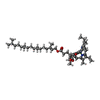
 Processing
 Electron microscopy
 FIELD EMISSION GUN

