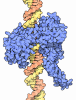
- EMDB-63118: structure of phage T4 topoisomerase II central domain -
+
Open data
ID or keywords:
Loading...
-
Basic information
Entry
Database: EMDB / ID: EMD-63118
Title
structure of phage T4 topoisomerase II central domain
Map data
map
Sample
Complex: Phage T4 topoisomerase II central domian apo state
Protein or peptide: DNA topoisomerase medium subunit
Protein or peptide: DNA topoisomerase large subunit,DNA topoisomerase small subunit
Keywords
topoisomerase II / ISOMERASE
Function / homology
Function and homology information
sister chromatid segregation / DNA topoisomerase type II (double strand cut, ATP-hydrolyzing) complex / DNA topoisomerase type II (double strand cut, ATP-hydrolyzing) activity / DNA topoisomerase (ATP-hydrolysing) / DNA topological change / protein-containing complex / DNA binding / ATP binding Similarity search - Function
C-terminal associated domain of TOPRIM / C-terminal associated domain of TOPRIM / DNA topoisomerase II, eukaryotic-type / : / Topoisomerase (Topo) IIA-type catalytic domain profile. / DNA topoisomerase, type IIA, alpha-helical domain superfamily / DNA topoisomerase, type IIA, domain A / DNA topoisomerase, type IIA, domain A, alpha-beta / DNA gyrase/topoisomerase IV, subunit A / DNA Topoisomerase IV ...C-terminal associated domain of TOPRIM / C-terminal associated domain of TOPRIM / DNA topoisomerase II, eukaryotic-type / : / Topoisomerase (Topo) IIA-type catalytic domain profile. / DNA topoisomerase, type IIA, alpha-helical domain superfamily / DNA topoisomerase, type IIA, domain A / DNA topoisomerase, type IIA, domain A, alpha-beta / DNA gyrase/topoisomerase IV, subunit A / DNA Topoisomerase IV / DNA topoisomerase, type IIA, subunit B, domain 2 / DNA gyrase B / DNA topoisomerase, type IIA / DNA topoisomerase, type IIA, conserved site / DNA topoisomerase II signature. / TopoisomeraseII / DNA topoisomerase, type IIA, subunit B, C-terminal / DNA topoisomerase, type IIA-like domain superfamily / Histidine kinase-, DNA gyrase B-, and HSP90-like ATPase / Histidine kinase-like ATPases / Histidine kinase/HSP90-like ATPase / Histidine kinase/HSP90-like ATPase superfamily / Ribosomal protein S5 domain 2-type fold, subgroup / Ribosomal protein S5 domain 2-type fold Similarity search - Domain/homology
DNA topoisomerase medium subunit / DNA topoisomerase large subunit / DNA topoisomerase small subunit Similarity search - Component
Biological species
Enterobacteria phage T4 (virus)
Method
single particle reconstruction / cryo EM / Resolution: 3.06 Å
Journal: Sci Adv / Year: 2025 Title: Direct trapping of the transport-segment DNA by the central domain of type IIA topoisomerases. Authors: Yuhui Xin / Runqi Xian / Congrong Liu / Oujia Zhang / Zihe Rao / Xuemei Li / Yutao Chen / Abstract: Type IIA topoisomerases modulate DNA topology by coordinating the cleavage of gate-segment DNA and the passage of transport-segment DNA-a mechanism conserved across species and essential for diverse ...Type IIA topoisomerases modulate DNA topology by coordinating the cleavage of gate-segment DNA and the passage of transport-segment DNA-a mechanism conserved across species and essential for diverse cellular processes. While gate-segment interactions have been extensively studied, direct structural evidence of transport-segment capture has remained elusive, limiting our understanding of the full catalytic cycle. Here, we present a cryo-electron microscopy structure of the T4 bacteriophage topoisomerase II with a transport-segment DNA bound directly to its central domain. The structure reveals conformational rearrangements in the central domain that accommodate the transport-segment DNA, suggesting an alternative sequence of events in which the enzyme sliding along the loosely bound religated gate segment may precede transport-segment passage through the coiled-coil gate. Supported by mutational and biochemical assays, our findings provide previously unidentified mechanistic insights and open potential avenues for the development of next-generation type IIA topoisomerase inhibitors.
Entire : Phage T4 topoisomerase II central domian apo state
Entire
Name: Phage T4 topoisomerase II central domian apo state
Components
Complex: Phage T4 topoisomerase II central domian apo state
Protein or peptide: DNA topoisomerase medium subunit
Protein or peptide: DNA topoisomerase large subunit,DNA topoisomerase small subunit
-
Supramolecule #1: Phage T4 topoisomerase II central domian apo state
Supramolecule
Name: Phage T4 topoisomerase II central domian apo state / type: complex / ID: 1 / Parent: 0 / Macromolecule list: all
Source (natural)
Organism: Enterobacteria phage T4 (virus)
-
Macromolecule #1: DNA topoisomerase medium subunit
Macromolecule
Name: DNA topoisomerase medium subunit / type: protein_or_peptide / ID: 1 / Number of copies: 2 / Enantiomer: LEVO / EC number: DNA topoisomerase (ATP-hydrolysing)
Macromolecule #2: DNA topoisomerase large subunit,DNA topoisomerase small subunit
Macromolecule
Name: DNA topoisomerase large subunit,DNA topoisomerase small subunit type: protein_or_peptide / ID: 2 / Number of copies: 2 / Enantiomer: LEVO / EC number: DNA topoisomerase (ATP-hydrolysing)
In the structure databanks used in Yorodumi, some data are registered as the other names, "COVID-19 virus" and "2019-nCoV". Here are the details of the virus and the list of structure data.
Jan 31, 2019. EMDB accession codes are about to change! (news from PDBe EMDB page)
EMDB accession codes are about to change! (news from PDBe EMDB page)
The allocation of 4 digits for EMDB accession codes will soon come to an end. Whilst these codes will remain in use, new EMDB accession codes will include an additional digit and will expand incrementally as the available range of codes is exhausted. The current 4-digit format prefixed with “EMD-” (i.e. EMD-XXXX) will advance to a 5-digit format (i.e. EMD-XXXXX), and so on. It is currently estimated that the 4-digit codes will be depleted around Spring 2019, at which point the 5-digit format will come into force.
The EM Navigator/Yorodumi systems omit the EMD- prefix.
Related info.:Q: What is EMD? / ID/Accession-code notation in Yorodumi/EM Navigator
Yorodumi is a browser for structure data from EMDB, PDB, SASBDB, etc.
This page is also the successor to EM Navigator detail page, and also detail information page/front-end page for Omokage search.
The word "yorodu" (or yorozu) is an old Japanese word meaning "ten thousand". "mi" (miru) is to see.
Related info.:EMDB / PDB / SASBDB / Comparison of 3 databanks / Yorodumi Search / Aug 31, 2016. New EM Navigator & Yorodumi / Yorodumi Papers / Jmol/JSmol / Function and homology information / Changes in new EM Navigator and Yorodumi
 Movie
Movie Controller


 Open data
 Basic information
 Map data
 Sample
 Keywords
 Function and homology information
 Enterobacteria phage T4 (virus)
 Authors
 China, 1 items
  Citation
 Structure visualization
 Downloads & links
 emd_63118.png
 http://ftp.pdbj.org/pub/emdb/structures/EMD-63118


 Z (Sec.)
 Y (Row.)
 X (Col.)


 Sample components
 Escherichia coli (E. coli)
 Processing
 Electron microscopy
 FIELD EMISSION GUN