Council of Scientific & Industrial Research (CSIR)
09/0079(13652)/2022-EMR-I
India
Science and Engineering Research Board (SERB)
CRG/2022/002674
India
Science and Engineering Research Board (SERB)
STR/2022/000006
India
Citation
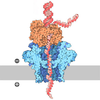
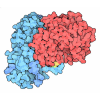
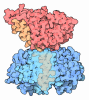
Journal: Structure / Year: 2026 Title: Cradle loop regulates β-barrel pore-formation mechanism of Vibrio cholerae cytolysin. Authors: Mahendra Singh / Arnab Chatterjee / Ananya Nayak / Prasenjit Naskar / Gurvinder Kaur / Jagannath Mondal / Somnath Dutta / Kausik Chattopadhyay / Abstract: Vibrio cholerae cytolysin (VCC) is a β-barrel pore-forming toxin (β-PFT). The membrane insertion of its pore-forming "pre-stem" motif is the most crucial step in the pore-formation mechanism. In ...Vibrio cholerae cytolysin (VCC) is a β-barrel pore-forming toxin (β-PFT). The membrane insertion of its pore-forming "pre-stem" motif is the most crucial step in the pore-formation mechanism. In the soluble monomeric form, pre-stem remains clamped against the central cytolysin domain by the so-called cradle loop. In the course of oligomeric pore-formation in the target membranes, the cradle loop gets detached from the pre-stem and reorients, thus allowing the pre-stem to extend and insert into the membrane. Here, we show that the specific cradle loop residue(s) play crucial roles in governing the pore-formation mechanism of VCC by establishing decisive interactions with the neighboring structural domains/modules. The alteration of the cradle loop residue, Y194 in particular, compromises the membrane-insertion of the pre-stem, and tends to arrest the membrane-bound toxin in the pre-pore-like oligomeric states. Our study suggests that the native cradle loop architecture, with its intact contacts with the surrounding interaction partners, is essential for VCC pore-formation.
In the structure databanks used in Yorodumi, some data are registered as the other names, "COVID-19 virus" and "2019-nCoV". Here are the details of the virus and the list of structure data.
Jan 31, 2019. EMDB accession codes are about to change! (news from PDBe EMDB page)
EMDB accession codes are about to change! (news from PDBe EMDB page)
The allocation of 4 digits for EMDB accession codes will soon come to an end. Whilst these codes will remain in use, new EMDB accession codes will include an additional digit and will expand incrementally as the available range of codes is exhausted. The current 4-digit format prefixed with “EMD-” (i.e. EMD-XXXX) will advance to a 5-digit format (i.e. EMD-XXXXX), and so on. It is currently estimated that the 4-digit codes will be depleted around Spring 2019, at which point the 5-digit format will come into force.
The EM Navigator/Yorodumi systems omit the EMD- prefix.
Related info.:Q: What is EMD? / ID/Accession-code notation in Yorodumi/EM Navigator
Yorodumi is a browser for structure data from EMDB, PDB, SASBDB, etc.
This page is also the successor to EM Navigator detail page, and also detail information page/front-end page for Omokage search.
The word "yorodu" (or yorozu) is an old Japanese word meaning "ten thousand". "mi" (miru) is to see.
Related info.:EMDB / PDB / SASBDB / Comparison of 3 databanks / Yorodumi Search / Aug 31, 2016. New EM Navigator & Yorodumi / Yorodumi Papers / Jmol/JSmol / Function and homology information / Changes in new EM Navigator and Yorodumi
 Movie
Movie Controller


 Open data
 Basic information
 Map data
 Sample
 Keywords
 Function and homology information
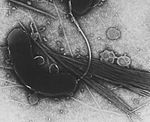 Vibrio cholerae (bacteria)
 Authors
 India, 5 items
  Citation
 Structure visualization
 Downloads & links
 emd_63088.png
 http://ftp.pdbj.org/pub/emdb/structures/EMD-63088


 Z (Sec.)
 Y (Row.)
 X (Col.)


 Sample components
 Escherichia coli (E. coli)
 Processing
 Electron microscopy
 FIELD EMISSION GUN