Type III-B CRISPR module RAMP protein Cmr1 / GGDEF domain-containing protein / Type III-B CRISPR module-associated protein Cmr3 / CRISPR type III-associated protein domain-containing protein / CRISPR system Cmr subunit Cmr5 / CRISPR type III-associated protein domain-containing protein Similarity search - Component
Journal: To Be Published Title: A new in vitro reconstitution system of type III-B CRISPR-Cas effector for functional and structural studies Authors: Ouchi R / Numata T
Name: ZINC ION / type: ligand / ID: 10 / Number of copies: 1 / Formula: ZN
Molecular weight
Theoretical: 65.409 Da
-
Experimental details
-
Structure determination
Method
cryo EM
Processing
single particle reconstruction
Aggregation state
particle
-
Sample preparation
Concentration
0.8 mg/mL
Buffer
pH: 7 Component:
Concentration
Name
20.0 mM
Tris-HCl
200.0 mM
NaCl
1.0 mM
DTT
2.0 mM
MgCl2
Grid
Model: Quantifoil R1.2/1.3 / Material: COPPER / Mesh: 200 / Support film - Material: CARBON / Support film - topology: HOLEY ARRAY / Pretreatment - Type: GLOW DISCHARGE / Pretreatment - Time: 10 sec. / Pretreatment - Atmosphere: AIR / Pretreatment - Pressure: 0.007 kPa
Vitrification
Cryogen name: ETHANE / Chamber humidity: 100 % / Chamber temperature: 281 K / Instrument: FEI VITROBOT MARK IV
-
Electron microscopy
Microscope
JEOL CRYO ARM 300
Specialist optics
Energy filter - Name: In-column Omega Filter
Image recording
Film or detector model: GATAN K3 BIOCONTINUUM (6k x 4k) / Number grids imaged: 1 / Number real images: 5500 / Average exposure time: 2.597 sec. / Average electron dose: 50.0 e/Å2
Electron beam
Acceleration voltage: 300 kV / Electron source: FIELD EMISSION GUN
Applied symmetry - Point group: C1 (asymmetric) / Resolution.type: BY AUTHOR / Resolution: 2.97 Å / Resolution method: FSC 0.143 CUT-OFF / Software - Name: cryoSPARC (ver. 4.3.1) / Number images used: 80152
Initial angle assignment
Type: MAXIMUM LIKELIHOOD / Software - Name: cryoSPARC (ver. 4.3.1)
Final angle assignment
Type: MAXIMUM LIKELIHOOD / Software - Name: cryoSPARC (ver. 4.3.1)
FSC plot (resolution estimation)
-
Atomic model buiding 1
Initial model
Chain - Source name: AlphaFold / Chain - Initial model type: in silico model Details: The initial model containing all protein subunits was constructed by AlphaFold2
Output model
PDB-9l7c: Type III-B CRISPR-Cas effector from Archaeoglobus fulgidus (Form 1)
+
About Yorodumi
-
News
-
Feb 9, 2022. New format data for meta-information of EMDB entries
New format data for meta-information of EMDB entries
Version 3 of the EMDB header file is now the official format.
The previous official version 1.9 will be removed from the archive.
In the structure databanks used in Yorodumi, some data are registered as the other names, "COVID-19 virus" and "2019-nCoV". Here are the details of the virus and the list of structure data.
Jan 31, 2019. EMDB accession codes are about to change! (news from PDBe EMDB page)
EMDB accession codes are about to change! (news from PDBe EMDB page)
The allocation of 4 digits for EMDB accession codes will soon come to an end. Whilst these codes will remain in use, new EMDB accession codes will include an additional digit and will expand incrementally as the available range of codes is exhausted. The current 4-digit format prefixed with “EMD-” (i.e. EMD-XXXX) will advance to a 5-digit format (i.e. EMD-XXXXX), and so on. It is currently estimated that the 4-digit codes will be depleted around Spring 2019, at which point the 5-digit format will come into force.
The EM Navigator/Yorodumi systems omit the EMD- prefix.
Related info.:Q: What is EMD? / ID/Accession-code notation in Yorodumi/EM Navigator
Yorodumi is a browser for structure data from EMDB, PDB, SASBDB, etc.
This page is also the successor to EM Navigator detail page, and also detail information page/front-end page for Omokage search.
The word "yorodu" (or yorozu) is an old Japanese word meaning "ten thousand". "mi" (miru) is to see.
Related info.:EMDB / PDB / SASBDB / Comparison of 3 databanks / Yorodumi Search / Aug 31, 2016. New EM Navigator & Yorodumi / Yorodumi Papers / Jmol/JSmol / Function and homology information / Changes in new EM Navigator and Yorodumi
 Movie
Movie Controller

 Yorodumi
 Open data
 Basic information
 Map data
 Sample
 Keywords
 Function and homology information
 Archaeoglobus fulgidus DSM 4304 (archaea) /
  Authors
 Japan, 4 items
  Citation
 Structure visualization
 Downloads & links
 emd_62872.png
 https://data.pdbj.org/pub/emdb/structures/EMD-62872


 Z (Sec.)
 Y (Row.)
 X (Col.)


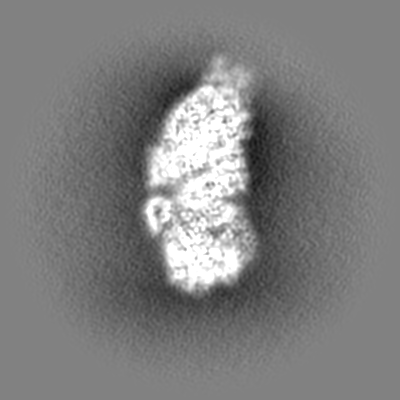


 Sample components
 Escherichia coli BL21(DE3) (bacteria)
 Processing
 Electron microscopy
 FIELD EMISSION GUN
