[English] 日本語
Yorodumi
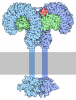
- EMDB-62726: Structure of gain-of-function polycystin-1/polycystin-2 complex -

+
Open data


ID or keywords:

Loading...

-
Basic information

Entry
Database: EMDB / ID: EMD-62726
TitleStructure of gain-of-function polycystin-1/polycystin-2 complex
Map data
Sample
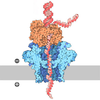
  • Complex: Structure of gain-of-function polycystin-1/polycystin-2 complex
    • Complex: Polycystin-1
      • Protein or peptide: Polycystin-1
    • Complex: Polycystin-2
      • Protein or peptide: Polycystin-2
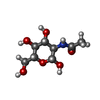
  • Ligand: 2-acetamido-2-deoxy-beta-D-glucopyranose
KeywordsADPKD / polycystin-1 / polycystin-2 / ion channel / MEMBRANE PROTEIN
Function / homology
Function and homology information


metanephric distal tubule morphogenesis / nitrogen cycle metabolic process / detection of nodal flow / metanephric smooth muscle tissue development / metanephric cortex development / metanephric cortical collecting duct development / metanephric distal tubule development / polycystin complex / mesonephric tubule development / mesonephric duct development ...metanephric distal tubule morphogenesis / nitrogen cycle metabolic process / detection of nodal flow / metanephric smooth muscle tissue development / metanephric cortex development / metanephric cortical collecting duct development / metanephric distal tubule development / polycystin complex / mesonephric tubule development / mesonephric duct development / metanephric part of ureteric bud development / renal tubule morphogenesis / determination of liver left/right asymmetry / lung epithelium development / metanephric ascending thin limb development / lymph vessel morphogenesis / metanephric mesenchyme development / metanephric S-shaped body morphogenesis / basal cortex / renal artery morphogenesis / mitocytosis / metanephric proximal tubule development / HLH domain binding / calcium-induced calcium release activity / calcium-independent cell-matrix adhesion / Wnt receptor activity / cilium organization / VxPx cargo-targeting to cilium / genitalia development / migrasome / muscle alpha-actinin binding / detection of mechanical stimulus / regulation of calcium ion import / voltage-gated monoatomic ion channel activity / placenta blood vessel development / cellular response to hydrostatic pressure / Golgi-associated vesicle membrane / response to fluid shear stress / cellular response to fluid shear stress / metanephric collecting duct development / cation channel complex / outward rectifier potassium channel activity / non-motile cilium / cartilage development / cellular response to osmotic stress / actinin binding / determination of left/right symmetry / digestive tract development / : / voltage-gated monoatomic cation channel activity / neural tube development / voltage-gated sodium channel activity / aorta development / motile cilium / branching involved in ureteric bud morphogenesis / ciliary membrane / cartilage condensation / skin development / protein heterotetramerization / branching morphogenesis of an epithelial tube / negative regulation of G1/S transition of mitotic cell cycle / spinal cord development / heart looping / positive regulation of phospholipase C-activating G protein-coupled receptor signaling pathway / cytoplasmic side of endoplasmic reticulum membrane / establishment of cell polarity / homophilic cell-cell adhesion / centrosome duplication / regulation of G1/S transition of mitotic cell cycle / voltage-gated potassium channel activity / lateral plasma membrane / anatomical structure morphogenesis / cell surface receptor signaling pathway via JAK-STAT / potassium channel activity / embryonic placenta development / regulation of cell adhesion / monoatomic cation channel activity / voltage-gated calcium channel activity / transcription regulator inhibitor activity / cytoskeletal protein binding / regulation of proteasomal protein catabolic process / release of sequestered calcium ion into cytosol / potassium ion transmembrane transport / calcium channel complex / cellular response to calcium ion / sodium ion transmembrane transport / basal plasma membrane / protein export from nucleus / cellular response to cAMP / cytoplasmic vesicle membrane / regulation of mitotic spindle organization / cell-matrix adhesion / cellular response to reactive oxygen species / protein tetramerization / lumenal side of endoplasmic reticulum membrane / kidney development / phosphoprotein binding / liver development / establishment of localization in cell / peptidyl-serine phosphorylation
Similarity search - Function
Polycystic kidney disease type 1 protein / PKD/REJ-like domain / Polycystin cation channel / REJ domain / REJ domain / REJ domain profile. / Polycystin-1 like, PLAT/LH2 domain / Carbohydrate-binding WSC / WSC domain / WSC domain profile. ...Polycystic kidney disease type 1 protein / PKD/REJ-like domain / Polycystin cation channel / REJ domain / REJ domain / REJ domain profile. / Polycystin-1 like, PLAT/LH2 domain / Carbohydrate-binding WSC / WSC domain / WSC domain profile. / present in yeast cell wall integrity and stress response component proteins / Ferredoxin I 4Fe-4S cluster domain / : / Polycystic kidney disease type 2 protein / Polycystin domain / PKD domain / Polycystin domain / Lipoxygenase homology 2 (beta barrel) domain / PLAT/LH2 domain / PLAT/LH2 domain superfamily / PLAT/LH2 domain / PLAT domain profile. / Polycystic kidney disease (PKD) domain profile. / : / GPS motif / G-protein-coupled receptor proteolytic site domain / Polycystin cation channel, PKD1/PKD2 / Polycystin cation channel / GAIN-B domain profile. / PKD domain / PKD domain superfamily / PKD/Chitinase domain / Repeats in polycystic kidney disease 1 (PKD1) and other proteins / Leucine-rich repeat N-terminal domain / Leucine rich repeat N-terminal domain / Cysteine-rich flanking region, C-terminal / Leucine rich repeat C-terminal domain / Lectin C-type domain / C-type lectin domain profile. / C-type lectin-like / C-type lectin (CTL) or carbohydrate-recognition domain (CRD) / C-type lectin-like/link domain superfamily / C-type lectin fold / Voltage-dependent channel domain superfamily / Leucine rich repeat / Leucine-rich repeat, typical subtype / Leucine-rich repeats, typical (most populated) subfamily / Leucine-rich repeat profile. / Leucine-rich repeat / Leucine-rich repeat domain superfamily / EF-hand calcium-binding domain profile. / EF-hand domain / EF-hand domain pair / Immunoglobulin-like fold
Similarity search - Domain/homology
Polycystin-1 / Polycystin-2
Similarity search - Component
Biological speciesHomo sapiens (human)
Methodsingle particle reconstruction / cryo EM / Resolution: 3.69 Å
AuthorsChen MY / Su Q / Shi YG
Funding support China, 4 items
OrganizationGrant numberCountry
National Natural Science Foundation of China (NSFC)31930059 China
National Natural Science Foundation of China (NSFC)81970633 China
National Natural Science Foundation of China (NSFC)U1904146 China
National Natural Science Foundation of China (NSFC)81920108015 China
CitationJournal: To Be Published
Title: Structure of polycystin-1/polycystin-2 complex
Authors: Chen M / Su Q / Shi Y
History
DepositionDec 13, 2024-
Header (metadata) releaseDec 17, 2025-
Map releaseDec 17, 2025-
UpdateDec 17, 2025-
Current statusDec 17, 2025Processing site: PDBc / Status: Released

-
Structure visualization

Supplemental images

Downloads & links

-
Map

FileDownload / File: emd_62726.map.gz / Format: CCP4 / Size: 52.7 MB / Type: IMAGE STORED AS FLOATING POINT NUMBER (4 BYTES)
Projections & slices

Image control

Size
Brightness
Contrast
Others
AxesZ (Sec.)Y (Row.)X (Col.)
1.09 Å/pix.
x 240 pix.
= 260.88 Å
1.09 Å/pix.
x 240 pix.
= 260.88 Å
1.09 Å/pix.
x 240 pix.
= 260.88 Å

Surface

Projections

Slices (1/3)

Slices (1/2)

Slices (2/3)

Images are generated by Spider.

Voxel sizeX=Y=Z: 1.087 Å
Density
Contour LevelBy AUTHOR: 0.15
Minimum - Maximum-0.39727503 - 0.9479938
Average (Standard dev.)0.015893178 (±0.058498587)
SymmetrySpace group: 1
Details

EMDB XML:

Map geometry
Axis orderXYZ
Origin000
Dimensions240240240
Spacing240240240
CellA=B=C: 260.88 Å
α=β=γ: 90.0 °

-
Supplemental data

-
Half map: #1

Fileemd_62726_half_map_1.map
Projections & Slices
AxesZYX

Projections

Slices (1/2)
Density Histograms

-
Half map: #2

Fileemd_62726_half_map_2.map
Projections & Slices
AxesZYX

Projections

Slices (1/2)
Density Histograms

-
Sample components

-
Entire : Structure of gain-of-function polycystin-1/polycystin-2 complex

EntireName: Structure of gain-of-function polycystin-1/polycystin-2 complex
Components
  • Complex: Structure of gain-of-function polycystin-1/polycystin-2 complex
    • Complex: Polycystin-1
      • Protein or peptide: Polycystin-1
    • Complex: Polycystin-2
      • Protein or peptide: Polycystin-2
  • Ligand: 2-acetamido-2-deoxy-beta-D-glucopyranose

-
Supramolecule #1: Structure of gain-of-function polycystin-1/polycystin-2 complex

SupramoleculeName: Structure of gain-of-function polycystin-1/polycystin-2 complex
type: complex / ID: 1 / Parent: 0 / Macromolecule list: #1-#2
Source (natural)Organism: Homo sapiens (human)

-
Supramolecule #2: Polycystin-1

SupramoleculeName: Polycystin-1 / type: complex / ID: 2 / Parent: 1 / Macromolecule list: #1
Source (natural)Organism: Homo sapiens (human)

-
Supramolecule #3: Polycystin-2

SupramoleculeName: Polycystin-2 / type: complex / ID: 3 / Parent: 1 / Macromolecule list: #2
Source (natural)Organism: Homo sapiens (human)

-
Macromolecule #1: Polycystin-1

MacromoleculeName: Polycystin-1 / type: protein_or_peptide / ID: 1 / Number of copies: 1 / Enantiomer: LEVO
Source (natural)Organism: Homo sapiens (human)
Molecular weightTheoretical: 138.627828 KDa
Recombinant expressionOrganism: Homo sapiens (human)
SequenceString: MDYKDDDDKG ASLFVPPSHV RFVFPEPTAD VNYIVMLTCA VCLVTYMVMA AILHKLDQLD ASRGRAIPFC GQRGRFKYEI LVKTGWGRG SGTTAHVGIM LYGVDSRSGH RHLDGDRAFH RNSLDIFRIA TPHSLGSVWK IRVWHDNKGL SPAWFLQHVI V RDLQTARS ...String:
MDYKDDDDKG ASLFVPPSHV RFVFPEPTAD VNYIVMLTCA VCLVTYMVMA AILHKLDQLD ASRGRAIPFC GQRGRFKYEI LVKTGWGRG SGTTAHVGIM LYGVDSRSGH RHLDGDRAFH RNSLDIFRIA TPHSLGSVWK IRVWHDNKGL SPAWFLQHVI V RDLQTARS AFFLVNDWLS VETEANGGLV EKEVLAASDA ALLRFRRLLV AELQRGFFDK HIWLSIWDRP PRSRFTRIQR AT CCVLLIC LFLGANAVWY GAVGDSAYST GHVSRLSPLS VDTVAVGLVS SVVVYPVYLA ILFLFRMSRS KVAGSPSPTP AGQ QVLDID SCLDSSVLDS SFLTFSGLHA EQAFVGQMKS DLFLDDSKSL VCWPSGEGTL SWPDLLSDPS IVGSNLRQLA RGQA GHGLG PEEDGFSLAS PYSPAKSFSA SDEDLIQQVL AEGVSSPAPT QDTHMETDLL SSLSSTPGEK TETLALQRLG ELGPP SPGL NWEQPQAARL SRTGLVEGLR KRLLPAWCAS LAHGLSLLLV AVAVAVSGWV GASFPPGVSV AWLLSSSASF LASFLG WEP LKVLLEALYF SLVAKRLHPD EDDTLVESPA VTPVSARVPR VRPPHGFALF LAKEEARKVK RLHGMLRSLL VYMLFLL VT LLASYGDASC HGHAYRLQSA IKQELHSRAF LAITRSEELW PWMAHVLLPY VHGNQSSPEL GPPRLRQVRL QEALYPDP P GPRVHTCSAA GGFSTSDYDV GWESPHNGSG TWAYSAPDLL GAWSWGSCAV YDSGGYVQEL GLSLEESRDR LRFLQLHNW LDNRSRAVFL ELTRYSPAVG LHAAVTLRLE FPAAGRALAA LSVRPFALRR LSAGLSLPLL TSVCLLLFAV HFAVAEARTW HREGRWRVL RLGAWARWLL VALTAATALV RLAQLGAADR QWTRFVRGRP RRFTSFDQVA QLSSAARGLA ASLLFLLLVK A AQQLRFVR QWSVFGKTLC RALPELLGVT LGLVVLGVAY AQLAILLVSS CVDSLWSVAQ ALLVLCPGTG LSTLCPAESW HL SPLLCVG LWALRLWGAL RLGAVILRWR YHALRGELYR PAWEPQDYEM VELFLRRLRL WMGLSKVKEF RHKVRFEGME PLP SRSSRG SKVSPDVPPP SAGSDASHPS TSSSQLDGLS VSLGRLGTRC EPEPSRLQAV FEALLTQFDR LNQATEDVYQ LEQQ LHSLQ GRRSSRAPAG SSRGPSPGLR PALPSRLARA SRGVDLATGP SRTPLRAKNK VHPSSTL

UniProtKB: Polycystin-1

-
Macromolecule #2: Polycystin-2

MacromoleculeName: Polycystin-2 / type: protein_or_peptide / ID: 2 / Number of copies: 3 / Enantiomer: LEVO
Source (natural)Organism: Homo sapiens (human)
Molecular weightTheoretical: 113.313727 KDa
Recombinant expressionOrganism: Homo sapiens (human)
SequenceString: MGASSAWSHP QFEKGGGSGG GSGGSAWSHP QFEKGGSMVN SSRVQPQQPG DAKRPPAPRA PDPGRLMAGC AAVGASLAAP GGLCEQRGL EIEMQRIRQA AARDPPAGAA ASPSPPLSSC SRQAWSRDNP GFEAEEEEEE VEGEEGGMVV EMDVEWRPGS R RSAASSAV ...String:
MGASSAWSHP QFEKGGGSGG GSGGSAWSHP QFEKGGSMVN SSRVQPQQPG DAKRPPAPRA PDPGRLMAGC AAVGASLAAP GGLCEQRGL EIEMQRIRQA AARDPPAGAA ASPSPPLSSC SRQAWSRDNP GFEAEEEEEE VEGEEGGMVV EMDVEWRPGS R RSAASSAV SSVGARSRGL GGYHGAGHPS GRRRRREDQG PPCPSPVGGG DPLHRHLPLE GQPPRVAWAE RLVRGLRGLW GT RLMEESS TNREKYLKSV LRELVTYLLF LIVLCILTYG MMSSNVYYYT RMMSQLFLDT PVSKTEKTNF KTLSSMEDFW KFT EGSLLD GLYWKMQPSN QTEADNRSFI FYENLLLGVP RIRQLRVRNG SCSIPQDLRD EIKECYDVYS VSSEDRAPFG PRNG TAWIY TSEKDLNGSS HWGIIATYSG AGYYLDLSRT REETAAQVAS LKKNVWLDRG TRATFIDFSV YNANINLFCV VRLLV EFPA TGGVIPSWQF QPLKLIRYVT TFDFFLAACE IIFCFFIFYY VVEEILEIRI HKLHYFRSFW NCLDVVIVVL SVVAIG INI YRTSNVEVLL QFLEDQNTFP NFEHLAYWQI QFNNIAAVTV FFVWIKLFKF INFNRTMSQL STTMSRCAKD LFGFAIM FF IIFLAYAQLA YLVFGTQVDD FSTFQECIFT QFRIILGDIN FAEIEEANRV LGPIYFTTFV FFMFFILLNM FAAIIADT Y SEVKSDLAQQ KAEMELSDLI RKGYHKALVK LKLKKNTVDD ISESLRQGGG KLNFDELRQD LKGKGHTDAE IEAIFTKYD QDGDQELTEH EHQQMRDDLE KEREDLDLDH SSLPRPMSSR SFPRSLDDSE EDDDEDSGHS SRRRGSISSG VSYEEFQVLV RRVDRMEHS IGSIVSKIDA VIVKLEIMER AKLKRREVLG RLLDGVAEDE RLGRDSEIHR EQMERLVREE LERWESDDAA S QISHGLGT PVGLNGQPRP RSSRPSSSQS TEGMEGAGGN GSSNVHV

UniProtKB: Polycystin-2

-
Macromolecule #3: 2-acetamido-2-deoxy-beta-D-glucopyranose

MacromoleculeName: 2-acetamido-2-deoxy-beta-D-glucopyranose / type: ligand / ID: 3 / Number of copies: 6 / Formula: NAG
Molecular weightTheoretical: 221.208 Da
Chemical component information

ChemComp-NAG:
2-acetamido-2-deoxy-beta-D-glucopyranose

-
Experimental details

-
Structure determination

Methodcryo EM
Processingsingle particle reconstruction
Aggregation stateparticle

-
Sample preparation

Concentration5 mg/mL
BufferpH: 7.5
VitrificationCryogen name: ETHANE

-
Electron microscopy

MicroscopeTFS KRIOS
Image recordingFilm or detector model: GATAN K3 BIOQUANTUM (6k x 4k) / Average electron dose: 50.0 e/Å2
Electron beamAcceleration voltage: 300 kV / Electron source: FIELD EMISSION GUN
Electron opticsIllumination mode: FLOOD BEAM / Imaging mode: BRIGHT FIELD / Nominal defocus max: 2.0 µm / Nominal defocus min: 1.4000000000000001 µm
Experimental equipment
Model: Titan Krios / Image courtesy: FEI Company

+
Image processing

Particle selectionNumber selected: 172330
CTF correctionType: NONE
Startup modelType of model: NONE
Final reconstructionResolution.type: BY AUTHOR / Resolution: 3.69 Å / Resolution method: FSC 0.143 CUT-OFF / Number images used: 128014
Initial angle assignmentType: MAXIMUM LIKELIHOOD
Final angle assignmentType: MAXIMUM LIKELIHOOD

+
About Yorodumi

-
News

-
Feb 9, 2022. New format data for meta-information of EMDB entries

New format data for meta-information of EMDB entries

  • Version 3 of the EMDB header file is now the official format.
  • The previous official version 1.9 will be removed from the archive.

Related info.:EMDB header

External links:wwPDB to switch to version 3 of the EMDB data model

-
Aug 12, 2020. Covid-19 info

Covid-19 info

URL: https://pdbj.org/emnavi/covid19.php

New page: Covid-19 featured information page in EM Navigator.

Related info.:Covid-19 info / Mar 5, 2020. Novel coronavirus structure data

+
Mar 5, 2020. Novel coronavirus structure data

Novel coronavirus structure data

Related info.:Yorodumi Speices / Aug 12, 2020. Covid-19 info

External links:COVID-19 featured content - PDBj / Molecule of the Month (242):Coronavirus Proteases

+
Jan 31, 2019. EMDB accession codes are about to change! (news from PDBe EMDB page)

EMDB accession codes are about to change! (news from PDBe EMDB page)

  • The allocation of 4 digits for EMDB accession codes will soon come to an end. Whilst these codes will remain in use, new EMDB accession codes will include an additional digit and will expand incrementally as the available range of codes is exhausted. The current 4-digit format prefixed with “EMD-” (i.e. EMD-XXXX) will advance to a 5-digit format (i.e. EMD-XXXXX), and so on. It is currently estimated that the 4-digit codes will be depleted around Spring 2019, at which point the 5-digit format will come into force.
  • The EM Navigator/Yorodumi systems omit the EMD- prefix.

Related info.:Q: What is EMD? / ID/Accession-code notation in Yorodumi/EM Navigator

External links:EMDB Accession Codes are Changing Soon! / Contact to PDBj

+
Jul 12, 2017. Major update of PDB

Major update of PDB

  • wwPDB released updated PDB data conforming to the new PDBx/mmCIF dictionary.
  • This is a major update changing the version number from 4 to 5, and with Remediation, in which all the entries are updated.
  • In this update, many items about electron microscopy experimental information are reorganized (e.g. em_software).
  • Now, EM Navigator and Yorodumi are based on the updated data.

External links:wwPDB Remediation / Enriched Model Files Conforming to OneDep Data Standards Now Available in the PDB FTP Archive

-
Yorodumi

Thousand views of thousand structures

  • Yorodumi is a browser for structure data from EMDB, PDB, SASBDB, etc.
  • This page is also the successor to EM Navigator detail page, and also detail information page/front-end page for Omokage search.
  • The word "yorodu" (or yorozu) is an old Japanese word meaning "ten thousand". "mi" (miru) is to see.

Related info.:EMDB / PDB / SASBDB / Comparison of 3 databanks / Yorodumi Search / Aug 31, 2016. New EM Navigator & Yorodumi / Yorodumi Papers / Jmol/JSmol / Function and homology information / Changes in new EM Navigator and Yorodumi

Read more