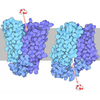
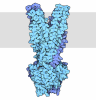
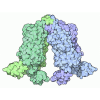
Journal: EMBO Rep / Year: 2026 Title: Structure-guided screening identifies Tucatinib as dual inhibitor for MCT1/2. Authors: Binghong Xu / Xiaoyu Zhou / Yuanyue Shan / Sai Shi / Jiachen Li / Qinqin Liang / Ziyu Wang / Mingfeng Zhang / Yaxin Wang / Duanqing Pei / Sheng Ye / Abstract: Cell surface glycoproteins Basigin or embigin form heterodimers with monocarboxylate transporters (MCTs), enhancing their membrane trafficking and modulating their transport functions. Cancer cells ...Cell surface glycoproteins Basigin or embigin form heterodimers with monocarboxylate transporters (MCTs), enhancing their membrane trafficking and modulating their transport functions. Cancer cells often reprogram their metabolism and depend on proton-coupled lactate transport mediated by MCTs to sustain their glycolytic state and to maintain intracellular pH. A deeper understanding of MCTs regulation may open avenues for the development of novel inhibitors, potentially applicable in clinical settings. Here, we determine the cryo-EM structures of the human MCT2-embigin complex in both apo and AR-C155858-bound states and observe that embigin engages in extensive interactions with MCT2, facilitating its localization to the plasma membrane and substrate transport. Given the high structural conservation among MCTs, we conduct virtual screening based on MCT1/2 structures and identify Tucatinib as an effective inhibitor of pyruvate transport mediated by both MCT1 and MCT2. We show that Tucatinib potently inhibits the proliferation and migration of cervical tumor cells in vitro and tumor growth in a mouse xenograft model, while exhibiting excellent biological safety. These findings offer molecular insights into the structural and functional mechanism of MCT2 and identify Tucatinib as novel dual inhibitor of both transporters.
In the structure databanks used in Yorodumi, some data are registered as the other names, "COVID-19 virus" and "2019-nCoV". Here are the details of the virus and the list of structure data.
Jan 31, 2019. EMDB accession codes are about to change! (news from PDBe EMDB page)
EMDB accession codes are about to change! (news from PDBe EMDB page)
The allocation of 4 digits for EMDB accession codes will soon come to an end. Whilst these codes will remain in use, new EMDB accession codes will include an additional digit and will expand incrementally as the available range of codes is exhausted. The current 4-digit format prefixed with “EMD-” (i.e. EMD-XXXX) will advance to a 5-digit format (i.e. EMD-XXXXX), and so on. It is currently estimated that the 4-digit codes will be depleted around Spring 2019, at which point the 5-digit format will come into force.
The EM Navigator/Yorodumi systems omit the EMD- prefix.
Related info.:Q: What is EMD? / ID/Accession-code notation in Yorodumi/EM Navigator
Yorodumi is a browser for structure data from EMDB, PDB, SASBDB, etc.
This page is also the successor to EM Navigator detail page, and also detail information page/front-end page for Omokage search.
The word "yorodu" (or yorozu) is an old Japanese word meaning "ten thousand". "mi" (miru) is to see.
Related info.:EMDB / PDB / SASBDB / Comparison of 3 databanks / Yorodumi Search / Aug 31, 2016. New EM Navigator & Yorodumi / Yorodumi Papers / Jmol/JSmol / Function and homology information / Changes in new EM Navigator and Yorodumi
 Movie
Movie Controller


 Open data
 Basic information
 Map data
 Sample
 Keywords
 Function and homology information
 Homo sapiens (human)
 Authors
 China, 1 items
  Citation
 Structure visualization
 Downloads & links
 emd_62696.png
 http://ftp.pdbj.org/pub/emdb/structures/EMD-62696


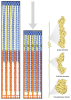
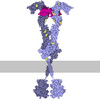
 Z (Sec.)
 Y (Row.)
 X (Col.)


 Sample components
 Processing
 Electron microscopy
 FIELD EMISSION GUN