- EMDB-62690: The cryo-EM structure of ATRX in complex with the nucleosome in t... -
+
Open data
ID or keywords:
Loading...
-
Basic information
Entry
Database: EMDB / ID: EMD-62690
Title
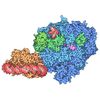
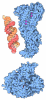
The cryo-EM structure of ATRX in complex with the nucleosome in the ADP.BeFx-bound state (composite)
Map data
composite map
Sample
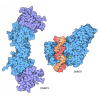
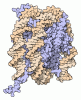
Complex: ATRX C-terminal domains in complex with the nucleosome
Protein or peptide: Histone H3.3
Protein or peptide: Histone H4
Protein or peptide: Histone H2A type 1-C
Protein or peptide: Histone H2B type 1-C/E/F/G/I
Protein or peptide: Histone H4
DNA: DNA (207-MER)
DNA: DNA (207-MER)
Protein or peptide: Transcriptional regulator ATRX
Ligand: ADENOSINE-5'-DIPHOSPHATE
Ligand: MAGNESIUM ION
Keywords
chromatin remodeler / nucleosome / DNA BINDING PROTEIN
Function / homology
Function and homology information
Defective Inhibition of DNA Recombination at Telomere Due to DAXX Mutations / Defective Inhibition of DNA Recombination at Telomere Due to ATRX Mutations / negative regulation of maintenance of mitotic sister chromatid cohesion, telomeric / positive regulation of nuclear cell cycle DNA replication / chromosome, subtelomeric region / cellular response to hydroxyurea / chromo shadow domain binding / DNA translocase activity / condensed chromosome, centromeric region / histone H3K9me2/3 reader activity ...Defective Inhibition of DNA Recombination at Telomere Due to DAXX Mutations / Defective Inhibition of DNA Recombination at Telomere Due to ATRX Mutations / negative regulation of maintenance of mitotic sister chromatid cohesion, telomeric / positive regulation of nuclear cell cycle DNA replication / chromosome, subtelomeric region / cellular response to hydroxyurea / chromo shadow domain binding / DNA translocase activity / condensed chromosome, centromeric region / histone H3K9me2/3 reader activity / protein localization to chromosome, telomeric region / kinetochore assembly / nuclear chromosome / positive regulation of telomere maintenance / replication fork processing / subtelomeric heterochromatin formation / mitotic metaphase chromosome alignment / RNA polymerase II core promoter sequence-specific DNA binding / pericentric heterochromatin / negative regulation of megakaryocyte differentiation / protein localization to CENP-A containing chromatin / heterochromatin / Replacement of protamines by nucleosomes in the male pronucleus / CENP-A containing nucleosome / nucleosomal DNA binding / Packaging Of Telomere Ends / Recognition and association of DNA glycosylase with site containing an affected purine / Cleavage of the damaged purine / Deposition of new CENPA-containing nucleosomes at the centromere / telomere organization / Recognition and association of DNA glycosylase with site containing an affected pyrimidine / Cleavage of the damaged pyrimidine / Regulation of PD-L1(CD274) transcription / RNA Polymerase I Promoter Opening / DNA helicase activity / Inhibition of DNA recombination at telomere / Assembly of the ORC complex at the origin of replication / Meiotic synapsis / SUMOylation of chromatin organization proteins / Regulation of endogenous retroelements by the Human Silencing Hub (HUSH) complex / DNA damage response, signal transduction by p53 class mediator / DNA methylation / Condensation of Prophase Chromosomes / Chromatin modifications during the maternal to zygotic transition (MZT) / HCMV Late Events / SIRT1 negatively regulates rRNA expression / ERCC6 (CSB) and EHMT2 (G9a) positively regulate rRNA expression / PRC2 methylates histones and DNA / Regulation of endogenous retroelements by KRAB-ZFP proteins / Defective pyroptosis / HDACs deacetylate histones / Regulation of endogenous retroelements by Piwi-interacting RNAs (piRNAs) / innate immune response in mucosa / Transcriptional regulation by small RNAs / RNA Polymerase I Promoter Escape / Nonhomologous End-Joining (NHEJ) / HDMs demethylate histones / Formation of the beta-catenin:TCF transactivating complex / Activated PKN1 stimulates transcription of AR (androgen receptor) regulated genes KLK2 and KLK3 / chromatin DNA binding / RUNX1 regulates genes involved in megakaryocyte differentiation and platelet function / PML body / Negative Regulation of CDH1 Gene Transcription / NoRC negatively regulates rRNA expression / G2/M DNA damage checkpoint / PKMTs methylate histone lysines / B-WICH complex positively regulates rRNA expression / DNA Damage/Telomere Stress Induced Senescence / Dengue Virus-Host Interactions / Meiotic recombination / Pre-NOTCH Transcription and Translation / Hydrolases; Acting on acid anhydrides; Acting on acid anhydrides to facilitate cellular and subcellular movement / Activation of anterior HOX genes in hindbrain development during early embryogenesis / Transcriptional regulation of granulopoiesis / kinetochore / RMTs methylate histone arginines / Metalloprotease DUBs / HCMV Early Events / structural constituent of chromatin / nucleosome / UCH proteinases / nucleosome assembly / antimicrobial humoral immune response mediated by antimicrobial peptide / HATs acetylate histones / E3 ubiquitin ligases ubiquitinate target proteins / Recruitment and ATM-mediated phosphorylation of repair and signaling proteins at DNA double strand breaks / Factors involved in megakaryocyte development and platelet production / MLL4 and MLL3 complexes regulate expression of PPARG target genes in adipogenesis and hepatic steatosis / antibacterial humoral response / RUNX1 regulates transcription of genes involved in differentiation of HSCs / positive regulation of cell growth / chromatin organization / heterochromatin formation / Processing of DNA double-strand break ends / Senescence-Associated Secretory Phenotype (SASP) / histone binding / Oxidative Stress Induced Senescence / Estrogen-dependent gene expression / nuclear body / chromosome, telomeric region Similarity search - Function
Name: Transcriptional regulator ATRX / type: protein_or_peptide / ID: 8 Details: 1901-1989 UNK (Poly-A to represent the backbone) "HHHHHHHHHHDYKDDDDK" is expression tag Number of copies: 1 / Enantiomer: LEVO / EC number: DNA helicase
In the structure databanks used in Yorodumi, some data are registered as the other names, "COVID-19 virus" and "2019-nCoV". Here are the details of the virus and the list of structure data.
Jan 31, 2019. EMDB accession codes are about to change! (news from PDBe EMDB page)
EMDB accession codes are about to change! (news from PDBe EMDB page)
The allocation of 4 digits for EMDB accession codes will soon come to an end. Whilst these codes will remain in use, new EMDB accession codes will include an additional digit and will expand incrementally as the available range of codes is exhausted. The current 4-digit format prefixed with “EMD-” (i.e. EMD-XXXX) will advance to a 5-digit format (i.e. EMD-XXXXX), and so on. It is currently estimated that the 4-digit codes will be depleted around Spring 2019, at which point the 5-digit format will come into force.
The EM Navigator/Yorodumi systems omit the EMD- prefix.
Related info.:Q: What is EMD? / ID/Accession-code notation in Yorodumi/EM Navigator
Yorodumi is a browser for structure data from EMDB, PDB, SASBDB, etc.
This page is also the successor to EM Navigator detail page, and also detail information page/front-end page for Omokage search.
The word "yorodu" (or yorozu) is an old Japanese word meaning "ten thousand". "mi" (miru) is to see.
Related info.:EMDB / PDB / SASBDB / Comparison of 3 databanks / Yorodumi Search / Aug 31, 2016. New EM Navigator & Yorodumi / Yorodumi Papers / Jmol/JSmol / Function and homology information / Changes in new EM Navigator and Yorodumi
 Movie
Movie Controller

 Yorodumi
 Open data
 Basic information
 Map data
 Sample
 Keywords
 Function and homology information
 Homo sapiens (human)
 Authors
 Hong Kong, 1 items
  Citation
 Structure visualization
 Downloads & links
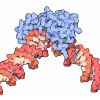
 emd_62690.png
 http://ftp.pdbj.org/pub/emdb/structures/EMD-62690


 Z (Sec.)
 Y (Row.)
 X (Col.)


 Sample components
 Spodoptera frugiperda (fall armyworm)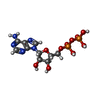
 Processing
 Electron microscopy
 FIELD EMISSION GUN
