Journal: Proc Natl Acad Sci U S A / Year: 2025 Title: Broad neutralizing antibody response of a monomeric spike-based SARS-CoV-2 bivalent vaccine against diverse variants. Authors: Siling Wang / Hui Sun / Yizhen Wang / Zikang Wang / Lunzhi Yuan / Huilin Guo / Jiahua Gao / Miaolin Lan / Yangtao Wu / Huixian Shang / Xiuting Chen / Zheng Chen / Jiayi Hu / Zimin Tang / ...Authors: Siling Wang / Hui Sun / Yizhen Wang / Zikang Wang / Lunzhi Yuan / Huilin Guo / Jiahua Gao / Miaolin Lan / Yangtao Wu / Huixian Shang / Xiuting Chen / Zheng Chen / Jiayi Hu / Zimin Tang / Guiping Wen / Dong Ying / Chang Liu / Yanan Jiang / Jinfu Su / Min Lin / Ting Wu / Shaowei Li / Tianying Zhang / Jun Zhang / Yi Guan / Ningshao Xia / Quan Yuan / Qingbing Zheng / Yali Zhang / Zizheng Zheng / Abstract: severeacute respiratory syndrome coronavirus 2 (SARS-CoV-2) bivalent vaccines show potential against variants but lack a full understanding of the immunological mechanisms that drive broadly ...severeacute respiratory syndrome coronavirus 2 (SARS-CoV-2) bivalent vaccines show potential against variants but lack a full understanding of the immunological mechanisms that drive broadly neutralizing antibodies (bnAbs). This study explored the immunogenicity of a bivalent vaccine in rhesus macaques, containing spike (S) proteins from the prototype (S) and chimeric S protein (S). The vaccine induced bnAbs against multiple variants, including challenging subvariants like EG.1, BA.2.86, and JN.1. The monomeric S protein exposed less accessible regions within the receptor-binding domain (RBD) "inner face" and "NTD face" and subdomains 1, eliciting a diverse array of bnAbs against various Omicron subvariants. Notably, antibodies targeting the conserved RBD inner face, such as 4A5, showed potent neutralization across all tested variants. Structural analyses provide insights into the broad protectiveness of these vaccine-elicited nAbs. This study underscores the potential of bivalent vaccines with monomeric spike proteins to confer broad-spectrum immunity, offering a promising direction for future SARS-CoV-2 universal vaccine design.
In the structure databanks used in Yorodumi, some data are registered as the other names, "COVID-19 virus" and "2019-nCoV". Here are the details of the virus and the list of structure data.
Jan 31, 2019. EMDB accession codes are about to change! (news from PDBe EMDB page)
EMDB accession codes are about to change! (news from PDBe EMDB page)
The allocation of 4 digits for EMDB accession codes will soon come to an end. Whilst these codes will remain in use, new EMDB accession codes will include an additional digit and will expand incrementally as the available range of codes is exhausted. The current 4-digit format prefixed with “EMD-” (i.e. EMD-XXXX) will advance to a 5-digit format (i.e. EMD-XXXXX), and so on. It is currently estimated that the 4-digit codes will be depleted around Spring 2019, at which point the 5-digit format will come into force.
The EM Navigator/Yorodumi systems omit the EMD- prefix.
Related info.:Q: What is EMD? / ID/Accession-code notation in Yorodumi/EM Navigator
Yorodumi is a browser for structure data from EMDB, PDB, SASBDB, etc.
This page is also the successor to EM Navigator detail page, and also detail information page/front-end page for Omokage search.
The word "yorodu" (or yorozu) is an old Japanese word meaning "ten thousand". "mi" (miru) is to see.
Related info.:EMDB / PDB / SASBDB / Comparison of 3 databanks / Yorodumi Search / Aug 31, 2016. New EM Navigator & Yorodumi / Yorodumi Papers / Jmol/JSmol / Function and homology information / Changes in new EM Navigator and Yorodumi
 Movie
Movie Controller

 Yorodumi
 Open data
 Basic information
 Map data
 Sample
 Keywords
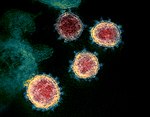 Severe acute respiratory syndrome coronavirus 2 /
 Macaca mulatta (Rhesus monkey)
 Authors
 Citation
 Structure visualization
 Downloads & links
 EMDB map data format
 emd_62590.png
 https://data.pdbj.org/pub/emdb/structures/EMD-62590


 Z (Sec.)
 Y (Row.)
 X (Col.)


 Sample components
 Processing
 Electron microscopy
 FIELD EMISSION GUN