[English] 日本語
Yorodumi
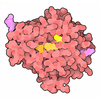
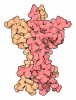
- EMDB-62574: Cryo-EM structure of E373A mutant RIG-I with 5'p-RNA -

+
Open data


ID or keywords:

Loading...

-
Basic information

Entry
Database: EMDB / ID: EMD-62574
TitleCryo-EM structure of E373A mutant RIG-I with 5'p-RNA
Map datamainmap
Sample
  • Complex: RIG-I E373A mutant protein with 5'p-RNA
    • Complex: RIG-I
      • Protein or peptide: Antiviral innate immune response receptor RIG-I
    • Complex: 5'p-RNA
      • RNA: RNA (60-MER)
  • Ligand: ZINC ION
KeywordsRNA recognition / RNA helicase / ATP hydrolysis / RLR signaling / IMMUNE SYSTEM
Function / homology
Function and homology information


regulation of type III interferon production / RIG-I signaling pathway / positive regulation of myeloid dendritic cell cytokine production / OAS antiviral response / detection of virus / positive regulation of response to cytokine stimulus / NF-kB activation through FADD/RIP-1 pathway mediated by caspase-8 and -10 / positive regulation of granulocyte macrophage colony-stimulating factor production / Modulation of host responses by IFN-stimulated genes / TRAF6 mediated IRF7 activation ...regulation of type III interferon production / RIG-I signaling pathway / positive regulation of myeloid dendritic cell cytokine production / OAS antiviral response / detection of virus / positive regulation of response to cytokine stimulus / NF-kB activation through FADD/RIP-1 pathway mediated by caspase-8 and -10 / positive regulation of granulocyte macrophage colony-stimulating factor production / Modulation of host responses by IFN-stimulated genes / TRAF6 mediated IRF7 activation / cellular response to exogenous dsRNA / pattern recognition receptor activity / response to exogenous dsRNA / RSV-host interactions / cytoplasmic pattern recognition receptor signaling pathway / TRAF6 mediated NF-kB activation / positive regulation of interferon-alpha production / bicellular tight junction / positive regulation of defense response to virus by host / positive regulation of interferon-beta production / regulation of cell migration / antiviral innate immune response / positive regulation of interleukin-8 production / Negative regulators of DDX58/IFIH1 signaling / DDX58/IFIH1-mediated induction of interferon-alpha/beta / positive regulation of interleukin-6 production / Evasion by RSV of host interferon responses / ISG15 antiviral mechanism / ruffle membrane / response to virus / SARS-CoV-1 activates/modulates innate immune responses / positive regulation of tumor necrosis factor production / Ovarian tumor domain proteases / double-stranded RNA binding / actin cytoskeleton / gene expression / double-stranded DNA binding / TRAF3-dependent IRF activation pathway / defense response to virus / RNA helicase activity / single-stranded RNA binding / Ub-specific processing proteases / RNA helicase / ribonucleoprotein complex / innate immune response / positive regulation of gene expression / ubiquitin protein ligase binding / GTP binding / SARS-CoV-2 activates/modulates innate and adaptive immune responses / positive regulation of transcription by RNA polymerase II / ATP hydrolysis activity / zinc ion binding / ATP binding / identical protein binding / plasma membrane / cytosol / cytoplasm
Similarity search - Function
RIG-I, CARD domain repeat 2 / RIG-I-like receptor, C-terminal / RIG-I receptor C-terminal domain / RIG-I-like receptor, C-terminal regulatory domain / RIG-I-like receptor, C-terminal domain superfamily / : / C-terminal domain of RIG-I / RIG-I-like receptor (RLR) C-terminal regulatory (CTR) domain profile. / Caspase recruitment domain / Caspase recruitment domain ...RIG-I, CARD domain repeat 2 / RIG-I-like receptor, C-terminal / RIG-I receptor C-terminal domain / RIG-I-like receptor, C-terminal regulatory domain / RIG-I-like receptor, C-terminal domain superfamily / : / C-terminal domain of RIG-I / RIG-I-like receptor (RLR) C-terminal regulatory (CTR) domain profile. / Caspase recruitment domain / Caspase recruitment domain / Death-like domain superfamily / DEAD/DEAH box helicase domain / DEAD/DEAH box helicase / Helicase conserved C-terminal domain / helicase superfamily c-terminal domain / Superfamilies 1 and 2 helicase C-terminal domain profile. / Superfamilies 1 and 2 helicase ATP-binding type-1 domain profile. / DEAD-like helicases superfamily / Helicase, C-terminal / Helicase superfamily 1/2, ATP-binding domain / P-loop containing nucleoside triphosphate hydrolase
Similarity search - Domain/homology
Antiviral innate immune response receptor RIG-I
Similarity search - Component
Biological speciesHomo sapiens (human) / synthetic construct (others)
Methodsingle particle reconstruction / cryo EM / Resolution: 2.4 Å
AuthorsTan YB / Luo D
Funding support Singapore, 1 items
OrganizationGrant numberCountry
Ministry of Education (MoE, Singapore)MOE AcRF Tier 1 award RT22/23 Singapore
CitationJournal: Sci Immunol / Year: 2025
Title: Local activation of mutant RIG-I by short noncoding Y-RNA in the kidney triggers lethal nephritis.
Authors: Saya Satoh / Yaw Bia Tan / Benjamin Heil / Shintaro Yamada / Verena Schütte / Celest Phang / Chaozhi Tang / Yuta Tsukamoto / Takahiro Higuchi / Takashi Fujita / Rayk Behrendt / Martin ...Authors: Saya Satoh / Yaw Bia Tan / Benjamin Heil / Shintaro Yamada / Verena Schütte / Celest Phang / Chaozhi Tang / Yuta Tsukamoto / Takahiro Higuchi / Takashi Fujita / Rayk Behrendt / Martin Schlee / Dahai Luo / Hiroki Kato /
Abstract: Detecting viral RNA by the ubiquitously expressed cytosolic receptor retinoic acid-inducible gene I (RIG-I) is critical for antiviral immune responses, including type I interferon (IFN-I) and ...Detecting viral RNA by the ubiquitously expressed cytosolic receptor retinoic acid-inducible gene I (RIG-I) is critical for antiviral immune responses, including type I interferon (IFN-I) and chemokine induction. RIG-I has evolved to sensitively recognize viral RNA but tolerate self-RNA. RIG-I mutations causing self-tolerance loss induce IFN-I and chemokines in patients, initiating autoinflammation. We observed that mice expressing the RIG-I patient variant E373A spontaneously developed lupus-like nephritis. Kidney-derived chemokines attracted monocytes through CCR2 (C-C motif chemokine receptor 2) and induced interstitial inflammation and tubular damage. This led to renal dysfunction independently of immunoglobulin G-nucleic acid complex deposition. Sequencing of RIG-I E373A-bound RNA from kidney-derived cells identified short noncoding Y-RNA. Deletion of the most enriched Y-RNA species reduced RIG-I E373A-induced IFN-I responses. Cryo-electron microscopy and molecular analyses revealed that RIG-I E373A binding to the Y-RNA stem region resulted in its activation. Thus, we demonstrate that Y-RNA activates a RIG-I gain-of-function mutant in a tissue-specific manner, causing autoinflammation culminating in lupus nephritis.
History
DepositionDec 3, 2024-
Header (metadata) releaseDec 3, 2025-
Map releaseDec 3, 2025-
UpdateJun 17, 2026-
Current statusJun 17, 2026Processing site: PDBj / Status: Released

-
Structure visualization

Supplemental images

Downloads & links

-
Map

FileDownload / File: emd_62574.map.gz / Format: CCP4 / Size: 64 MB / Type: IMAGE STORED AS FLOATING POINT NUMBER (4 BYTES)
Annotationmainmap
Projections & slices

Image control

Size
Brightness
Contrast
Others
AxesZ (Sec.)Y (Row.)X (Col.)
0.76 Å/pix.
x 256 pix.
= 194.56 Å
0.76 Å/pix.
x 256 pix.
= 194.56 Å
0.76 Å/pix.
x 256 pix.
= 194.56 Å

Surface

Projections

Slices (1/3)

Slices (1/2)

Slices (2/3)

Images are generated by Spider.

Voxel sizeX=Y=Z: 0.76 Å
Density
Contour LevelBy AUTHOR: 0.0784
Minimum - Maximum-1.1254965 - 2.135463
Average (Standard dev.)-0.000026139329 (±0.041579682)
SymmetrySpace group: 1
Details

EMDB XML:

Map geometry
Axis orderXYZ
Origin000
Dimensions256256256
Spacing256256256
CellA=B=C: 194.56 Å
α=β=γ: 90.0 °

-
Supplemental data

-
Mask #1

Fileemd_62574_msk_1.map
Projections & Slices
AxesZYX

Projections

Slices (1/2)
Density Histograms

-
Half map: halfB

Fileemd_62574_half_map_1.map
AnnotationhalfB
Projections & Slices
AxesZYX

Projections

Slices (1/2)
Density Histograms

-
Half map: halfA

Fileemd_62574_half_map_2.map
AnnotationhalfA
Projections & Slices
AxesZYX

Projections

Slices (1/2)
Density Histograms

-
Sample components

-
Entire : RIG-I E373A mutant protein with 5'p-RNA

EntireName: RIG-I E373A mutant protein with 5'p-RNA
Components
  • Complex: RIG-I E373A mutant protein with 5'p-RNA
    • Complex: RIG-I
      • Protein or peptide: Antiviral innate immune response receptor RIG-I
    • Complex: 5'p-RNA
      • RNA: RNA (60-MER)
  • Ligand: ZINC ION

-
Supramolecule #1: RIG-I E373A mutant protein with 5'p-RNA

SupramoleculeName: RIG-I E373A mutant protein with 5'p-RNA / type: complex / ID: 1 / Parent: 0 / Macromolecule list: #1-#2
Details: RIG-I E373A mutant protein bind internally to the stem region of 5'p-RNA, providing insights to immune regulation.
Molecular weightTheoretical: 106.6 KDa

-
Supramolecule #2: RIG-I

SupramoleculeName: RIG-I / type: complex / ID: 2 / Parent: 1 / Macromolecule list: #1
Source (natural)Organism: Homo sapiens (human)

-
Supramolecule #3: 5'p-RNA

SupramoleculeName: 5'p-RNA / type: complex / ID: 3 / Parent: 1 / Macromolecule list: #2
Source (natural)Organism: synthetic construct (others) / Synthetically produced: Yes

-
Macromolecule #1: Antiviral innate immune response receptor RIG-I

MacromoleculeName: Antiviral innate immune response receptor RIG-I / type: protein_or_peptide / ID: 1 / Number of copies: 1 / Enantiomer: LEVO / EC number: RNA helicase
Source (natural)Organism: Homo sapiens (human)
Molecular weightTheoretical: 106.682523 KDa
Recombinant expressionOrganism: Escherichia coli (E. coli)
SequenceString: MTTEQRRSLQ AFQDYIRKTL DPTYILSYMA PWFREEEVQY IQAEKNNKGP MEAATLFLKF LLELQEEGWF RGFLDALDHA GYSGLYEAI ESWDFKKIEK LEEYRLLLKR LQPEFKTRII PTDIISDLSE CLINQECEEI LQICSTKGMM AGAEKLVECL L RSDKENWP ...String:
MTTEQRRSLQ AFQDYIRKTL DPTYILSYMA PWFREEEVQY IQAEKNNKGP MEAATLFLKF LLELQEEGWF RGFLDALDHA GYSGLYEAI ESWDFKKIEK LEEYRLLLKR LQPEFKTRII PTDIISDLSE CLINQECEEI LQICSTKGMM AGAEKLVECL L RSDKENWP KTLKLALEKE RNKFSELWIV EKGIKDVETE DLEDKMETSD IQIFYQEDPE CQNLSENSCP PSEVSDTNLY SP FKPRNYQ LELALPAMKG KNTIICAPTG CGKTFVSLLI CEHHLKKFPQ GQKGKVVFFA NQIPVYEQQK SVFSKYFERH GYR VTGISG ATAENVPVEQ IVENNDIIIL TPQILVNNLK KGTIPSLSIF TLMIFDACHN TSKQHPYNMI MFNYLDQKLG GSSG PLPQV IGLTASVGVG DAKNTDEALD YICKLCASLD ASVIATVKHN LEELEQVVYK PQKFFRKVES RISDKFKYII AQLMR DTES LAKRICKDLE NLSQIQNREF GTQKYEQWIV TVQKACMVFQ MPDKDEESRI CKALFLYTSH LRKYNDALII SEHARM KDA LDYLKDFFSN VRAAGFDEIE QDLTQRFEEK LQELESVSRD PSNENPKLED LCFILQEEYH LNPETITILF VKTRALV DA LKNWIEGNPK LSFLKPGILT GRGKTNQNTG MTLPAQKCIL DAFKASGDHN ILIATSVADE GIDIAQCNLV ILYEYVGN V IKMIQTRGRG RARGSKCFLL TSNAGVIEKE QINMYKEKMM NDSILRLQTW DEAVFREKIL HIQTHEKFIR DSQEKPKPV PDKENKKLLC RKCKALACYT ADVRVIEECH YTVLGDAFKE CFVSRPHPKP KQFSSFEKRA KIFCARQNCS HDWGIHVKYK TFEIPVIKI ESFVVEDIAT GVQTLYSKWK DFHFEKIPFD PAEMSK

UniProtKB: Antiviral innate immune response receptor RIG-I

-
Macromolecule #2: RNA (60-MER)

MacromoleculeName: RNA (60-MER) / type: rna / ID: 2 / Number of copies: 1
Source (natural)Organism: synthetic construct (others)
Molecular weightTheoretical: 19.242414 KDa
SequenceString:
GGGACGCUGA CCCAGAAGAU CUACUAGAAA UAGUAGAUCU UCUGGGUCAG CGUCCCUUUU

-
Macromolecule #3: ZINC ION

MacromoleculeName: ZINC ION / type: ligand / ID: 3 / Number of copies: 1 / Formula: ZN
Molecular weightTheoretical: 65.409 Da

-
Experimental details

-
Structure determination

Methodcryo EM
Processingsingle particle reconstruction
Aggregation stateparticle

-
Sample preparation

Concentration2 mg/mL
BufferpH: 7.4
Component:
ConcentrationFormulaName
25.0 mMHEPESHEPES
150.0 mMNaClsodium chloride

Details: 25mM HEPES, 150mM NaCl
VitrificationCryogen name: ETHANE / Chamber humidity: 100 % / Chamber temperature: 283.15 K / Instrument: FEI VITROBOT MARK III

-
Electron microscopy

MicroscopeTFS KRIOS
Image recordingFilm or detector model: TFS FALCON 4i (4k x 4k) / Average electron dose: 50.0 e/Å2
Electron beamAcceleration voltage: 300 kV / Electron source: FIELD EMISSION GUN
Electron opticsIllumination mode: FLOOD BEAM / Imaging mode: BRIGHT FIELD / Nominal defocus max: 1.6 µm / Nominal defocus min: 0.4 µm
Experimental equipment
Model: Titan Krios / Image courtesy: FEI Company

+
Image processing

Particle selectionNumber selected: 2897164 / Details: topaz train/extract
CTF correctionSoftware - Name: cryoSPARC / Type: PHASE FLIPPING AND AMPLITUDE CORRECTION
Startup modelType of model: PDB ENTRY
PDB model - PDB ID:
Final reconstructionNumber classes used: 1 / Applied symmetry - Point group: C1 (asymmetric) / Resolution.type: BY AUTHOR / Resolution: 2.4 Å / Resolution method: FSC 0.143 CUT-OFF / Software - Name: cryoSPARC / Number images used: 441310
Initial angle assignmentType: MAXIMUM LIKELIHOOD / Software - Name: cryoSPARC
Final angle assignmentType: MAXIMUM LIKELIHOOD / Software - Name: cryoSPARC
FSC plot (resolution estimation)

-
Atomic model buiding 1

Initial modelPDB ID:

Chain - Chain ID: A / Chain - Source name: PDB / Chain - Initial model type: experimental model
RefinementSpace: REAL / Protocol: RIGID BODY FIT
Output model

PDB-9ku4:
Cryo-EM structure of E373A mutant RIG-I with 5'p-RNA

+
About Yorodumi

-
News

-
Feb 9, 2022. New format data for meta-information of EMDB entries

New format data for meta-information of EMDB entries

  • Version 3 of the EMDB header file is now the official format.
  • The previous official version 1.9 will be removed from the archive.

Related info.:EMDB header

External links:wwPDB to switch to version 3 of the EMDB data model

-
Aug 12, 2020. Covid-19 info

Covid-19 info

URL: https://pdbj.org/emnavi/covid19.php

New page: Covid-19 featured information page in EM Navigator.

Related info.:Covid-19 info / Mar 5, 2020. Novel coronavirus structure data

+
Mar 5, 2020. Novel coronavirus structure data

Novel coronavirus structure data

Related info.:Yorodumi Speices / Aug 12, 2020. Covid-19 info

External links:COVID-19 featured content - PDBj / Molecule of the Month (242):Coronavirus Proteases

+
Jan 31, 2019. EMDB accession codes are about to change! (news from PDBe EMDB page)

EMDB accession codes are about to change! (news from PDBe EMDB page)

  • The allocation of 4 digits for EMDB accession codes will soon come to an end. Whilst these codes will remain in use, new EMDB accession codes will include an additional digit and will expand incrementally as the available range of codes is exhausted. The current 4-digit format prefixed with “EMD-” (i.e. EMD-XXXX) will advance to a 5-digit format (i.e. EMD-XXXXX), and so on. It is currently estimated that the 4-digit codes will be depleted around Spring 2019, at which point the 5-digit format will come into force.
  • The EM Navigator/Yorodumi systems omit the EMD- prefix.

Related info.:Q: What is EMD? / ID/Accession-code notation in Yorodumi/EM Navigator

External links:EMDB Accession Codes are Changing Soon! / Contact to PDBj

+
Jul 12, 2017. Major update of PDB

Major update of PDB

  • wwPDB released updated PDB data conforming to the new PDBx/mmCIF dictionary.
  • This is a major update changing the version number from 4 to 5, and with Remediation, in which all the entries are updated.
  • In this update, many items about electron microscopy experimental information are reorganized (e.g. em_software).
  • Now, EM Navigator and Yorodumi are based on the updated data.

External links:wwPDB Remediation / Enriched Model Files Conforming to OneDep Data Standards Now Available in the PDB FTP Archive

-
Yorodumi

Thousand views of thousand structures

  • Yorodumi is a browser for structure data from EMDB, PDB, SASBDB, etc.
  • This page is also the successor to EM Navigator detail page, and also detail information page/front-end page for Omokage search.
  • The word "yorodu" (or yorozu) is an old Japanese word meaning "ten thousand". "mi" (miru) is to see.

Related info.:EMDB / PDB / SASBDB / Comparison of 3 databanks / Yorodumi Search / Aug 31, 2016. New EM Navigator & Yorodumi / Yorodumi Papers / Jmol/JSmol / Function and homology information / Changes in new EM Navigator and Yorodumi

Read more