Journal: Nat Commun / Year: 2026 Title: CXCR4 induces memory formation over exhaustion in CAR-T cells to achieve durable leukemia targeting. Authors: Ari Itoh-Nakadai / Minggao Liang / Michiho Shindo / Chen Bibi / Mariko Tomizawa-Murasawa / Saera Fujiki / Akiko Kaneko / Emi Kanamaru / Mari Hashimoto / Hiroshi Kajita / Yoshinari Ando / ...Authors: Ari Itoh-Nakadai / Minggao Liang / Michiho Shindo / Chen Bibi / Mariko Tomizawa-Murasawa / Saera Fujiki / Akiko Kaneko / Emi Kanamaru / Mari Hashimoto / Hiroshi Kajita / Yoshinari Ando / Miki Kojima / Jonathan Moody / Makoto Iwasaki / Shinsuke Takagi / Ryo Nakagawa / Saumya Agrawal / Hanae Amitani-Iijima / Kaori Sato / Yuriko Sorimachi / Nahoko Suzuki / Takehiro Fukami / Kazuharu Hanada / Satoshi Morita / Kazushige Katsura / Takehisa Matsumoto / Maiko Kobayashi / Masahiko Kato / Yasuyuki Negishi / Mikako Shirouzu / Yuho Najima / Keiyo Takubo / Chung Chau Hon / Naoyuki Uchida / Shuichi Taniguchi / Yukihide Momozawa / Piero Carninci / Leonard D Shultz / Yoriko Saito / Michiel de Hoon / Jay W Shin / Fumihiko Ishikawa / Abstract: Chimeric antigen receptor (CAR)-T cell therapy has transformed the treatment of B-cell malignancies, but its success in acute myeloid leukemia (AML) remains limited. Durable responses depend on the ...Chimeric antigen receptor (CAR)-T cell therapy has transformed the treatment of B-cell malignancies, but its success in acute myeloid leukemia (AML) remains limited. Durable responses depend on the formation of long-lived memory T cells, whereas T cell exhaustion contributes to non-response and relapse. In patients with AML who achieved remission after cord blood transplantation, we here first observe enrichment of memory T cells with high expression of the chemokine receptor CXCR4. Next, we show that engineering CAR-T cells to co-express CXCR4 enhances their persistence and anti-leukemic activity in patient-derived xenograft models. Using single-cell profiling and metabolic analysis, we find that CXCR4 promotes memory-associated transcriptional programs, reduces exhaustion, and supports oxidative metabolism. These effects are observed with CAR-T cells targeting CD25 or CD96 as AML-associated targets. Our results indicate that CXCR4 strengthens CAR-T cell memory and durability, offering a strategy to improve immunotherapy outcomes in AML and beyond.
In the structure databanks used in Yorodumi, some data are registered as the other names, "COVID-19 virus" and "2019-nCoV". Here are the details of the virus and the list of structure data.
Jan 31, 2019. EMDB accession codes are about to change! (news from PDBe EMDB page)
EMDB accession codes are about to change! (news from PDBe EMDB page)
The allocation of 4 digits for EMDB accession codes will soon come to an end. Whilst these codes will remain in use, new EMDB accession codes will include an additional digit and will expand incrementally as the available range of codes is exhausted. The current 4-digit format prefixed with “EMD-” (i.e. EMD-XXXX) will advance to a 5-digit format (i.e. EMD-XXXXX), and so on. It is currently estimated that the 4-digit codes will be depleted around Spring 2019, at which point the 5-digit format will come into force.
The EM Navigator/Yorodumi systems omit the EMD- prefix.
Related info.:Q: What is EMD? / ID/Accession-code notation in Yorodumi/EM Navigator
Yorodumi is a browser for structure data from EMDB, PDB, SASBDB, etc.
This page is also the successor to EM Navigator detail page, and also detail information page/front-end page for Omokage search.
The word "yorodu" (or yorozu) is an old Japanese word meaning "ten thousand". "mi" (miru) is to see.
Related info.:EMDB / PDB / SASBDB / Comparison of 3 databanks / Yorodumi Search / Aug 31, 2016. New EM Navigator & Yorodumi / Yorodumi Papers / Jmol/JSmol / Function and homology information / Changes in new EM Navigator and Yorodumi
 Movie
Movie Controller

 Yorodumi
 Open data
 Basic information
 Map data
 Sample
 Keywords
 Function and homology information
 Homo sapiens (human) / sythetic construct (others) / synthetic construct (others)
 Authors
 Citation


 Structure visualization
 Downloads & links
 emd_62427.png
 https://data.pdbj.org/pub/emdb/structures/EMD-62427
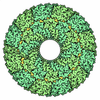
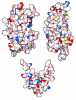
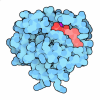
 X (Sec.)
 Y (Row.)
 Z (Col.)


 Sample components
 Trichoplusia ni (cabbage looper)
 Escherichia coli (E. coli)
 Processing
 Electron microscopy
 FIELD EMISSION GUN

