organelle inner membrane / plasma membrane-derived chromatophore membrane / plasma membrane light-harvesting complex / bacteriochlorophyll binding / photosynthetic electron transport in photosystem II / photosynthesis, light reaction / metal ion binding / plasma membrane Similarity search - Function
Intrinsic membrane protein family, PufX / Intrinsic membrane protein PufX / Antenna complex, beta subunit, conserved site / Antenna complexes beta subunits signature. / Antenna complex, alpha subunit / Antenna complex, alpha subunit conserved site / Antenna complexes alpha subunits signature. / Antenna complex, alpha/beta subunit / Light-harvesting protein B beta chain / Antenna complex, beta domain superfamily ...Intrinsic membrane protein family, PufX / Intrinsic membrane protein PufX / Antenna complex, beta subunit, conserved site / Antenna complexes beta subunits signature. / Antenna complex, alpha subunit / Antenna complex, alpha subunit conserved site / Antenna complexes alpha subunits signature. / Antenna complex, alpha/beta subunit / Light-harvesting protein B beta chain / Antenna complex, beta domain superfamily / Antenna complex alpha/beta subunit / Light-harvesting complex / Photosynthetic reaction centre, H subunit / Bacterial photosynthetic reaction centre, H-chain, C-terminal / Photosynthetic reaction centre, H subunit, N-terminal / PRC-barrel domain / Photosynthetic reaction centre, H subunit, N-terminal domain superfamily / Photosynthetic reaction centre, H-chain N-terminal region / Photosynthetic reaction centre, M subunit / PRC-barrel domain / PRC-barrel-like superfamily / Photosynthetic reaction centre, L subunit / : / Photosynthetic reaction centre, L/M / Photosystem II protein D1/D2 superfamily / Photosynthetic reaction centre protein / Photosynthetic reaction center proteins signature. Similarity search - Domain/homology
: / Light-harvesting protein B-875 alpha chain / Reaction center protein H chain / Reaction center protein L chain / Reaction center protein M chain / Intrinsic membrane protein PufX / Antenna pigment protein beta chain Similarity search - Component
Biological species
Cereibacter sphaeroides (bacteria)
Method
single particle reconstruction / cryo EM / Resolution: 2.6 Å
Journal: Photosynth Res / Year: 2025 Title: Molecular and structural insights into neurosporene accumulation in Rhodobacter sphaeroides G1C. Authors: Yu-Lu Wu / Guang-Lei Wang / Xiang-Ping Wang / Xing-Yu Yue / Mei-Juan Zou / Zheng-Yu Wang-Otomo / Michael T Madigan / Richard J Cogdell / Long-Jiang Yu / Abstract: Carotenoids are tetraterpenoid pigments that play important roles in photosynthesis, provide protection from oxidative stress, and facilitate environmental adaptation. The green-colored carotenoid ...Carotenoids are tetraterpenoid pigments that play important roles in photosynthesis, provide protection from oxidative stress, and facilitate environmental adaptation. The green-colored carotenoid neurosporene, a key intermediate in carotenoid biosynthesis, plays a central role in the production of several other carotenoids; however, neurosporene accumulation is rare in nature. In this study, we investigated the accumulation of neurosporene in Rhodobacter sphaeroides strain G1C, a mutant derivative of wild-type Rba. sphaeroides 2.4.1 obtained by nitrosoguanidine mutagenesis. Whole-genome sequencing of strain G1C identified a nonsense mutation in the crtC gene resulting in enzyme inactivation and disruption of normal carotenoid biosynthesis. Physiological analysis and cryo-EM structural analysis of the major photosynthetic complexes of strain G1C showed that the accumulation of neurosporene did not significantly alter either the structure or functioning of the light-harvesting complexes and had no perceptible effect on photosynthetic growth. While the carotenoid composition of strain G1C shifts from spheroidene to neurosporene, its photocomplexes remain structurally intact and their physiological properties remain largely unchanged. This study provides genomic insights into the importance of CrtC activity to the production of carotenoids in Rba. sphaeroides and highlights the unexpected finding that carotenoid substitution in photocomplexes can occur without significantly disrupting photocomplex function.
In the structure databanks used in Yorodumi, some data are registered as the other names, "COVID-19 virus" and "2019-nCoV". Here are the details of the virus and the list of structure data.
Jan 31, 2019. EMDB accession codes are about to change! (news from PDBe EMDB page)
EMDB accession codes are about to change! (news from PDBe EMDB page)
The allocation of 4 digits for EMDB accession codes will soon come to an end. Whilst these codes will remain in use, new EMDB accession codes will include an additional digit and will expand incrementally as the available range of codes is exhausted. The current 4-digit format prefixed with “EMD-” (i.e. EMD-XXXX) will advance to a 5-digit format (i.e. EMD-XXXXX), and so on. It is currently estimated that the 4-digit codes will be depleted around Spring 2019, at which point the 5-digit format will come into force.
The EM Navigator/Yorodumi systems omit the EMD- prefix.
Related info.:Q: What is EMD? / ID/Accession-code notation in Yorodumi/EM Navigator
Yorodumi is a browser for structure data from EMDB, PDB, SASBDB, etc.
This page is also the successor to EM Navigator detail page, and also detail information page/front-end page for Omokage search.
The word "yorodu" (or yorozu) is an old Japanese word meaning "ten thousand". "mi" (miru) is to see.
Related info.:EMDB / PDB / SASBDB / Comparison of 3 databanks / Yorodumi Search / Aug 31, 2016. New EM Navigator & Yorodumi / Yorodumi Papers / Jmol/JSmol / Function and homology information / Changes in new EM Navigator and Yorodumi
 Movie
Movie Controller

 Yorodumi
 Open data
 Basic information
 Map data
 Sample
 Keywords
 Function and homology information
 Cereibacter sphaeroides (bacteria)
 Authors
 China, 1 items
  Citation


 Structure visualization
 Downloads & links
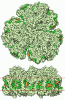
 emd_62409.png
 http://ftp.pdbj.org/pub/emdb/structures/EMD-62409
 Z (Sec.)
 Y (Row.)
 X (Col.)


 Sample components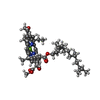
 Processing
 Electron microscopy
 FIELD EMISSION GUN

