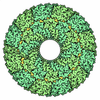
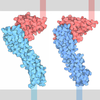
Journal: J Biol Chem / Year: 2025 Title: Structural basis of nectin-4 recognition by the antibody-drug conjugate 9MW2821. Authors: Peng Fang / Meng You / Haiying Wen / Yuxia Cao / Wei Zhou / Xiaohong Zhu / Lei Shi / Xiaowei Sun / Kaiying Li / Wendi Li / Jin Wang / Hai Wu / Xiaoding Tan / Abstract: Nectin-4, a membrane protein highly expressed in multiple solid tumors, has become an attractive target for antibody-drug conjugate development. We designed and developed 9MW2821, an anti-nectin-4 ...Nectin-4, a membrane protein highly expressed in multiple solid tumors, has become an attractive target for antibody-drug conjugate development. We designed and developed 9MW2821, an anti-nectin-4 antibody-drug conjugate with an enzymatically cleavable valine-citrulline linker and monomethyl auristatin E as the payload. Although 9MW2821 has shown good efficacy and safety in multiple solid tumors in clinical trials, the interaction between 9MW2821 and nectin-4 at the molecular level remains unclear. In this study, we solved the structure of the antigen-binding fragment of 9MW2821 in complex with nectin-4 at a resolution of 3.26 Å using single-particle cryo-EM. The structure shows that 9MW2821 binds the front β-sheet of nectin-4 D1 through three complementarity-determining region loops from the heavy chain and two complementarity-determining region loops from the light chain. The binding involves extensive hydrogen bonds and hydrophobic interactions. The buried surface area is more than 1600 Å. Mutagenesis studies revealed that four residues (Q77, E78, H83, and E95) of nectin-4 contributed significantly to the binding of 9MW2821 monoclonal antibody (mAb). The structure also shows that 9MW2821 mAb blocks nectin-4 homodimer formation by competing with the nectin-4 partner D1 domain for part of the nectin-4 surface area. Furthermore, 9MW2821 mAb prevents nectin-4 from interacting with nectin-1 and T-cell immunoglobulin and immunoreceptor tyrosine-based inhibitory motif domain, enhancing the activation of NK cells. Based on the structure of the nectin-4 D1-9MW2821 antigen-binding fragment complex resolved in this study, we have elucidated the molecular mechanism of 9MW2821 in cancer therapy. The findings provide a basis for optimizing future mAbs targeting nectin-4.
In the structure databanks used in Yorodumi, some data are registered as the other names, "COVID-19 virus" and "2019-nCoV". Here are the details of the virus and the list of structure data.
Jan 31, 2019. EMDB accession codes are about to change! (news from PDBe EMDB page)
EMDB accession codes are about to change! (news from PDBe EMDB page)
The allocation of 4 digits for EMDB accession codes will soon come to an end. Whilst these codes will remain in use, new EMDB accession codes will include an additional digit and will expand incrementally as the available range of codes is exhausted. The current 4-digit format prefixed with “EMD-” (i.e. EMD-XXXX) will advance to a 5-digit format (i.e. EMD-XXXXX), and so on. It is currently estimated that the 4-digit codes will be depleted around Spring 2019, at which point the 5-digit format will come into force.
The EM Navigator/Yorodumi systems omit the EMD- prefix.
Related info.:Q: What is EMD? / ID/Accession-code notation in Yorodumi/EM Navigator
Yorodumi is a browser for structure data from EMDB, PDB, SASBDB, etc.
This page is also the successor to EM Navigator detail page, and also detail information page/front-end page for Omokage search.
The word "yorodu" (or yorozu) is an old Japanese word meaning "ten thousand". "mi" (miru) is to see.
Related info.:EMDB / PDB / SASBDB / Comparison of 3 databanks / Yorodumi Search / Aug 31, 2016. New EM Navigator & Yorodumi / Yorodumi Papers / Jmol/JSmol / Function and homology information / Changes in new EM Navigator and Yorodumi
 Movie
Movie Controller

 Yorodumi
 Open data
 Basic information
 Map data
 Sample
 Keywords
 Function and homology information
 Mus musculus (house mouse) /
  Homo sapiens (human)
 Authors
 Citation
 Structure visualization
 Downloads & links
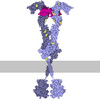
 emd_62389.png
 http://ftp.pdbj.org/pub/emdb/structures/EMD-62389

 Z (Sec.)
 Y (Row.)
 X (Col.)


 Sample components
 Processing
 Electron microscopy
 FIELD EMISSION GUN
