National Natural Science Foundation of China (NSFC)
32171204
中国
引用
ジャーナル: Science / 年: 2026 タイトル: Deep contrastive learning enables genome-wide virtual screening. 著者: Yinjun Jia / Bowen Gao / Jiaxin Tan / Jiqing Zheng / Xin Hong / Wenyu Zhu / Haichuan Tan / Yuan Xiao / Liping Tan / Hongyi Cai / Yanwen Huang / Zhiheng Deng / Xiangwei Wu / Yue Jin / Yafei ...著者: Yinjun Jia / Bowen Gao / Jiaxin Tan / Jiqing Zheng / Xin Hong / Wenyu Zhu / Haichuan Tan / Yuan Xiao / Liping Tan / Hongyi Cai / Yanwen Huang / Zhiheng Deng / Xiangwei Wu / Yue Jin / Yafei Yuan / Jiekang Tian / Wei He / Weiying Ma / Yaqin Zhang / Lei Liu / Chuangye Yan / Wei Zhang / Yanyan Lan / 要旨: Recent breakthroughs in protein structure prediction have opened new avenues for genome-wide drug discovery, yet existing virtual screening methods remain computationally prohibitive. We present ...Recent breakthroughs in protein structure prediction have opened new avenues for genome-wide drug discovery, yet existing virtual screening methods remain computationally prohibitive. We present DrugCLIP, a contrastive learning framework that achieves ultrafast and accurate virtual screening, up to 10 million times faster than docking, while consistently outperforming various baselines on in silico benchmarks. In wet-lab validations, DrugCLIP achieved a 15% hit rate for norepinephrine transporter, and structures of two identified inhibitors were determined in complex with the target protein. For thyroid hormone receptor interactor 12, a target that lacks holo structures and small-molecule binders, DrugCLIP achieved a 17.5% hit rate using only AlphaFold2-predicted structures. Finally, we released GenomeScreenDB, an open-access database providing precomputed results for ~10,000 human proteins screened against 500 million compounds, pioneering a drug discovery paradigm in the post-AlphaFold era.
 ムービー
ムービー コントローラー


 データを開く
 基本情報
基本情報
 マップデータ
 試料
試料 キーワード
キーワード 機能・相同性情報
 Homo sapiens (ヒト)
 データ登録者
 中国, 1件
  引用
引用 構造の表示
構造の表示
 ダウンロードとリンク
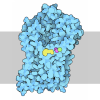
 emd_61426.png
 https://data.pdbj.org/pub/emdb/structures/EMD-61426


 Z (Sec.)
 Y (Row.)
 X (Col.)


 試料の構成要素
 解析
解析 電子顕微鏡法
 FIELD EMISSION GUN