Topoisomerase / DNA binding protein / Topoisomerase inhibitor / ISOMERASE
Function / homology
Function and homology information
sister chromatid segregation / resolution of meiotic recombination intermediates / DNA topoisomerase type II (double strand cut, ATP-hydrolyzing) activity / DNA topoisomerase (ATP-hydrolysing) / DNA topological change / DNA binding / ATP binding / metal ion binding / nucleus Similarity search - Function
DNA topoisomerase 2, TOPRIM domain / C-terminal associated domain of TOPRIM / C-terminal associated domain of TOPRIM / DNA topoisomerase II, eukaryotic-type / : / Topoisomerase (Topo) IIA-type catalytic domain profile. / DNA topoisomerase, type IIA, alpha-helical domain superfamily / DNA topoisomerase, type IIA, domain A / DNA topoisomerase, type IIA, domain A, alpha-beta / DNA gyrase/topoisomerase IV, subunit A ...DNA topoisomerase 2, TOPRIM domain / C-terminal associated domain of TOPRIM / C-terminal associated domain of TOPRIM / DNA topoisomerase II, eukaryotic-type / : / Topoisomerase (Topo) IIA-type catalytic domain profile. / DNA topoisomerase, type IIA, alpha-helical domain superfamily / DNA topoisomerase, type IIA, domain A / DNA topoisomerase, type IIA, domain A, alpha-beta / DNA gyrase/topoisomerase IV, subunit A / DNA Topoisomerase IV / DNA topoisomerase, type IIA, subunit B, domain 2 / DNA gyrase B / DNA topoisomerase, type IIA / DNA topoisomerase, type IIA, conserved site / DNA topoisomerase II signature. / TopoisomeraseII / DNA topoisomerase, type IIA, subunit B, C-terminal / DNA topoisomerase, type IIA-like domain superfamily / Toprim domain profile. / TOPRIM domain / Histidine kinase-, DNA gyrase B-, and HSP90-like ATPase / Histidine kinase/HSP90-like ATPase / Histidine kinase/HSP90-like ATPase superfamily / Ribosomal protein S5 domain 2-type fold, subgroup / Ribosomal protein S5 domain 2-type fold Similarity search - Domain/homology
Journal: Proc Natl Acad Sci U S A / Year: 2026 Title: IID432, a parasite-selective topoisomerase II inhibitor, achieves rapid single-dose parasite clearance in a murine chronic Chagas model. Authors: Manuel Saldivia / Rajiv S Jumani / Bryanna Thomas / Grace M Baxley / Jayant Sancheti / Domenico Bullara / Jean-Rene Galarneau / Harry Cheung / Yen-Liang Chen / Reginara Souza DeAsis / ...Authors: Manuel Saldivia / Rajiv S Jumani / Bryanna Thomas / Grace M Baxley / Jayant Sancheti / Domenico Bullara / Jean-Rene Galarneau / Harry Cheung / Yen-Liang Chen / Reginara Souza DeAsis / Debjani Patra / Olivier René / Jonas Noeske / Andreas D Schenk / Colin Deniston / Samarth Thakore / Catherine Luu / Charles Wartchow / Dennis C Koester / Amanda Fortes Francisco / Johanne Blais / Jan Jiricek / Scott A Hollingsworth / Jonathan E Gable / John M Kelly / Natasha Hochberg / Charlie G Knutson / Suresh B Lakshminarayana / Christopher Sarko / Ujjini H Manjunatha / Colin S Osborne / Thierry T Diagana / Srinivasa P S Rao / Abstract: Chagas disease is a neglected disease that affects millions of people from the Latin American region. Current nitroheterocyclic therapies suffer from long treatment duration and safety-related ...Chagas disease is a neglected disease that affects millions of people from the Latin American region. Current nitroheterocyclic therapies suffer from long treatment duration and safety-related treatment discontinuations. A safe, short course therapy would significantly benefit Chagas patients. Here, we report the comprehensive biological, structural, pharmacodynamic, and pharmacokinetic characterization of IID432, an optimized cyanotriazole with superior potency, favorable pharmacokinetics, and improved safety profile compared to the lead compound CT1. IID432 is a fast-acting, parasite-selective topoisomerase II poison that achieves sterile cure after a single oral dose in a murine model of chronic Trypanosoma cruzi infection. Mechanistically, IID432 stabilizes the parasite TcTopoII-DNA cleavage complex by covalently engaging a parasite-specific cysteine (Cys477), thereby conferring selectivity over the human TOP2A. IID432 displays favorable oral pharmacokinetics, with no off-target activity on human topoisomerases. Brief exposure of IID432 rapidly induces parasite-specific DNA damage and produces sterilizing activity in vitro and in vivo without recrudescence. Together, these findings identify IID432 as a first-in-class, parasite-selective covalent topoisomerase poison with a potential to significantly shorten treatment duration for infections.
In the structure databanks used in Yorodumi, some data are registered as the other names, "COVID-19 virus" and "2019-nCoV". Here are the details of the virus and the list of structure data.
Jan 31, 2019. EMDB accession codes are about to change! (news from PDBe EMDB page)
EMDB accession codes are about to change! (news from PDBe EMDB page)
The allocation of 4 digits for EMDB accession codes will soon come to an end. Whilst these codes will remain in use, new EMDB accession codes will include an additional digit and will expand incrementally as the available range of codes is exhausted. The current 4-digit format prefixed with “EMD-” (i.e. EMD-XXXX) will advance to a 5-digit format (i.e. EMD-XXXXX), and so on. It is currently estimated that the 4-digit codes will be depleted around Spring 2019, at which point the 5-digit format will come into force.
The EM Navigator/Yorodumi systems omit the EMD- prefix.
Related info.:Q: What is EMD? / ID/Accession-code notation in Yorodumi/EM Navigator
Yorodumi is a browser for structure data from EMDB, PDB, SASBDB, etc.
This page is also the successor to EM Navigator detail page, and also detail information page/front-end page for Omokage search.
The word "yorodu" (or yorozu) is an old Japanese word meaning "ten thousand". "mi" (miru) is to see.
Related info.:EMDB / PDB / SASBDB / Comparison of 3 databanks / Yorodumi Search / Aug 31, 2016. New EM Navigator & Yorodumi / Yorodumi Papers / Jmol/JSmol / Function and homology information / Changes in new EM Navigator and Yorodumi
 Movie
Movie Controller

 Yorodumi
 Open data
 Basic information
 Map data
 Sample
 Keywords
 Function and homology information
 Trypanosoma cruzi (eukaryote) /
 Escherichia coli (E. coli)
 Authors
 United Kingdom, 1 items
  Citation


 Structure visualization
 Downloads & links
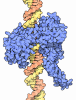
 emd_59152.png
 https://data.pdbj.org/pub/emdb/structures/EMD-59152
 Z (Sec.)
 Y (Row.)
 X (Col.)


 Sample components
 Spodoptera frugiperda (fall armyworm)
 Processing
 Electron microscopy
 FIELD EMISSION GUN

