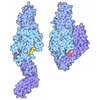
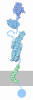
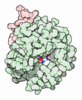
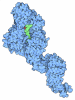
Journal: J Biol Chem / Year: 2026 Title: Cryo-EM structure of the complex between transglutaminase 2 and the 45 kDa domain of fibronectin. Authors: Julie Elisabeth Heggelund / Ahmad Ali-Ahmad / Marie Kongshaug Johannesen / Nikolina Sekulić / Ludvig M Sollid / Abstract: Fibronectin (FN) and transglutaminase 2 (TG2) engage in a high-affinity interaction. This interaction affects anchoring, migration and survival of cells, and high cellular expression of TG2 is ...Fibronectin (FN) and transglutaminase 2 (TG2) engage in a high-affinity interaction. This interaction affects anchoring, migration and survival of cells, and high cellular expression of TG2 is associated with metastasis potential of cancers. Previous work has mapped the interaction to involve the N-terminal part of TG2 and an N-terminally located 45 kDa domain of FN (FN45). In particular, the I module of FN45 is reported to be necessary and sufficient for TG2 binding. Here, we present the cryo-EM structure of a complex between human TG2 and FN45 at 2.8 Å resolution. In the structure, the distal region of the TG2 N-terminal domain binds the FN45 I module, whereas the proximal N-terminal region and adjacent catalytic core segment bind the FN45 I module and, to a lesser extent, the FN45 II module. The FN45 I and FN45 I modules have about equal buried surface areas in their interaction with TG2. A glycine residue at position 127 of TG2 is crucial for interaction with Trp553 of the FN45 I module. Mutation of this residue to isoleucine, which is carried by transglutaminase 3 that does not bind FN45, abrogates the binding of FN45 to TG2. This finding suggests that the interaction of the FN45 I module with TG2 is contingent on the FN45 I module making an interaction with TG2. Further, this finding highlights the region surrounding residue 127 of TG2 as a promising target for structure-based design of anticancer drugs aimed at disrupting the TG2-FN interaction.
In the structure databanks used in Yorodumi, some data are registered as the other names, "COVID-19 virus" and "2019-nCoV". Here are the details of the virus and the list of structure data.
Jan 31, 2019. EMDB accession codes are about to change! (news from PDBe EMDB page)
EMDB accession codes are about to change! (news from PDBe EMDB page)
The allocation of 4 digits for EMDB accession codes will soon come to an end. Whilst these codes will remain in use, new EMDB accession codes will include an additional digit and will expand incrementally as the available range of codes is exhausted. The current 4-digit format prefixed with “EMD-” (i.e. EMD-XXXX) will advance to a 5-digit format (i.e. EMD-XXXXX), and so on. It is currently estimated that the 4-digit codes will be depleted around Spring 2019, at which point the 5-digit format will come into force.
The EM Navigator/Yorodumi systems omit the EMD- prefix.
Related info.:Q: What is EMD? / ID/Accession-code notation in Yorodumi/EM Navigator
Yorodumi is a browser for structure data from EMDB, PDB, SASBDB, etc.
This page is also the successor to EM Navigator detail page, and also detail information page/front-end page for Omokage search.
The word "yorodu" (or yorozu) is an old Japanese word meaning "ten thousand". "mi" (miru) is to see.
Related info.:EMDB / PDB / SASBDB / Comparison of 3 databanks / Yorodumi Search / Aug 31, 2016. New EM Navigator & Yorodumi / Yorodumi Papers / Jmol/JSmol / Function and homology information / Changes in new EM Navigator and Yorodumi
 Movie
Movie Controller

 Yorodumi
 Open data
 Basic information
 Map data
 Sample
 Keywords
 Function and homology information
 Homo sapiens (human)
 Authors
 Denmark,
  Norway, 2 items
  Citation
 Structure visualization
 Downloads & links
 emd_58048.png
 https://data.pdbj.org/pub/emdb/structures/EMD-58048

 Z (Sec.)
 Y (Row.)
 X (Col.)


 Sample components
 Spodoptera frugiperda (fall armyworm)

 Processing
 Electron microscopy
 FIELD EMISSION GUN

