Journal: Nat Commun / Year: 2026 Title: Pulsed-electron illumination does not reduce beam damage for imaging biological macromolecules. Authors: Vishal Kumar / Julika Radecke / Chinmaya K V / Inayathulla Mohammed / Ricardo C Guerrero-Ferreira / Daniel Harder / Dimitrios Fotiadis / Henning Stahlberg / Abstract: Radiation damage remains a fundamental limitation in cryo-electron microscopy (cryo-EM), constraining the total electron dose that can be used and thus limiting high-resolution imaging of biological ...Radiation damage remains a fundamental limitation in cryo-electron microscopy (cryo-EM), constraining the total electron dose that can be used and thus limiting high-resolution imaging of biological specimens. Recent studies have proposed that temporally structured or pulsed electron beams could reduce radiation damage by allowing time for energy dissipation between individual electron interactions. To evaluate this hypothesis, we present a systematic investigation using a radiofrequency (RF) driven 300 kV Titan Krios microscope equipped with a cold field emission gun (c-FEG) to generate pulsed electron beams for specimens under cryogenic conditions. We compare radiation damage in three representative samples: paraffin 2D crystals, bacteriorhodopsin (purple membrane) 2D crystals, and plunge-frozen tobacco mosaic virus (TMV) in vitreous ice, under both pulsed and conventional ( = random) illumination, while keeping all other imaging conditions constant. Radiation damage is quantified by tracking the decay of computed diffraction intensities to determine the critical dose (N). We observe no statistically significant difference in critical dose between pulsed and random illumination across all 3 samples. Our findings provide a critical reference point for future development and evaluation of temporally modulated electron sources in cryo-EM instrumentation.
In the structure databanks used in Yorodumi, some data are registered as the other names, "COVID-19 virus" and "2019-nCoV". Here are the details of the virus and the list of structure data.
Jan 31, 2019. EMDB accession codes are about to change! (news from PDBe EMDB page)
EMDB accession codes are about to change! (news from PDBe EMDB page)
The allocation of 4 digits for EMDB accession codes will soon come to an end. Whilst these codes will remain in use, new EMDB accession codes will include an additional digit and will expand incrementally as the available range of codes is exhausted. The current 4-digit format prefixed with “EMD-” (i.e. EMD-XXXX) will advance to a 5-digit format (i.e. EMD-XXXXX), and so on. It is currently estimated that the 4-digit codes will be depleted around Spring 2019, at which point the 5-digit format will come into force.
The EM Navigator/Yorodumi systems omit the EMD- prefix.
Related info.:Q: What is EMD? / ID/Accession-code notation in Yorodumi/EM Navigator
Yorodumi is a browser for structure data from EMDB, PDB, SASBDB, etc.
This page is also the successor to EM Navigator detail page, and also detail information page/front-end page for Omokage search.
The word "yorodu" (or yorozu) is an old Japanese word meaning "ten thousand". "mi" (miru) is to see.
Related info.:EMDB / PDB / SASBDB / Comparison of 3 databanks / Yorodumi Search / Aug 31, 2016. New EM Navigator & Yorodumi / Yorodumi Papers / Jmol/JSmol / Function and homology information / Changes in new EM Navigator and Yorodumi
 Movie
Movie Controller


 Open data
 Basic information
 Map data
 Sample
 Keywords
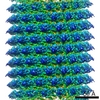 Tobacco mosaic virus
 Authors
 Citation

 Structure visualization
 Downloads & links
 EMDB map data format
 emd_57762.png
 https://data.pdbj.org/pub/emdb/structures/EMD-57762
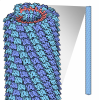
 Z (Sec.)
 Y (Row.)
 X (Col.)


 Sample components
 Processing
 Electron microscopy
 FIELD EMISSION GUN


