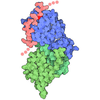
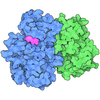
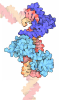
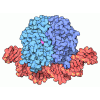
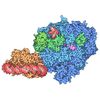
Journal: Mol Cell / Year: 2026 Title: The +1 nucleosome functions in RNA Pol II transcription initiation and the transition to elongation. Authors: Yumeng Zhan / Julio Abril-Garrido / Frauke Grabbe / Paulina Seweryn / Ute Neef / Christian Dienemann / Patrick Cramer / Abstract: Transcription initiation by RNA polymerase II (RNA Pol II) occurs next to a +1 nucleosome, which is positioned downstream of the transcription start site (TSS). The +1 nucleosome influences pre- ...Transcription initiation by RNA polymerase II (RNA Pol II) occurs next to a +1 nucleosome, which is positioned downstream of the transcription start site (TSS). The +1 nucleosome influences pre-initiation complex (PIC) assembly and RNA Pol II pausing, but its function in transcription initiation and the transition to elongation remains unclear. Here, we investigate the transcription initiation-elongation transition in vitro using DNA templates containing a +1 nucleosome and present cryo-electron microscopy (cryo-EM) structures of five intermediate states. First, after PIC assembly, ATP binding to TFIIH enables the +1 nucleosome to evict TFIID from the PIC. Following DNA opening, the +1 nucleosome stimulates TFIIH translocase activity and initial RNA synthesis. Finally, after DNA bubble rewinding, the +1 nucleosome removes TFIIH from the early elongation complex for promoter escape. Our findings show that the +1 nucleosome not only acts passively in PIC assembly and RNA Pol II pausing but rather has active functions during the initiation-elongation transition of transcription.
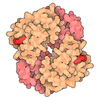
Macromolecule #1: General transcription and DNA repair factor IIH helicase subunit XPB
Macromolecule
Name: General transcription and DNA repair factor IIH helicase subunit XPB type: protein_or_peptide / ID: 1 / Number of copies: 1 / Enantiomer: LEVO / EC number: DNA helicase
Name: ZINC ION / type: ligand / ID: 37 / Number of copies: 17 / Formula: ZN
Molecular weight
Theoretical: 65.409 Da
+
Macromolecule #38: MAGNESIUM ION
Macromolecule
Name: MAGNESIUM ION / type: ligand / ID: 38 / Number of copies: 1 / Formula: MG
Molecular weight
Theoretical: 24.305 Da
-
Experimental details
-
Structure determination
Method
cryo EM
Processing
single particle reconstruction
Aggregation state
particle
-
Sample preparation
Buffer
pH: 7.5
Grid
Model: Quantifoil R3.5/1 / Material: COPPER / Mesh: 200 / Support film - Material: CARBON / Support film - topology: CONTINUOUS / Support film - Film thickness: 3
Vitrification
Cryogen name: ETHANE / Chamber humidity: 100 % / Chamber temperature: 277 K / Instrument: FEI VITROBOT MARK IV
-
Electron microscopy
Microscope
TFS KRIOS
Specialist optics
Energy filter - Name: GIF Quantum SE / Energy filter - Slit width: 20 eV
Image recording
Film or detector model: GATAN K3 (6k x 4k) / Number real images: 79440 / Average exposure time: 3.0 sec. / Average electron dose: 40.0 e/Å2
Electron beam
Acceleration voltage: 300 kV / Electron source: FIELD EMISSION GUN
In the structure databanks used in Yorodumi, some data are registered as the other names, "COVID-19 virus" and "2019-nCoV". Here are the details of the virus and the list of structure data.
Jan 31, 2019. EMDB accession codes are about to change! (news from PDBe EMDB page)
EMDB accession codes are about to change! (news from PDBe EMDB page)
The allocation of 4 digits for EMDB accession codes will soon come to an end. Whilst these codes will remain in use, new EMDB accession codes will include an additional digit and will expand incrementally as the available range of codes is exhausted. The current 4-digit format prefixed with “EMD-” (i.e. EMD-XXXX) will advance to a 5-digit format (i.e. EMD-XXXXX), and so on. It is currently estimated that the 4-digit codes will be depleted around Spring 2019, at which point the 5-digit format will come into force.
The EM Navigator/Yorodumi systems omit the EMD- prefix.
Related info.:Q: What is EMD? / ID/Accession-code notation in Yorodumi/EM Navigator
Yorodumi is a browser for structure data from EMDB, PDB, SASBDB, etc.
This page is also the successor to EM Navigator detail page, and also detail information page/front-end page for Omokage search.
The word "yorodu" (or yorozu) is an old Japanese word meaning "ten thousand". "mi" (miru) is to see.
Related info.:EMDB / PDB / SASBDB / Comparison of 3 databanks / Yorodumi Search / Aug 31, 2016. New EM Navigator & Yorodumi / Yorodumi Papers / Jmol/JSmol / Function and homology information / Changes in new EM Navigator and Yorodumi
 Movie
Movie Controller

 Yorodumi
 Open data
 Basic information
 Map data
 Sample
 Keywords
 Function and homology information
 Homo sapiens (human) /
 Sus scrofa (pig) /
  Xenopus laevis (African clawed frog) /
  unidentified adenovirus / Synthetic construct (others)
 Authors
 Germany, 1 items
  Citation
 Structure visualization
 Downloads & links
 emd_57693.png
 https://data.pdbj.org/pub/emdb/structures/EMD-57693



 Z (Sec.)
 Y (Row.)
 X (Col.)


 Sample components
 Trichoplusia ni (cabbage looper)
 Escherichia coli (E. coli)
 Processing
 Electron microscopy
 FIELD EMISSION GUN

