 Movie
Movie Controller

[English] 日本語
 Yorodumi
- EMDB-56927: Polyclonal immune complex comprising B41 SOSIP.v4.1 in complex wi... -
+ Open data

- Basic information
| Entry |  | |||||||||
|---|---|---|---|---|---|---|---|---|---|---|
| Title | Polyclonal immune complex comprising B41 SOSIP.v4.1 in complex with polyclonal antibodies from rabbit r1645 - Obtained by negative stain EM. | |||||||||
 Map data Map data | Main map generated by 3D refinement of the particle subset corresponding to the B41 SOSIP.v4.1 antigen complexed with polyclonal antibodies from rabbit r1645 | |||||||||
 Sample Sample |
| |||||||||
 Keywords Keywords | Antigen / antibody / complex / HIV / VIRAL PROTEIN | |||||||||
| Biological species |   Human immunodeficiency virus 1 Human immunodeficiency virus 1 | |||||||||
| Method | single particle reconstruction / negative staining / Resolution: 20.0 Å | |||||||||
 Authors Authors | Brown S / Eray ER / Antanasijevic A | |||||||||
| Funding support |  United States, 2 items United States, 2 items
| |||||||||
 Citation Citation | Journal: bioRxiv / Year: 2026 Title: Decoding epitope immunodominance in HIV Env using cryoEM and machine learning. Authors: Jan S Schuhmacher / Shuhao Xiao / Elise R Eray / Sharidan Brown / Alexander Zambrowski / Aryan Jain / Daniel Montiel Garcia / Gabriel Ozorowski / Wenwen Zhu / Katrina Saam / Tom G Caniels / ...Authors: Jan S Schuhmacher / Shuhao Xiao / Elise R Eray / Sharidan Brown / Alexander Zambrowski / Aryan Jain / Daniel Montiel Garcia / Gabriel Ozorowski / Wenwen Zhu / Katrina Saam / Tom G Caniels / John P Moore / Max Crispin / Rogier W Sanders / Srirupa Chakraborty / Bruno E Correia / Andrew B Ward / Aleksandar Antanasijevic /    Abstract: Viral surface glycoproteins, such as the HIV envelope protein (Env), present numerous antibody (Ab) epitopes, yet immune responses consistently focus on only a subset, a phenomenon known as ...Viral surface glycoproteins, such as the HIV envelope protein (Env), present numerous antibody (Ab) epitopes, yet immune responses consistently focus on only a subset, a phenomenon known as immunodominance. Although structural studies have provided insights into Env antigenicity, our understanding of the molecular features that govern efficient Ab engagement remains incomplete, thereby limiting the predictive and rational design of vaccines. Here, we characterized the structural determinants of epitope immunodominance in HIV Env by integrating high-resolution cryoEM-based polyclonal epitope mapping (cryoEMPEM) across different clades with quantitative analyses of epitope topology, accessibility, and physicochemical properties. More than 70 new structures were resolved to assemble a library of >100 Env-antibody complexes. These data informed the development of a surface-centric, machine-learning model to predict relative ntigen urface mmunodominance (ASI model). Comparison of ASI-predicted epitope sites with the specificities of Env-induced antibodies showed that the model accurately identifies immunodominant regions and highlights the structural features driving immune bias. Notably, immunogens redesigned based on model predictions successfully redirected Ab responses toward a normally subdominant epitope, demonstrating the potential of strategies coupling targeted assembly of focused structural libraries with machine learning to uncover complex molecular patterns and enable design of more effective vaccine antigens. | |||||||||
| History |
|
- Structure visualization
| Supplemental images |
|---|

- Downloads & links
-EMDB archive
| Map data | emd_56927.map.gz | 11.2 MB |  EMDB map data format EMDB map data format | |
|---|---|---|---|---|
| Header (meta data) | emd-56927-v30.xmlemd-56927.xml | 21.8 KB 21.8 KB | Display Display | EMDB header |
| Images |  emd_56927.png emd_56927.png | 41.2 KB | ||
| Filedesc metadata | emd-56927.cif.gz | 5.9 KB | ||
| Others | emd_56927_additional_1.map.gzemd_56927_half_map_1.map.gzemd_56927_half_map_2.map.gz | 11.2 MB 33.1 MB 33.1 MB | ||
| Archive directory |  https://data.pdbj.org/pub/emdb/structures/EMD-56927ftp://data.pdbj.org/pub/emdb/structures/EMD-56927 https://data.pdbj.org/pub/emdb/structures/EMD-56927ftp://data.pdbj.org/pub/emdb/structures/EMD-56927 | HTTPS FTP |
-Related structure data
| Related structure data | C: citing same article ( |
|---|


-Links
| EMDB pages | EMDB (EBI/PDBe) / EMDataResource |
|---|
-Map
| File | Download / File: emd_56927.map.gz / Format: CCP4 / Size: 42.9 MB / Type: IMAGE STORED AS FLOATING POINT NUMBER (4 BYTES) | ||||||||||||||||||||||||||||||||||||
|---|---|---|---|---|---|---|---|---|---|---|---|---|---|---|---|---|---|---|---|---|---|---|---|---|---|---|---|---|---|---|---|---|---|---|---|---|---|
| Annotation | Main map generated by 3D refinement of the particle subset corresponding to the B41 SOSIP.v4.1 antigen complexed with polyclonal antibodies from rabbit r1645 | ||||||||||||||||||||||||||||||||||||
| Projections & slices | Image control
Images are generated by Spider. | ||||||||||||||||||||||||||||||||||||
| Voxel size | X=Y=Z: 1.77 Å | ||||||||||||||||||||||||||||||||||||
| Density |
| ||||||||||||||||||||||||||||||||||||
| Symmetry | Space group: 1 | ||||||||||||||||||||||||||||||||||||
| Details | EMDB XML:
|
 Z (Sec.)
 Y (Row.)
 X (Col.)


-Supplemental data
-Additional map: Additional map generated by 3D refinement of the...
| File | emd_56927_additional_1.map | ||||||||||||
|---|---|---|---|---|---|---|---|---|---|---|---|---|---|
| Annotation | Additional map generated by 3D refinement of the particle subset corresponding to the B41 SOSIP.v4.1 antigen complexed with polyclonal antibodies from rabbit r1645 | ||||||||||||
| Projections & Slices |
| ||||||||||||
| Density Histograms |


-Half map: Half map 2 generated by 3D refinement of...
| File | emd_56927_half_map_1.map | ||||||||||||
|---|---|---|---|---|---|---|---|---|---|---|---|---|---|
| Annotation | Half map 2 generated by 3D refinement of the particle subset corresponding to the B41 SOSIP.v4.1 antigen complexed with polyclonal antibodies from rabbit r1645 | ||||||||||||
| Projections & Slices |
| ||||||||||||
| Density Histograms |


-Half map: Half map 1 generated by 3D refinement of...
| File | emd_56927_half_map_2.map | ||||||||||||
|---|---|---|---|---|---|---|---|---|---|---|---|---|---|
| Annotation | Half map 1 generated by 3D refinement of the particle subset corresponding to the B41 SOSIP.v4.1 antigen complexed with polyclonal antibodies from rabbit r1645 | ||||||||||||
| Projections & Slices |
| ||||||||||||
| Density Histograms |


- Sample components
-Entire : Polyclonal antibody from rabbit r1645 in complex with B41 SOSIP.v4.1
| Entire | Name: Polyclonal antibody from rabbit r1645 in complex with B41 SOSIP.v4.1 |
|---|---|
| Components |
|
-Supramolecule #1: Polyclonal antibody from rabbit r1645 in complex with B41 SOSIP.v4.1
| Supramolecule | Name: Polyclonal antibody from rabbit r1645 in complex with B41 SOSIP.v4.1 type: complex / ID: 1 / Parent: 0 / Macromolecule list: all Details: Antigen was recombinantly expressed while the antibodies were obtained from a natural source (rabbit). |
|---|---|
| Source (natural) | Organism: Human immunodeficiency virus 1 |
-Macromolecule #1: B41 SOSIP.v4.1
| Macromolecule | Name: B41 SOSIP.v4.1 / type: protein_or_peptide / ID: 1 / Enantiomer: LEVO |
|---|---|
| Source (natural) | Organism: Human immunodeficiency virus 1 |
| Recombinant expression | Organism:  Homo sapiens (human) Homo sapiens (human) |
| Sequence | String: MDAMKRGLCC VLLLCGAVFV SPSQEIHARF RRGARAAKKW VTVYYGVPVW KEATTTLFCA SDAKAYDTKV HNVWATHACV PTDPNPQEIV LGNVTENFNM WKNNMVEQMH EDIISLWDQS LKPCVKLTPL CVTLNCNNVN TNNTNNSTNA TISDWEKMET GEMKNCSFNV ...String: MDAMKRGLCC VLLLCGAVFV SPSQEIHARF RRGARAAKKW VTVYYGVPVW KEATTTLFCA SDAKAYDTKV HNVWATHACV PTDPNPQEIV LGNVTENFNM WKNNMVEQMH EDIISLWDQS LKPCVKLTPL CVTLNCNNVN TNNTNNSTNA TISDWEKMET GEMKNCSFNV TTSIRDKIKK EYALFYKLDV VPLENKNNIN NTNITNYRLI NCNTSVITQA CPKVSFEPIP IHYCAPAGFA ILKCNSKTFN GSGPCTNVST VQCTHGIRPV VSTQLLLNGS LAEEEIVIRS ENITDNAKTI IVQLNEAVEI NCTRPNNNTR KSIHIGPGRW FYATGDIIGN IRQAHCNISK ARWNETLGQI VAKLEEQFPN KTIIFNHSSG GDPEIVTHSF NCGGEFFYCN TTPLFNSTWN NTRTDDYPTG GEQNITLQCR IKQIINMWQG VGKAMYAPPI RGQIRCSSNI TGLLLTRDGG RDQNGTETFR PGGGNMRDNW RSELYKYKVV KIEPLGIAPT ACKRRVVQRR RRRRAVGLGA FILGFLGAAG STMGAASMAL TVQARNLLSG IVQQQNNLLR APEAQQHMLQ LTVWGIKQLQ ARVLAVERYL RDQQLLGIWG CSGKIICCTN VPWNDSWSNK TINEIWDNMT WMQWEKEIDN YTQHIYTLLE VSQIQQEKNE QELLELD |
-Experimental details
-Structure determination
| Method | negative staining |
|---|---|
 Processing Processing | single particle reconstruction |
| Aggregation state | particle |
-Sample preparation
| Concentration | 0.05 mg/mL | |||||||||
|---|---|---|---|---|---|---|---|---|---|---|
| Buffer | pH: 7.4 Component:
Details: TBS | |||||||||
| Staining | Type: NEGATIVE / Material: UF 2% | |||||||||
| Grid | Model: Homemade / Material: COPPER / Mesh: 400 / Support film - Material: CARBON / Support film - topology: CONTINUOUS / Pretreatment - Type: GLOW DISCHARGE / Pretreatment - Time: 30 sec. / Pretreatment - Atmosphere: AIR |
- Electron microscopy
| Microscope | FEI TECNAI F20 |
|---|---|
| Image recording | Film or detector model: TVIPS TEMCAM-F416 (4k x 4k) / Number grids imaged: 1 / Average electron dose: 25.0 e/Å2 |
| Electron beam | Acceleration voltage: 200 kV / Electron source:  FIELD EMISSION GUN FIELD EMISSION GUN |
| Electron optics | Illumination mode: FLOOD BEAM / Imaging mode: BRIGHT FIELD / Nominal defocus max: 20.0 µm / Nominal defocus min: 15.0 µm / Nominal magnification: 62000 |
| Sample stage | Specimen holder model: SIDE ENTRY, EUCENTRIC / Cooling holder cryogen: NITROGEN |
| Experimental equipment | 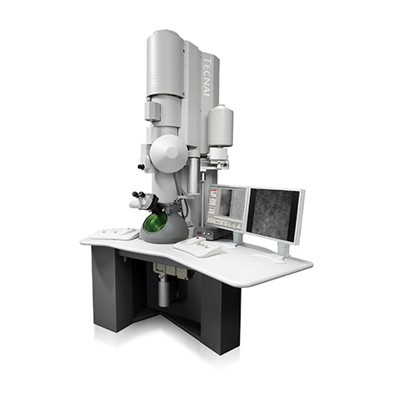 Model: Tecnai F20 / Image courtesy: FEI Company |
