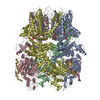
Journal: Nat Commun / Year: 2026 Title: Stereoselectivity and functional plasticity of a common ligand-binding pocket in TRPM3. Authors: Bahar Bazeli / Alexander V Shkumatov / Stephan Schenck / Jean-Christophe Vanherck / Annelies Janssens / Stéphane A H Spieser / Damien Marchand / Robbe Roelens / Patrick Chaltin / Arnaud ...Authors: Bahar Bazeli / Alexander V Shkumatov / Stephan Schenck / Jean-Christophe Vanherck / Annelies Janssens / Stéphane A H Spieser / Damien Marchand / Robbe Roelens / Patrick Chaltin / Arnaud Marchand / Joris Vriens / Thomas Voets / Janine D Brunner / Abstract: The transient receptor potential melastatin 3 (TRPM3) channel is a key mediator of peripheral pain signaling, and pathogenic mutations in TRPM3 are linked to neurodevelopmental delay and epilepsy. ...The transient receptor potential melastatin 3 (TRPM3) channel is a key mediator of peripheral pain signaling, and pathogenic mutations in TRPM3 are linked to neurodevelopmental delay and epilepsy. Despite the therapeutic promise of TRPM3 modulators, the molecular mechanisms by which ligands modulate channel gating remain poorly understood. Here, we combine cryo-electron microscopy (cryo-EM) with functional analyses to characterize a promiscuous ligand-binding pocket formed by transmembrane helices S1-S4. This pocket accommodates several chemically diverse plant-derived and synthetic agonists and antagonists. We show stereoselectivity of TRPM3 for the (R)-enantiomer of the flavonoid antagonist isosakuranetin and the (R)-enantiomer of the synthetic agonist CIM0216. Mutations within this pocket-including variants identified in patients -alter ligand affinity and, in some cases, invert the functional outcome of ligand binding. These findings reveal the stereoselectivity and functional plasticity of the TRPM3 ligand-binding pocket, highlighting how subtle changes in the molecular interactions can produce divergent effects on channel gating, with important ramifications for TRPM3-targeted drug development and therapy.
In the structure databanks used in Yorodumi, some data are registered as the other names, "COVID-19 virus" and "2019-nCoV". Here are the details of the virus and the list of structure data.
Jan 31, 2019. EMDB accession codes are about to change! (news from PDBe EMDB page)
EMDB accession codes are about to change! (news from PDBe EMDB page)
The allocation of 4 digits for EMDB accession codes will soon come to an end. Whilst these codes will remain in use, new EMDB accession codes will include an additional digit and will expand incrementally as the available range of codes is exhausted. The current 4-digit format prefixed with “EMD-” (i.e. EMD-XXXX) will advance to a 5-digit format (i.e. EMD-XXXXX), and so on. It is currently estimated that the 4-digit codes will be depleted around Spring 2019, at which point the 5-digit format will come into force.
The EM Navigator/Yorodumi systems omit the EMD- prefix.
Related info.:Q: What is EMD? / ID/Accession-code notation in Yorodumi/EM Navigator
Yorodumi is a browser for structure data from EMDB, PDB, SASBDB, etc.
This page is also the successor to EM Navigator detail page, and also detail information page/front-end page for Omokage search.
The word "yorodu" (or yorozu) is an old Japanese word meaning "ten thousand". "mi" (miru) is to see.
Related info.:EMDB / PDB / SASBDB / Comparison of 3 databanks / Yorodumi Search / Aug 31, 2016. New EM Navigator & Yorodumi / Yorodumi Papers / Jmol/JSmol / Function and homology information / Changes in new EM Navigator and Yorodumi
 Movie
Movie Controller

 Yorodumi
 Open data
 Basic information
 Map data
 Sample
 Keywords
 Mus musculus (house mouse)
 Authors
 Citation
 Structure visualization
 Downloads & links
 EMDB map data format
 emd_55736.png
 http://ftp.pdbj.org/pub/emdb/structures/EMD-55736


 Z (Sec.)
 Y (Row.)
 X (Col.)


 Sample components
 Processing
 Electron microscopy
 FIELD EMISSION GUN