N-terminal L-serine Nalpha-acetyltransferase NatD / histone H2A acetyltransferase activity / Synthesis of diphthamide-EEF2 / negative regulation of striated muscle cell apoptotic process / regulation of skeletal muscle fiber development / protein N-terminal-serine acetyltransferase activity / positive regulation of skeletal muscle tissue growth / positive regulation of cell proliferation involved in heart morphogenesis / cardiac ventricle development / translation at postsynapse ...N-terminal L-serine Nalpha-acetyltransferase NatD / histone H2A acetyltransferase activity / Synthesis of diphthamide-EEF2 / negative regulation of striated muscle cell apoptotic process / regulation of skeletal muscle fiber development / protein N-terminal-serine acetyltransferase activity / positive regulation of skeletal muscle tissue growth / positive regulation of cell proliferation involved in heart morphogenesis / cardiac ventricle development / translation at postsynapse / PML body organization / glial cell proliferation / negative regulation of protein localization to endoplasmic reticulum / nascent polypeptide-associated complex / skeletal muscle cell differentiation / translation elongation factor binding / heart trabecula morphogenesis / ribosome hibernation / histone H4 acetyltransferase activity / response to folic acid / SUMO binding / skeletal muscle tissue regeneration / positive regulation of cytoplasmic translation / male meiosis I / translation at presynapse / response to insecticide / negative regulation of endoplasmic reticulum unfolded protein response / eukaryotic 80S initiation complex / ribosomal protein import into nucleus / regulation of G1 to G0 transition / oxidized pyrimidine DNA binding / response to TNF agonist / positive regulation of base-excision repair / positive regulation of intrinsic apoptotic signaling pathway in response to DNA damage / positive regulation of respiratory burst involved in inflammatory response / positive regulation of gastrulation / regulation of adenylate cyclase-activating G protein-coupled receptor signaling pathway / protein tyrosine kinase inhibitor activity / IRE1-RACK1-PP2A complex / TNFR1-mediated ceramide production / positive regulation of Golgi to plasma membrane protein transport / G1 to G0 transition / negative regulation of formation of translation preinitiation complex / nucleolus organization / positive regulation of ubiquitin-protein transferase activity / positive regulation of DNA-templated transcription initiation / negative regulation of RNA splicing / GAIT complex / negative regulation of DNA repair / TORC2 complex binding / erythrocyte homeostasis / supercoiled DNA binding / regulation of establishment of cell polarity / rRNA modification in the nucleus and cytosol / oxidized purine DNA binding / NF-kappaB complex / negative regulation of intrinsic apoptotic signaling pathway in response to hydrogen peroxide / negative regulation of phagocytosis / Uptake and function of diphtheria toxin / ubiquitin-like protein conjugating enzyme binding / cytoplasmic translational initiation / cytoplasmic side of rough endoplasmic reticulum membrane / regulation of translation involved in cellular response to UV / A band / Formation of the ternary complex, and subsequently, the 43S complex / laminin receptor activity / ion channel inhibitor activity / positive regulation of intrinsic apoptotic signaling pathway in response to DNA damage by p53 class mediator / response to aldosterone / negative regulation of myoblast fusion / protein-DNA complex disassembly / lncRNA binding / Ribosomal scanning and start codon recognition / protein kinase A binding / Translation initiation complex formation / negative regulation of Wnt signaling pathway / positive regulation of DNA damage response, signal transduction by p53 class mediator / fibroblast growth factor binding / BH3 domain binding / Protein hydroxylation / TOR signaling / mTORC1-mediated signalling / negative regulation of translational frameshifting / monocyte chemotaxis / PELO:HBS1L and ABCE1 dissociate a ribosome on a non-stop mRNA / SRC activates STAT3 in a quantitative manner, through Cadherin-11 (CDH11), RAC1 and gp130 (IL6ST) / SARS-CoV-1 modulates host translation machinery / regulation of cell division / positive regulation of GTPase activity / protein localization to nucleus / translational elongation / Peptide chain elongation / Selenocysteine synthesis / negative regulation of protein binding / Formation of a pool of free 40S subunits / translation elongation factor activity / negative regulation of respiratory burst involved in inflammatory response / positive regulation of intrinsic apoptotic signaling pathway by p53 class mediator / protein targeting / protein serine/threonine kinase inhibitor activity Similarity search - Function
N-alpha-acetyltransferase 40 / Nascent polypeptide-associated complex subunit alpha / Intracellular hyaluronan-binding protein 4, N-terminal domain / Intracellular hyaluronan-binding protein 4 N-terminal / Nascent polypeptide-associated complex subunit alpha-like, UBA domain / HYPK UBA domain / Hyaluronan / mRNA binding family / RNA binding protein HABP4/SERBP1 / Transcription factor BTF3 / Nascent polypeptide-associated complex NAC domain ...N-alpha-acetyltransferase 40 / Nascent polypeptide-associated complex subunit alpha / Intracellular hyaluronan-binding protein 4, N-terminal domain / Intracellular hyaluronan-binding protein 4 N-terminal / Nascent polypeptide-associated complex subunit alpha-like, UBA domain / HYPK UBA domain / Hyaluronan / mRNA binding family / RNA binding protein HABP4/SERBP1 / Transcription factor BTF3 / Nascent polypeptide-associated complex NAC domain / NAC A/B domain superfamily / NAC domain / NAC A/B domain profile. / NAC / Hyaluronan/mRNA-binding protein / Hyaluronan / mRNA binding family / Elongation Factor G, domain II / Elongation Factor G, domain III / Acetyltransferase (GNAT) family / Elongation factor G, domain IV / Translation elongation factor EFG/EF2, domain IV / Elongation factor G, domain IV / Elongation factor G C-terminus / 40S ribosomal protein SA / Elongation factor EFG, domain V-like / Elongation factor G C-terminus / 40S ribosomal protein SA, C-terminal domain / 40S ribosomal protein SA C-terminus / Ribosomal protein L6, N-terminal / Ribosomal protein L6, N-terminal domain / Ubiquitin-like protein FUBI / EF-G domain III/V-like / Gcn5-related N-acetyltransferase (GNAT) domain profile. / Tr-type G domain, conserved site / Ribosomal protein L30e / Translational (tr)-type guanine nucleotide-binding (G) domain signature. / Ribosomal protein L28e / Ribosomal L15/L27a, N-terminal / : / GNAT domain / Ribosomal L28e/Mak16 / Ribosomal L28e protein family / Ribosomal protein L23 / Ribosomal protein L1, conserved site / Ribosomal protein L2, archaeal-type / Ribosomal protein L1 signature. / Ribosomal protein L1 / metallochaperone-like domain / TRASH domain / Ribosomal protein L1, 3-layer alpha/beta-sandwich / : / Ribosomal protein S26e signature. / Ribosomal protein L41 / Ribosomal protein L41 / Ribosomal protein L13e, conserved site / Ribosomal protein L13e signature. / Ribosomal protein S21e, conserved site / Ribosomal protein S21e signature. / : / Ribosomal protein S12e signature. / Translation elongation factor EFTu-like, domain 2 / Ribosomal protein S26e / Ribosomal protein S26e superfamily / Ribosomal protein S26e / Ribosomal protein S12e / Ribosomal protein L29e / Ribosomal L29e protein family / Ribosomal protein L1-like / Ribosomal protein L1/ribosomal biogenesis protein / Ribosomal protein L1p/L10e family / Small (40S) ribosomal subunit Asc1/RACK1 / Ribosomal protein L22e / Ribosomal protein L22e superfamily / Ribosomal L22e protein family / Ribosomal protein L27e, conserved site / Ribosomal protein L27e signature. / Ribosomal protein L13e / Ribosomal protein L13e / Ribosomal protein S21e / Ribosomal protein L38e / Ribosomal protein L38e superfamily / Ribosomal protein S21e superfamily / Ribosomal protein S21e / Ribosomal L38e protein family / Elongation factor Tu domain 2 / Ribosomal protein S5, eukaryotic/archaeal / Ribosomal protein S19e, conserved site / Ribosomal protein S19e signature. / : / Ribosomal protein S2, eukaryotic / Ribosomal protein L19, eukaryotic / Ribosomal protein L6e signature. / 60S ribosomal protein L18a/ L20, eukaryotes / Acyl-CoA N-acyltransferase / 40S Ribosomal protein S10 / Ribosomal protein L10e, conserved site / Ribosomal protein L10e signature. / S27a-like superfamily / Plectin/S10, N-terminal / Ribosomal protein L18/L18-A/B/e, conserved site Similarity search - Domain/homology
Small ribosomal subunit protein eS17 / Small ribosomal subunit protein uS2 / Elongation factor 2 / Small ribosomal subunit protein uS5 / Large ribosomal subunit protein eL33 / Large ribosomal subunit protein uL30 / Large ribosomal subunit protein uL22 / Transcription factor BTF3 / Small ribosomal subunit protein uS3 / Small ribosomal subunit protein eS12 ...Small ribosomal subunit protein eS17 / Small ribosomal subunit protein uS2 / Elongation factor 2 / Small ribosomal subunit protein uS5 / Large ribosomal subunit protein eL33 / Large ribosomal subunit protein uL30 / Large ribosomal subunit protein uL22 / Transcription factor BTF3 / Small ribosomal subunit protein uS3 / Small ribosomal subunit protein eS12 / Large ribosomal subunit protein eL13 / Large ribosomal subunit protein uL6 / Large ribosomal subunit protein eL22 / Large ribosomal subunit protein uL4 / Small ribosomal subunit protein eS19 / Large ribosomal subunit protein uL3 / Large ribosomal subunit protein uL13 / Small ribosomal subunit protein eS27 / Large ribosomal subunit protein uL29 / Large ribosomal subunit protein uL15 / Large ribosomal subunit protein uL18 / Large ribosomal subunit protein eL21 / Large ribosomal subunit protein eL28 / Small ribosomal subunit protein uS4 / Small ribosomal subunit protein uS7 / Small ribosomal subunit protein eS10 / Large ribosomal subunit protein eL29 / Large ribosomal subunit protein eL34 / Large ribosomal subunit protein eL14 / Small ribosomal subunit protein uS10 / Small ribosomal subunit protein eS1 / Large ribosomal subunit protein uL24 / Large ribosomal subunit protein eL15 / Large ribosomal subunit protein eL27 / Large ribosomal subunit protein eL43 / Large ribosomal subunit protein eL37 / Small ribosomal subunit protein eS7 / Small ribosomal subunit protein eS8 / Small ribosomal subunit protein uS8 / Small ribosomal subunit protein uS9 / Small ribosomal subunit protein uS11 / Small ribosomal subunit protein uS12 / Small ribosomal subunit protein uS13 / Small ribosomal subunit protein uS14 / Small ribosomal subunit protein uS15 / Small ribosomal subunit protein uS17 / Large ribosomal subunit protein eL8 / Small ribosomal subunit protein eS4, X isoform / Large ribosomal subunit protein uL23 / Small ribosomal subunit protein eS6 / Large ribosomal subunit protein uL14 / Small ribosomal subunit protein uS19 / Small ribosomal subunit protein eS24 / Small ribosomal subunit protein eS25 / Small ribosomal subunit protein eS26 / Small ribosomal subunit protein eS28 / Ubiquitin-like FUBI-ribosomal protein eS30 fusion protein / Large ribosomal subunit protein eL30 / Large ribosomal subunit protein eL39 / Large ribosomal subunit protein eL31 / Large ribosomal subunit protein uL1 / Large ribosomal subunit protein eL32 / Large ribosomal subunit protein uL5 / Large ribosomal subunit protein uL2 / Small ribosomal subunit protein eS32 / Ubiquitin-ribosomal protein eS31 fusion protein / Ubiquitin-ribosomal protein eL40 fusion protein / Large ribosomal subunit protein eL38 / Small ribosomal subunit protein eS21 / Small ribosomal subunit protein RACK1 / Large ribosomal subunit protein eL24 / Large ribosomal subunit protein eL42 / Large ribosomal subunit protein eL19 / Large ribosomal subunit protein eL20 / Large ribosomal subunit protein eL6 / Large ribosomal subunit protein eL18 / Nascent polypeptide-associated complex subunit alpha / N-alpha-acetyltransferase 40 / SERPINE1 mRNA-binding protein 1 / Ribosomal protein uL16-like / Large ribosomal subunit protein eL36 Similarity search - Component
Biological species
Homo sapiens (human)
Method
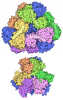
single particle reconstruction / cryo EM / Resolution: 2.67 Å
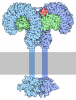
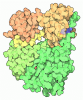
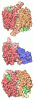
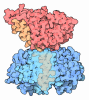
Journal: Nat Commun / Year: 2026 Title: NAA40 and NAC cooperate in co-translational histone acetylation in humans. Authors: Dandan Guan / Timo Denk / Ariel Klavaris / Matthias Thoms / Otto Berninghausen / Birgitta Beatrix / Antonis Kirmizis / Roland Beckmann / Abstract: N-terminal acetylation is an abundant and predominantly co-translational modification in eukaryotes that profoundly affects folding, compartmentalization fidelity and turnover of target proteins. ...N-terminal acetylation is an abundant and predominantly co-translational modification in eukaryotes that profoundly affects folding, compartmentalization fidelity and turnover of target proteins. Unlike other N-acetyltransferases, human NatD is composed solely of the catalytic subunit NAA40 and exclusively modifies histone proteins H2A and H4. However, the molecular details of co-translational NAA40 activity have remained elusive. Here, we show biochemically and by cryo-EM how NAA40 activity is coordinated at the ribosomal peptide tunnel exit involving the NAC complex. We demonstrate that the NAA40-NAC interaction is required for efficient ribosome binding and histone acetylation. Furthermore, we provide insights on the potential coordination of methionine removal and subsequent NAA40-mediated acetylation by formation of a multienzyme complex on the ribosome involving METAP1. Therefore, our results illustrate the details of N-terminal histone acetylation by NAA40 and highlight the role of NAC as a general coordinator of nascent protein modification.
In the structure databanks used in Yorodumi, some data are registered as the other names, "COVID-19 virus" and "2019-nCoV". Here are the details of the virus and the list of structure data.
Jan 31, 2019. EMDB accession codes are about to change! (news from PDBe EMDB page)
EMDB accession codes are about to change! (news from PDBe EMDB page)
The allocation of 4 digits for EMDB accession codes will soon come to an end. Whilst these codes will remain in use, new EMDB accession codes will include an additional digit and will expand incrementally as the available range of codes is exhausted. The current 4-digit format prefixed with “EMD-” (i.e. EMD-XXXX) will advance to a 5-digit format (i.e. EMD-XXXXX), and so on. It is currently estimated that the 4-digit codes will be depleted around Spring 2019, at which point the 5-digit format will come into force.
The EM Navigator/Yorodumi systems omit the EMD- prefix.
Related info.:Q: What is EMD? / ID/Accession-code notation in Yorodumi/EM Navigator
Yorodumi is a browser for structure data from EMDB, PDB, SASBDB, etc.
This page is also the successor to EM Navigator detail page, and also detail information page/front-end page for Omokage search.
The word "yorodu" (or yorozu) is an old Japanese word meaning "ten thousand". "mi" (miru) is to see.
Related info.:EMDB / PDB / SASBDB / Comparison of 3 databanks / Yorodumi Search / Aug 31, 2016. New EM Navigator & Yorodumi / Yorodumi Papers / Jmol/JSmol / Function and homology information / Changes in new EM Navigator and Yorodumi
 Movie
Movie Controller


 Open data
 Basic information
 Map data
 Sample
 Keywords
 Function and homology information
 Homo sapiens (human)
 Authors
 Germany, 1 items
  Citation
 Structure visualization
 Downloads & links
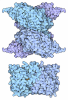
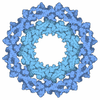
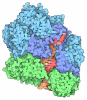
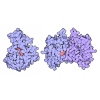
 emd_55613.png
 https://data.pdbj.org/pub/emdb/structures/EMD-55613



 Z (Sec.)
 Y (Row.)
 X (Col.)


 Sample components
 Processing
 Electron microscopy
 FIELD EMISSION GUN

