Journal: RNA / Year: 2024 Title: Molecular basis of human poly(A) polymerase recruitment by mPSF. Authors: Sofia Todesca / Felix Sandmeir / Achim Keidel / Elena Conti / Abstract: 3' end processing of most eukaryotic precursor-mRNAs (pre-mRNAs) is a crucial cotranscriptional process that generally involves the cleavage and polyadenylation of the precursor transcripts. Within ...3' end processing of most eukaryotic precursor-mRNAs (pre-mRNAs) is a crucial cotranscriptional process that generally involves the cleavage and polyadenylation of the precursor transcripts. Within the human 3' end processing machinery, the four-subunit mammalian polyadenylation specificity factor (mPSF) recognizes the polyadenylation signal (PAS) in the pre-mRNA and recruits the poly(A) polymerase α (PAPOA) to it. To shed light on the molecular mechanisms of PAPOA recruitment to mPSF, we used a combination of cryogenic-electron microscopy (cryo-EM) single-particle analysis, computational structure prediction, and in vitro biochemistry to reveal an intricate interaction network. A short linear motif in the mPSF subunit FIP1 interacts with the structured core of human PAPOA, with a binding mode that is evolutionarily conserved from yeast to human. In higher eukaryotes, however, PAPOA contains a conserved C-terminal motif that can interact intramolecularly with the same residues of the PAPOA structured core used to bind FIP1. Interestingly, using biochemical assay and cryo-EM structural analysis, we found that the PAPOA C-terminal motif can also directly interact with mPSF at the subunit CPSF160. These results show that PAPOA recruitment to mPSF is mediated by two distinct intermolecular connections and further suggest the presence of mutually exclusive interactions in the regulation of 3' end processing.
In the structure databanks used in Yorodumi, some data are registered as the other names, "COVID-19 virus" and "2019-nCoV". Here are the details of the virus and the list of structure data.
Jan 31, 2019. EMDB accession codes are about to change! (news from PDBe EMDB page)
EMDB accession codes are about to change! (news from PDBe EMDB page)
The allocation of 4 digits for EMDB accession codes will soon come to an end. Whilst these codes will remain in use, new EMDB accession codes will include an additional digit and will expand incrementally as the available range of codes is exhausted. The current 4-digit format prefixed with “EMD-” (i.e. EMD-XXXX) will advance to a 5-digit format (i.e. EMD-XXXXX), and so on. It is currently estimated that the 4-digit codes will be depleted around Spring 2019, at which point the 5-digit format will come into force.
The EM Navigator/Yorodumi systems omit the EMD- prefix.
Related info.:Q: What is EMD? / ID/Accession-code notation in Yorodumi/EM Navigator
Yorodumi is a browser for structure data from EMDB, PDB, SASBDB, etc.
This page is also the successor to EM Navigator detail page, and also detail information page/front-end page for Omokage search.
The word "yorodu" (or yorozu) is an old Japanese word meaning "ten thousand". "mi" (miru) is to see.
Related info.:EMDB / PDB / SASBDB / Comparison of 3 databanks / Yorodumi Search / Aug 31, 2016. New EM Navigator & Yorodumi / Yorodumi Papers / Jmol/JSmol / Function and homology information / Changes in new EM Navigator and Yorodumi
 Movie
Movie Controller


 Open data
 Basic information
 Map data
 Sample
 Keywords
 Function and homology information
 Homo sapiens (human)
 Authors
 Germany, European Union,
  Denmark, 5 items
  Citation
 Structure visualization
 Downloads & links
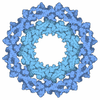
 emd_55520.png
 http://ftp.pdbj.org/pub/emdb/structures/EMD-55520

 Z (Sec.)
 Y (Row.)
 X (Col.)


 Sample components
 Processing
 Electron microscopy
 FIELD EMISSION GUN
